
桥梁建设技术

Search documents
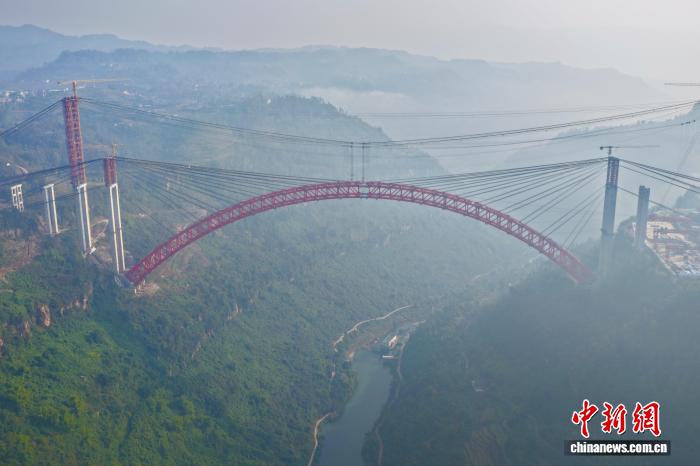
世界跨径最大钢拱桥凤来大溪河特大桥钢桁拱合龙
Zhong Guo Xin Wen Wang· 2025-11-27 10:04
Core Points - The Fenglai Daxihe Grand Bridge, the world's largest steel arch bridge by span, successfully completed its steel truss arch closure on November 27 [1][3] - The bridge spans 1,136.7 meters, with a main bridge design of a 580-meter upper承式 steel box truss arch, making it the largest of its kind globally [3] - The bridge is located in a steep canyon area of Wulong District, with a height difference of over 310 meters from the bridge deck to the river surface, equivalent to the height of a 100-story building [3] - The total steel used in the bridge construction amounts to 25,000 tons [3] Engineering and Design - The design selected a more economical and suitable steel arch bridge construction scheme for the deep mountain canyon terrain, ensuring clearer stress distribution, relative safety, and easier construction [3] - During the construction process, the team overcame three major core challenges: stress and shape control of the fully bolted steel truss arch segments, posture adjustment of truss pieces in limited space, and digital assembly and timely shape correction of the arch ribs [3] Economic Impact - The Wulong to Liangjiang New Area Expressway, of which the bridge is a part, is the sixteenth line in Chongqing's highway network, connecting various tourist resources such as Xianren Mountain and Baima Mountain [3] - The completion of the expressway is expected to boost the development of local特色 agriculture and eco-tourism industries along the route [3]

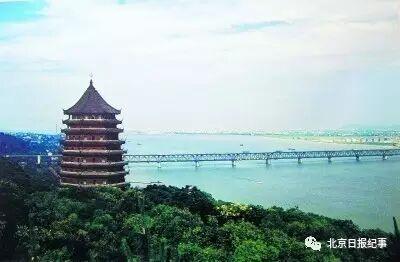
中国人自己设计的现代化大桥,为何通车89天即被炸毁?
Bei Jing Ri Bao Ke Hu Duan· 2025-09-26 09:31
Core Viewpoint - The article reflects on the historical significance and engineering challenges of the Qiantang River Bridge, emphasizing its role in Chinese history and the sacrifices made during its construction amid wartime conditions [1][3][36]. Group 1: Historical Context - The Qiantang River Bridge was the first modern bridge in China designed and constructed entirely by Chinese engineers, symbolizing national pride and technological advancement [3][4]. - The bridge was completed in 1937 but was destroyed shortly after its completion to prevent it from being used by invading Japanese forces, highlighting the tragic circumstances of wartime [1][37]. Group 2: Engineering Challenges - The construction faced numerous difficulties, including the unique geological conditions of the Qiantang River, characterized by deep layers of quicksand and strong tidal forces [11][13][26]. - Innovative techniques, such as the "water jet method" for pile driving, were developed to address the challenges posed by the river's conditions, significantly improving construction efficiency [27][28]. Group 3: Financial and Political Aspects - The funding for the bridge was a significant challenge, requiring collaboration between various banks and government entities to secure the necessary capital [16][17][18]. - Political tensions and the involvement of multiple stakeholders, including the Ministry of Railways, complicated the financing and construction process [18][19]. Group 4: Personal Sacrifices and Leadership - The lead engineer, Ma Yisheng, demonstrated exceptional commitment and leadership throughout the project, often working under extreme pressure and facing personal risks [30][32]. - The emotional toll of having to destroy the bridge he had worked so hard to build was profound for Ma, reflecting the deep connection engineers have with their creations [37][38].
国内跨径最大的跨峡谷分离式混合梁斜拉桥成功合龙
Zhong Guo Xin Wen Wang· 2025-08-24 14:55
Core Points - The successful completion of the Danjiang Xiaosanxia Bridge marks a significant milestone for the Mianxi Expressway project, which connects Henan and Hubei provinces [1][2] - The bridge is the largest span cable-stayed bridge in Henan province, with a main span of 536 meters and a total length of 919 meters [1] - The Mianxi Expressway project is expected to reduce travel time between Xichuan, Henan, and Danjiangkou, Hubei, by over one hour, benefiting approximately three million residents in the area [2] Summary by Sections Project Overview - The Mianxi Expressway spans 24.838 kilometers, designed for a speed of 100 km/h, and features a dual four-lane configuration [1] - The Danjiang Xiaosanxia Bridge is a key control project within this expressway, constructed by China Communications Construction Company [1] Construction Details - The main beam of the bridge is a separated steel box beam, constructed from 35 segments, with a maximum single segment weight of approximately 312 tons [1] - The total steel usage for the bridge approaches 10,000 tons, highlighting the scale of the construction [1] - The construction faced challenges due to environmental factors such as wind and bridge sway, necessitating high precision in monitoring and control during the installation [1] Future Implications - Following the completion of the bridge, the project will transition to the construction of road and bridge ancillary facilities, with an expected completion date in 2025 [2] - The new expressway will create a new transportation corridor for industrial development and the movement of people and goods among the provinces of Shaanxi, Henan, and Hubei [2]