
模型驱动

Search documents
卖出最多轮式具身智能机器人的企业,再出新品
机器人大讲堂· 2026-03-23 06:10
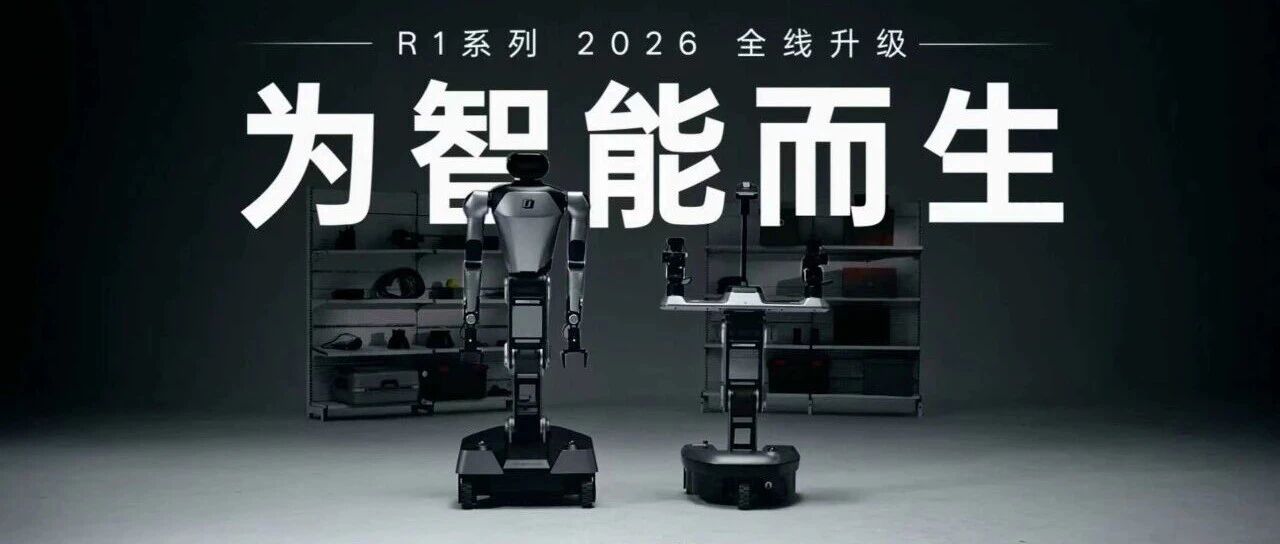
Core Viewpoint - The article discusses the evolution of embodied intelligence and the importance of hardware in supporting advanced models, emphasizing that hardware should not merely be seen as a "carrier" but as an integral part of the system that enhances model performance and reliability [1][2]. Group 1: Hardware Upgrade as a Means to an End - Hardware is viewed as the "senses and muscles" of the model, where its precision, rigidity, and data consistency directly influence the model's capabilities [2][4]. - The R1 series upgrade is a commitment to the "model-driven" philosophy, focusing on real-world feedback to enhance product reliability rather than merely increasing parameters [2][4]. Group 2: Calibration and Data Quality - The R1 series features a high-quality real machine data system, with dual perspective data collection achieving a resolution of 1920x1536 and a stable frame rate of 30Hz, ensuring high consistency and low latency for model training [5][7]. - Each R1 robot undergoes factory-level precision calibration to eliminate assembly errors, ensuring data consistency across multiple units, which is crucial for effective model training [7][8]. Group 3: Structural Rigidity and Dynamic Operations - The R1 series has significantly improved its structural rigidity, with the natural frequency increasing from 3Hz to 15Hz, reducing resonance and vibration during high-speed operations [8][10]. - Enhanced torque capabilities, with a maximum single joint torque of 200Nm, provide the necessary power for complex operations, ensuring precise control even under dynamic conditions [10][16]. Group 4: Edge Deployment and Navigation - The R1 Lite 2026 is equipped with a high-performance computing platform that supports edge inference acceleration, shortening the cycle for algorithm validation and application deployment [11][13]. - The addition of a 360-degree LiDAR enables mapping and positioning in large areas of up to 1000 square meters, with a navigation accuracy of 3cm and a maximum speed of 1.5m/s [11][13]. Group 5: Industrial Reliability and Longevity - The R1 series meets industrial-grade reliability standards, with an MTBF exceeding 1000 hours and extensive testing for high-temperature and vibration resilience [14][16]. - The R1 Pro model offers an optional dexterous hand, enhancing operational capabilities for complex tasks, transitioning from simple grasping to more sophisticated manipulations [16][19]. Group 6: Comprehensive Upgrade for Productivity - The upgrades in the R1 series are designed to enhance model training, deployment, and generalization, providing a robust foundation for embodied intelligence applications [17][19]. - The focus on practical product development addresses real-world challenges, positioning the R1 series as a strong competitor in the field of embodied intelligence [19][20].

WAIC2025前沿聚焦(4):从模型驱动向意图驱动的重大范式跃迁
Haitong Securities International· 2025-07-28 13:04
Investment Rating - The report does not explicitly provide an investment rating for the industry discussed Core Insights - The 2025 World Artificial Intelligence Conference highlights a significant paradigm shift from a "model-driven" approach to an "intent-driven" approach in artificial intelligence, emphasizing the integration of human goals and values with AI processing [1][11] - Intent-driven intelligence aims to enhance decision-making reliability by incorporating causal reasoning and self-checking capabilities, moving beyond mere statistical outputs to achieve "purpose rationality" [2][12] - Current limitations of the model-driven paradigm, such as hallucination issues and diminishing marginal returns, necessitate breakthroughs at the paradigm level rather than just increasing computational power [3][13] Summary by Sections Section 1: Paradigm Shift - The transition from model-driven to intent-driven intelligence is characterized by the system's ability to autonomously identify and decompose goals without explicit instructions, integrating human values deeply into AI processing [1][11] - This shift requires AI systems to not only generate statistically valid outputs but also to possess capabilities for causal reasoning and self-correction to enhance decision-making reliability [2][12] Section 2: Challenges and Limitations - The report identifies key challenges in realizing the intent-driven paradigm, including the hallucination problem in large models, which threatens decision-making safety and raises ethical concerns [3][13] - The diminishing returns from merely increasing model parameters and data highlight the need for innovative approaches to overcome inherent limitations in current AI systems [3][13] Section 3: Technical Bottlenecks - Three major technical bottlenecks are identified: intent representation, causal reasoning mechanisms, and innovative learning architectures, which are essential for achieving the intent-driven paradigm [4][15] - Addressing these challenges is crucial for developing intelligent systems capable of general task modeling, maintaining decision-making robustness, and achieving deep collaboration with humans [4][15]