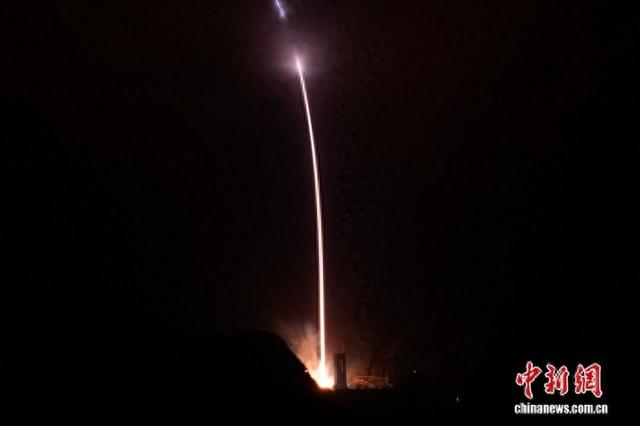
气象卫星

Search documents
成功发射!风云四号C星有哪些“超强能力”
Xin Hua She· 2025-12-27 12:44
Core Viewpoint - The successful launch of the Fengyun-4C satellite enhances China's capabilities in monitoring extreme weather and addressing climate change, marking a significant advancement in meteorological satellite technology [1][3]. Group 1: Observational Performance - The Fengyun-4C satellite features six advanced payloads that significantly improve the frequency and precision of monitoring small to medium-scale weather systems [2]. - The satellite's geostationary radiation imaging instrument has doubled its spatial resolution, allowing for full-disk observations every 5 minutes and regional imaging every minute [2]. - The interferometric atmospheric vertical profiler has improved its spatial resolution from 12 kilometers to 8 kilometers, enabling more accurate data for numerical weather prediction and typhoon modeling [2]. Group 2: Enhanced Early Warning Capabilities - The Fengyun-4C satellite provides enhanced monitoring and early warning for severe weather events, with a 33% improvement in time resolution for monitoring strong convective clouds compared to its predecessor [6]. - In the case of severe convective weather, the satellite can predict hail and heavy rainfall areas 1 to 2 hours in advance, improving warning accuracy by approximately 20% [6]. - For typhoon monitoring, the satellite captures rapid changes in temperature and humidity in the typhoon's core, significantly reducing forecast errors for path and intensity [6]. Group 3: Climate Change Response - The satellite's capabilities in atmospheric composition detection will enhance numerical forecasting and improve responses to climate change [7]. - It can continuously observe key atmospheric parameters, significantly reducing precipitation forecast errors and providing precise monitoring of extreme heat events [7]. - The satellite's high-frequency monitoring of vegetation indices and surface temperatures aids in identifying drought conditions and their development [7]. Group 4: Future Developments - Following the launch of Fengyun-4C, China plans to continue launching additional Fengyun satellites, including optical series and the world's first geostationary microwave detection satellite [10]. - The Fengyun-4C will work in conjunction with existing satellites to enhance global and regional disaster prevention capabilities [10]. - China has successfully launched 23 meteorological satellites across two generations, providing data services to 133 countries and regions, supporting disaster prevention and scientific research [10].

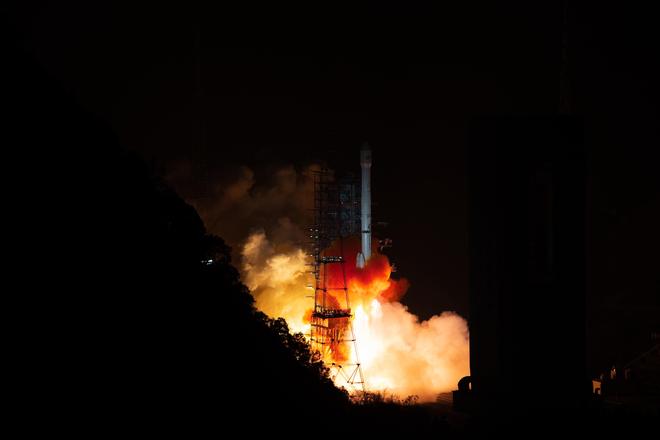
“风云家族”上“星” 太空“气象哨兵”再升级
Xin Lang Cai Jing· 2025-12-27 05:18
Core Viewpoint - The successful launch of the Fengyun-4C satellite enhances China's meteorological capabilities, particularly in short-term weather forecasting and space weather monitoring [1][3]. Group 1: Launch Details - The Fengyun-4C satellite was launched on December 27 using the Long March 3B rocket from the Xichang Satellite Launch Center, marking the 621st flight of the Long March series [3]. - This satellite is the 23rd in the Fengyun meteorological satellite family and is designed to operate in a geostationary orbit 36,000 kilometers above the equator, providing continuous monitoring of nearly one-third of the Earth's surface [3][4]. Group 2: Technological Advancements - Fengyun-4C features significant upgrades in observational capabilities, achieving 2 to 3 times the technical specifications compared to its predecessor, Fengyun-4B, making it the most advanced geostationary meteorological satellite globally [4]. - The satellite is equipped with four advanced remote sensing instruments and two solar observation instruments, enhancing its ability to monitor atmospheric conditions and solar activity [4][5]. Group 3: Power and Efficiency - The power system of Fengyun-4C has been upgraded, with solar panels increasing in area by over 20% and improving power generation by approximately 26% due to higher efficiency solar cells [5]. - The satellite's battery capacity has been expanded by 50% using next-generation high-energy lithium batteries to meet its increased power demands [5]. Group 4: Future Developments - The launch of Fengyun-4C will contribute to a more efficient observational network alongside previous satellites, improving China's capabilities in weather forecasting, disaster prevention, and ecological monitoring [5]. - Future plans include launching additional geostationary and low-orbit meteorological satellites to establish a comprehensive space-based meteorological observation system [5].