气象卫星技术

Search documents
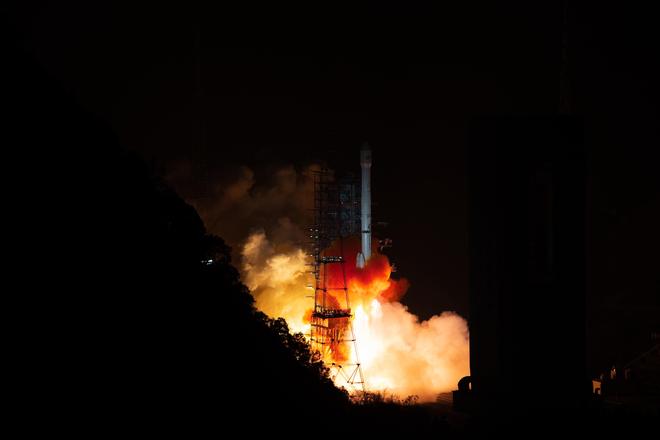
成功发射!风云四号C星有哪些硬核实力
Xin Lang Cai Jing· 2025-12-27 18:41
Core Viewpoint - The successful launch of the Fengyun-4C satellite marks a significant advancement in China's meteorological observation capabilities, enhancing the country's ability to predict severe weather and monitor space weather [1][2][3] Group 1: Satellite Specifications and Capabilities - Fengyun-4C satellite's technical indicators are improved by 2 to 3 times compared to Fengyun-4B, making it the strongest geostationary meteorological satellite globally in terms of comprehensive observation capabilities [1] - The satellite is equipped with four different ground remote sensing instruments and two solar observation instruments, enabling multi-channel two-dimensional imaging, three-dimensional atmospheric detection, high-frequency lightning detection, ionospheric imaging, and solar imaging [1][2] - The satellite's geostationary radiation imaging instrument can now distinguish atmospheric temperature changes of 1/50 degrees Celsius from 10,000 kilometers away, with a full disk imaging time reduced from 15 minutes to 5 minutes [2] Group 2: Technological Innovations - The satellite features a new electric propulsion high-performance remote sensing platform, which allows for high-precision in-orbit autonomous maintenance and angular momentum unloading, achieving a precision improvement of over 10 times [1] - The interferometric infrared detector has improved spatial resolution from 12 kilometers to 8 kilometers, capable of completing temperature and humidity detection in China within one hour [2] - The lightning imaging instrument can capture 500 frames per second, capable of identifying lightning events from a data stream of 30 Gbps, equivalent to reviewing 30 HD movies in one second [2] Group 3: Impact on Meteorological Services - Fengyun-4C will work in conjunction with previous satellites to form a more efficient collaborative observation network, significantly enhancing China's capabilities in weather forecasting, disaster prevention, and ecological monitoring [2][3] - The satellite's inter-satellite collaborative observation capability aims to create a "data highway" in space, advancing the international meteorological observation system towards a model of "discovery and observation, observation and service" [3]
可在万里之外分辨出大气五十分之一摄氏度的变化——风云四号03星本领高强
Xin Hua She· 2025-12-27 10:54
Core Viewpoint - The successful launch of the Fengyun-4 03 satellite marks a significant advancement in China's meteorological capabilities, enhancing weather forecasting and disaster prevention systems [1][5]. Group 1: Launch Details - The Fengyun-4 03 satellite was launched on December 27 at 0:07 using the Long March 3B rocket from the Xichang Satellite Launch Center, successfully entering its designated orbit [1][5]. - This satellite is the third in the Fengyun-4 series, which is designed for short-term weather forecasting, including typhoons and heavy rainfall, as well as space weather monitoring [3]. Group 2: Technological Advancements - The Fengyun-4 03 satellite features a new electric propulsion system that enhances its autonomous positioning accuracy by over 10 times [5]. - It is equipped with four different types of remote sensing instruments and two solar observation instruments, providing comprehensive observational capabilities [3][5]. - The satellite's advanced imaging capabilities include distinguishing temperature changes of one-fiftieth of a degree Celsius from thousands of kilometers away and completing humidity and temperature assessments of the Chinese region within one hour [5]. Group 3: Collaborative and Data Transmission Capabilities - The satellite supports inter-satellite collaboration and high-speed data transmission, contributing to a future "data highway" in space [5]. - Its lightning imaging capabilities allow it to capture 500 frames per second and identify lightning events from a data stream equivalent to playing 30 HD movies in one second [5].