水利现代化治理

Search documents
“十四五”时期天津构建保障维护水安全体系
Zhong Guo Fa Zhan Wang· 2025-11-10 07:13
Core Viewpoint - The Tianjin government emphasizes the importance of water security as a foundation for high-quality economic and social development during the "14th Five-Year Plan" period, highlighting significant progress in water management and infrastructure development [1][2]. Group 1: Water Infrastructure Investment - Water infrastructure investment during the "14th Five-Year Plan" is expected to reach approximately 89 billion yuan, doubling the investment from the "13th Five-Year Plan" period, marking a historical high in water construction scale [2]. - Over 380 water projects are being implemented, leveraging national debt issuance to support water infrastructure development [2]. Group 2: Flood Control and Disaster Response - The city has successfully enhanced its flood control capabilities, achieving a flood control levee compliance rate of 99% by 2025, up from 79% in 2020 [2]. - The city has effectively managed multiple extreme weather events, ensuring no casualties and minimal damage to critical infrastructure [2]. Group 3: Urban and Rural Water Supply - The dual water source system has been improved, adding 4.9 million cubic meters of water storage capacity and increasing water supply capacity by 610,000 cubic meters per day [3]. - The rural tap water coverage has reached 99.7%, positioning Tianjin among the top cities in the country for water supply levels [3]. Group 4: Ecological Environment and Water Resource Management - Continuous efforts have been made to restore river and lake ecosystems, with significant improvements in water quality and ecological health [3]. - Groundwater levels have risen for six consecutive years, with a cumulative increase of 11.8 meters, indicating effective management of groundwater over-extraction [3]. Group 5: Modernization of Water Management - The development of a digital twin system for monitoring flood control projects has been initiated, enhancing the digital and intelligent capabilities of flood prevention efforts [4]. - The quality of engineering projects has been maintained at 100% compliance, with over 90% of key projects rated as excellent [4].
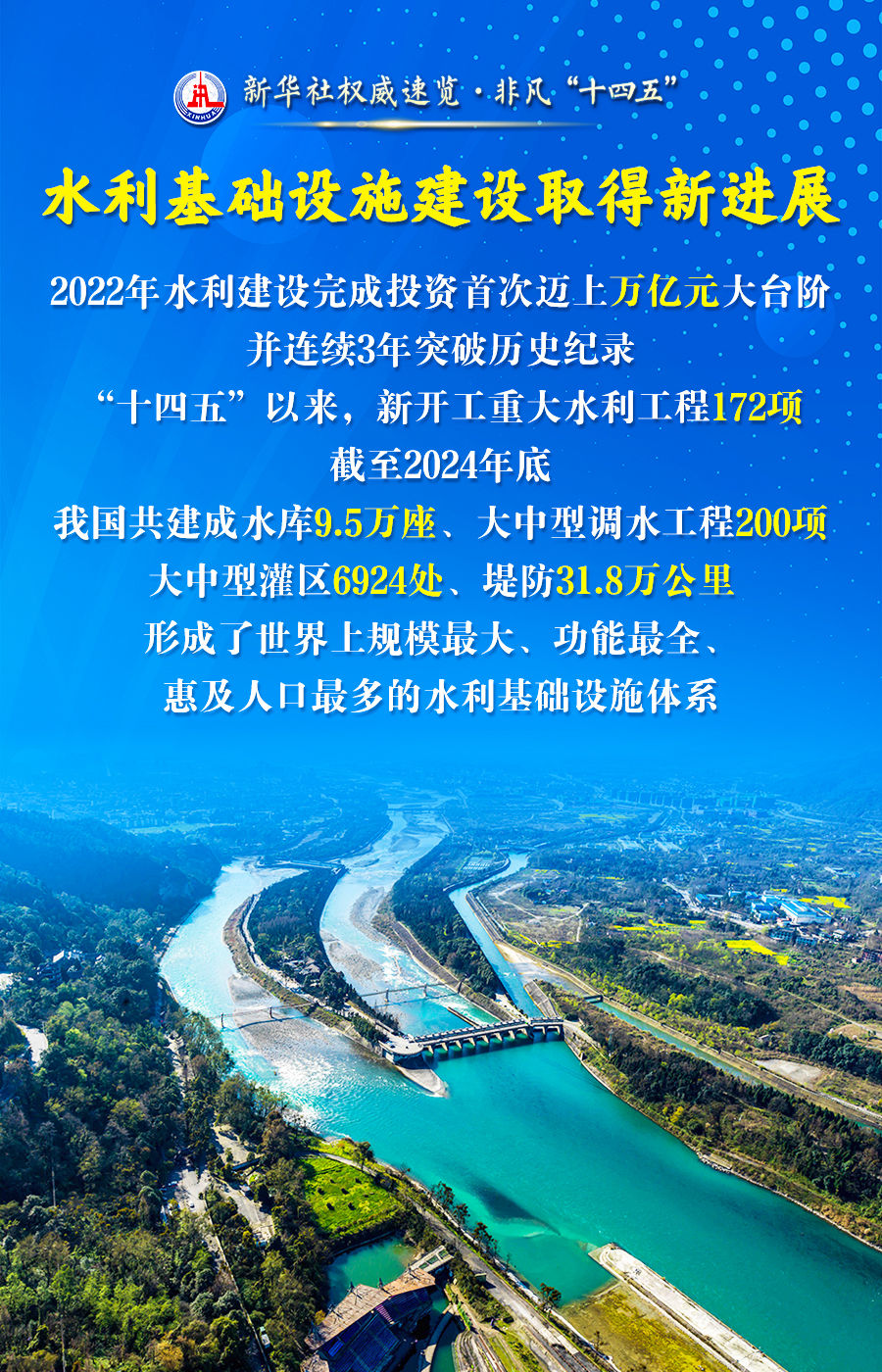
新华社权威速览·非凡“十四五” | 这三个“最”,凸显治水成绩单含金量!
Xin Hua She· 2025-09-29 06:15
Core Insights - China has made significant progress in water management and disaster prevention during the "14th Five-Year Plan" period, contributing to flood safety, water supply security, food security, and ecological safety [1][3]. Group 1: Flood and Disaster Management - The flood control capacity of reservoirs has reached 185.6 billion cubic meters, protecting a population of 660 million people [3]. - The national flood retention area has a capacity of 109 billion cubic meters, with 133,000 hydrological monitoring stations established [3]. - The proportion of flood disaster losses to GDP has decreased from 0.28% during the "13th Five-Year Plan" to 0.18% during the "14th Five-Year Plan" [3]. Group 2: Ecological Restoration - Key rivers and lakes have seen improvements, with a 98.6% compliance rate for ecological flow standards [6]. - Issues related to "disorderly occupation, mining, stacking, and construction" have been addressed, with an expected increase in soil erosion control area by 340,000 square kilometers [6]. - Soil conservation rate has reached 73% [6]. Group 3: Water Resource Utilization - By the end of the "14th Five-Year Plan," the national water network coverage is expected to reach 80%, with irrigated farmland area at 109 million acres and rural tap water coverage at 96% [8]. - Water usage per unit of GDP is projected to decrease by 17.7%, and water usage per unit of industrial added value is expected to decline by 23.6% compared to the end of the "13th Five-Year Plan" [8]. - The effective utilization coefficient of irrigation water has improved from 0.565 at the end of the "13th Five-Year Plan" to 0.58 [8]. Group 4: Modern Governance and Management - New laws and regulations, including the Yangtze River Protection Law and the Yellow River Protection Law, have been implemented to enhance water management [10]. - A total of 1.2 million river and lake chiefs have been appointed to oversee water bodies [10]. - Non-fiscal funding usage averaged 395.7 billion yuan annually over the first four years of the "14th Five-Year Plan," which is 2.3 times that of the "13th Five-Year Plan" [10].