汽车照明智能化

Search documents
2025全球汽车照明用 LED 驱动器行业Top5 生产商排名及市场占比
QYResearch· 2026-01-22 05:57
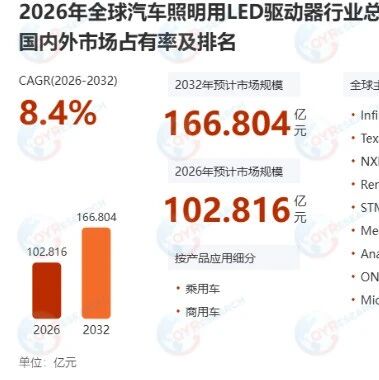
Core Viewpoint - The automotive LED driver market is projected to reach $2.45 billion by 2032, with a compound annual growth rate (CAGR) of 8.4% from 2026 to 2032, driven by the increasing penetration of LED technology in automotive lighting and the shift towards intelligent and high-safety lighting systems [2][10]. Market Overview - The global automotive LED driver market is expected to grow significantly, with the top three manufacturers holding approximately 36.0% market share by 2025 [6]. - Key players in the market include Infineon Technologies, Texas Instruments, and NXP [6][17]. Industry Chain Analysis - The automotive LED driver integrates multiple functions such as power conversion, current regulation, and diagnostics within a compact chip architecture, ensuring stable output under varying voltage conditions [7]. - The upstream segment relies heavily on advanced semiconductor materials and equipment, including silicon wafers and photolithography tools, which are crucial for high-yield manufacturing [7]. - The midstream phase focuses on circuit design and power management system integration, balancing efficiency, stability, and durability to meet automotive standards [8]. - The downstream applications encompass passenger and commercial vehicles, with significant use in headlights, taillights, daytime running lights, and smart ambient lighting systems [9]. Industry Development Opportunities and Challenges - The main drivers for the automotive LED driver industry include the ongoing adoption of LED sources in automotive lighting and the demand for intelligent lighting systems, which require higher precision in current control and energy efficiency [10]. - Challenges include stringent automotive reliability requirements and the complexity of systems, which increase R&D and validation costs [11]. Future Trends - The automotive LED driver is expected to evolve towards higher integration, energy efficiency, and enhanced functional safety capabilities, with power management and diagnostic functions becoming more integrated within single chips [12]. - Automation, process optimization, and digital validation methods will continue to advance in the manufacturing chain, improving consistency and reliability [12].