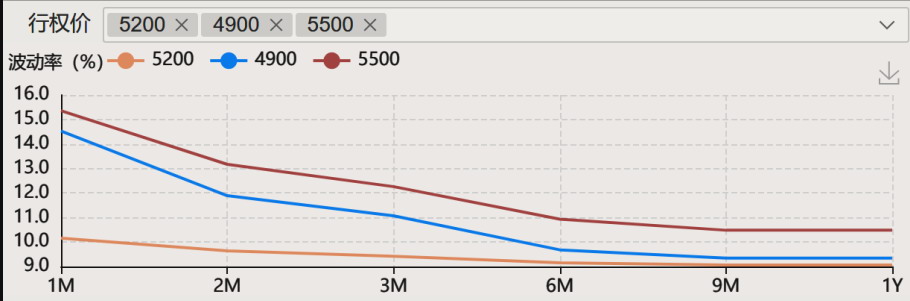
波动率曲面

Search documents
白糖2605系列期权:从波动率中捕捉趋势与机遇
Qi Huo Ri Bao Wang· 2026-02-02 01:25
Core Insights - Implied volatility (IV) serves as a key variable in options pricing, acting as a "thermometer" for market sentiment regarding future price uncertainty and a "risk gauge" [1] - Sugar, being a cyclical and policy-sensitive agricultural product, experiences price fluctuations influenced by various factors such as domestic production and sales rhythm, import conditions, weather in major production areas, and external market linkages [1] - The introduction of sugar options in 2025 has improved liquidity, enhancing the responsiveness of IV to short-term information [1] Comparison of IV and HV - The comparison between implied volatility (IV) and historical volatility (HV) is crucial for assessing market sentiment and the relative "richness" of options pricing [2] - HV is a retrospective measure based on the standard deviation of past returns, while IV is a forward-looking indicator derived from real-time market prices of options [3][4] Current IV and HV Analysis - As of January 31, 2026, the HV for the Zheng Sugar 2605 contract is approximately 8.62%, indicating low actual price volatility, while the IV for the at-the-money call option is 9.72%, resulting in a positive premium of 1.10% [5] - This positive premium suggests that despite low recent volatility, traders anticipate potential increases in volatility post-Chinese New Year due to supply constraints from India and Thailand [5][6] Strategy Logic Under IV and HV Premium - The positive premium structure of IV over HV indicates that option sellers can sell "insurance" at higher prices, benefiting from time decay, but must manage significant gamma risk due to market concerns [8] - Buyers of options face higher costs due to elevated IV, necessitating substantial price movements to achieve profitability, suggesting a strategy of waiting for IV to decrease before entering positions [8] Volatility Surface Analysis - The volatility surface shows a "smile" or "skew" pattern, with IV for at-the-money options ranging from 9.06% to 10.16%, indicating a risk premium for future uncertainty despite low current volatility [9] - The structure reveals that short-term IV is higher than long-term IV, reflecting greater perceived uncertainty in the near term [10] Hedging Strategy Exploration - The current volatility surface indicates a "left low, right high" characteristic, suggesting that the market perceives greater upside risk driven by supply constraints [12] - Investors holding long positions may consider buying out-of-the-money put options for cost-effective downside protection, while those looking to enhance returns might sell out-of-the-money call options, albeit with caution regarding potential upside risks [12]