
注册制监管

Search documents
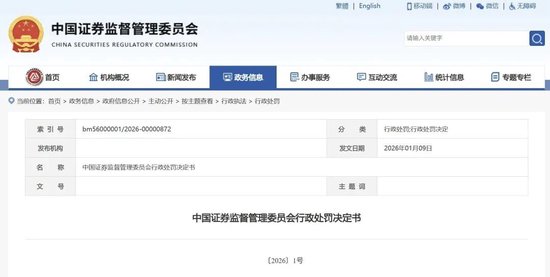
证监会1号罚单剑指“自然人”
Xin Lang Cai Jing· 2026-01-27 05:09
Core Viewpoint - The recent administrative penalty imposed by the China Securities Regulatory Commission (CSRC) highlights a zero-tolerance approach towards market manipulation, with a record fine exceeding 1 billion yuan for an individual involved in manipulating the stock of BoShi Glasses over a five-year period [1][6]. Group 1: Manipulation Details - The manipulation case spanned from 2019 to 2024, involving 67 accounts controlled by an individual, which systematically traded BoShi Glasses stock [2][9]. - During the 1,252 trading days of manipulation, the accounts were active on 837 days, with buying volume exceeding 10% of the market's total on 181 days and over 20% on 45 days [2][9]. - The average daily holding of the accounts was 13,913,349 shares, representing 13.64% of the circulating shares, with over 1,026 trading days where holdings exceeded 10% [2][9]. Group 2: Trading Techniques - The individual employed deceptive tactics, including aggressive buying at or above market prices to create a false sense of trading activity, while simultaneously engaging in wash trading [3][10]. - There were 212 trading days where self-buying and selling occurred, with the highest single-day wash trading volume reaching 25.32% of the market total [3][10]. Group 3: Stock Performance and Market Impact - The stock price of BoShi Glasses surged from 13.72 yuan to 37.81 yuan, marking a 175.58% increase, while the Shenzhen Composite Index fell by 9.36%, indicating a significant divergence from market trends [4][12]. - This price increase was not a result of genuine market forces but rather a product of manipulation, as evidenced by the extreme deviation from the overall market performance [4][12]. Group 4: Regulatory Response - The CSRC's penalty included a fine of over 1 billion yuan, requiring the individual to return all illegal gains and pay an equivalent fine, reflecting a shift towards stricter enforcement in the registration system [6][13]. - The individual faces a three-year ban from the securities market and a prohibition on trading, effectively preventing any future involvement in capital markets [6][13]. Group 5: Investor Awareness - This case serves as a cautionary tale for retail investors, emphasizing the risks of stock price manipulation and the importance of recognizing signs of potential market manipulation [7][14]. - Investors are advised to be vigilant about stocks that show significant price deviations from the market, fluctuating trading volumes, and lack of fundamental support [7][14].

恒立实业29年上市路终落幕 转型锂电"救命稻草"反成"催命符"
Xin Lang Cai Jing· 2025-06-24 09:41
Core Viewpoint - The decision by the Shenzhen Stock Exchange to delist Hengli Industrial marks the end of a long struggle for the company, which has faced significant operational decline and financial losses over the years [1][4]. Group 1: Company Performance and Financials - Hengli Industrial's stock will enter a delisting period starting June 25, 2025, with the final trading day expected to be July 15, 2025 [1]. - The company has experienced a drastic decline in revenue, with figures dropping from 346 million yuan in 2021 to 111 million yuan in 2023, and only 70.06 million yuan in the first three quarters of 2024 [1]. - The company reported a net profit of negative 33 million to negative 43 million yuan for the year 2024, despite a revenue forecast of 300 million to 350 million yuan [3]. Group 2: Strategic Moves and Challenges - In an attempt to avert delisting, Hengli Industrial acquired 100% of a newly established lithium battery materials processing company for no more than 15 million yuan in August 2024 [2]. - The acquisition led to a significant revenue increase in the fourth quarter, but the company faced discrepancies with its auditing firm regarding revenue figures, which were reported as only 196 million yuan [3]. - The company’s chairman obstructed the board's review of the annual report, leading to a delay that contributed to the delisting process [4]. Group 3: Industry Context and Implications - The failure of Hengli Industrial's cross-industry venture into lithium battery materials reflects a broader trend of over a hundred companies exiting the lithium battery sector due to industry oversupply and cyclical fluctuations [4]. - The case illustrates the regulatory environment under the new registration system, which has zero tolerance for "shell restructuring" and "financial engineering" practices [4]. - The shift in the new energy industry from rapid growth to refined competition indicates that companies lacking core competitiveness will face significant challenges [4].
