跨界转型

Search documents
中信建投:国内家电制造能力外溢 开辟海外成长新曲线
Zhi Tong Cai Jing· 2026-02-25 02:15
Core Viewpoint - The transition of home appliance component companies into automotive and robotics sectors represents a high-certainty growth trend, driven by three underlying logics: the reusability of core technologies, the adaptability of precision manufacturing capabilities, and overlapping customer resources that accelerate the introduction of new supply chains [1][2]. Group 1: Underlying Logic of Transition - The synergy of technology, manufacturing, and customer resources is the foundational logic behind the expansion of home appliance manufacturing capabilities [2]. - Core technologies such as thermal management, motors, and intelligent control in home appliances are applicable to automotive and robotics sectors, significantly lowering R&D costs and barriers to entry [2]. Group 2: Case Study of Sanhua Intelligent Controls - Sanhua Intelligent Controls' cross-industry transformation demonstrates the significant impact of emerging business expansion on valuation systems [3]. - The company has leveraged its home appliance temperature control technology to enter automotive thermal management, AI liquid cooling, and humanoid robot actuator fields, securing large orders in automotive thermal management [3]. Group 3: Other Representative Companies - Other home appliance component companies like Dechang Holdings, Huazhi Jie, and Lek Electric have established competitive advantages through capability reuse, enhancing profit expectations [4]. - These companies have achieved large-scale delivery in automotive EPS motors, line control motors, and precision liquid cooling components, while also expanding into robotics components [4]. Group 4: Investment Recommendations - The increase in revenue from emerging businesses will reshape the valuation system of home appliance component companies, with profit growth in automotive and robotics sectors outpacing traditional home appliance businesses [5]. - The core business attributes of related companies are shifting from traditional manufacturing to technology hardware supply, which will systematically drive performance and overall valuation improvements [5].

和顺石油跨界收购半导体企业,股价与基本面现背离
Jing Ji Guan Cha Wang· 2026-02-13 03:54
Company Developments - The company plans to acquire at least 34% of semiconductor design firm Shanghai Kuixin Technology for a cash consideration of no more than 540 million yuan, aiming to gain control through voting rights delegation. This strategic move is seen as a key layout for seeking new growth points amid pressure on its traditional oil sales business [2] - The company's performance faces challenges, with total revenue of 2.126 billion yuan in Q3 2025, a year-on-year decrease of 0.13%. The net profit attributable to shareholders was 21.8062 million yuan, down 49.44% year-on-year. The company previously forecasted a net loss of between 22 million yuan and 17.6 million yuan for 2025, indicating a shift from profit to loss [4] Market Activity - The company's stock has shown strong performance, with a cumulative increase of 20.70% over the past 20 days. Market attention is focused on the cross-industry acquisition of semiconductor companies, active capital flow, and the coexistence of performance pressure and transformation expectations [1] - On February 2, 2026, the company was listed on the trading leaderboard due to a daily volatility of 16.72%, with a total net purchase of 97.094 million yuan from trading seats. Recent data indicates a net inflow of main funds, reflecting active market trading [3] Industry Environment - As a member of the oil and petrochemical sector, the company's stock price may be influenced by dynamics in the crude oil market and sector rotation. For instance, a recent trade agreement between the U.S. and India, where India committed to stop purchasing Russian oil in favor of U.S. imports, could impact the global energy market landscape and draw market attention to related sectors [5]

金字火腿2025年业绩预降,高层变动及跨界半导体引关注
Jing Ji Guan Cha Wang· 2026-02-11 09:00
Core Viewpoint - The company Jinzi Ham is expected to see a significant decline in net profit for 2025, primarily due to the absence of non-recurring gains and reduced interest income from the previous year [1][2]. Financial Performance - The company forecasts a net profit attributable to shareholders of between 20 million to 25 million yuan for 2025, representing a year-on-year decline of 59.79% to 67.83% [2]. - The decline is attributed to the lack of non-recurring gains such as equity transfer and property disposal income that were present in 2024, along with a decrease in interest income [2]. Executive Changes - On December 15, 2025, the company appointed Zheng Hu as the new president, who is the son of the controlling shareholder Zheng Qingsheng [3]. - This change comes approximately six months after Zheng Qingsheng officially took control of the company in June 2025, marking the second presidential transition within the year [3]. Strategic Initiatives - Following Zheng Qingsheng's takeover, the company has initiated a foray into the semiconductor sector [4]. - In July 2025, the company established two wholly-owned subsidiaries focused on chip business and announced plans in September to invest up to 300 million yuan to acquire no more than 20% equity in Zhongsheng Microelectronics, a company specializing in optical communication chips [4].

淡出地产?深圳老牌房企2.74亿跨界科技!
Cai Jing Wang· 2026-02-10 10:39
Core Viewpoint - The recent acquisition by Shahe Co., a state-owned enterprise in Shenzhen, marks a significant strategic shift aimed at overcoming challenges in the real estate sector and aligning with national policies favoring emerging industries [1][2]. Group 1: Acquisition Details - Shahe Co. plans to acquire 70% of Jinghua Electronics for approximately 274 million yuan, signaling a move to diversify beyond real estate [1]. - Following the announcement, Shahe Co.'s stock surged to a limit-up of 14.53 yuan per share, with a total market capitalization of 3.5 billion yuan as of February 10 [1]. Group 2: Financial Performance - Shahe Co. has faced significant revenue and profit declines, with a reported revenue of 14.29 million yuan for the first half of 2025, down 94.74% year-on-year, and a net loss of 18.96 million yuan, a 135.04% decline [2]. - The company anticipates a net loss of 136 to 156 million yuan for the full year 2025, with a basic loss per share projected between 0.5619 and 0.6445 yuan [2]. Group 3: Cash Flow and Financial Health - Despite ongoing losses, Shahe Co. maintains a robust cash flow, with a net cash flow from operating activities of 56.68 million yuan, up 188.93% year-on-year, and cash reserves of 502 million yuan [3]. - The company’s financial structure appears healthy, with short-term liabilities of only 3.98 million yuan, providing a solid foundation for the acquisition [3]. Group 4: Strategic Implications of the Acquisition - The acquisition of Jinghua Electronics will allow Shahe Co. to enter the smart display and control technology sector, reducing business concentration risks and expanding growth opportunities [3]. - Jinghua Electronics has a clear profit commitment for the years 2026 to 2028, with net profits guaranteed at no less than 37.20 million yuan, 40.31 million yuan, and 43.55 million yuan respectively, providing a predictable revenue stream for Shahe Co. [3][4]. Group 5: Jinghua Electronics Overview - Jinghua Electronics is recognized as a national-level "little giant" enterprise specializing in smart display controllers and LCD devices, with applications across various sectors including smart home and industrial automation [5]. - The company has established long-term partnerships with notable firms such as Kohler, Schneider, and DJI, indicating a strong market position [5]. - The acquisition is facilitated by the shared control of both companies by the Shenzhen State-owned Assets Supervision and Administration Commission, enhancing the transaction's stability and support [5]. Group 6: Challenges Ahead - Transitioning from a real estate focus to a technology-intensive industry presents challenges for Shahe Co., including the need for industry knowledge, technical expertise, and operational adjustments [5].
东方材料亏损背后,接连跨界暗藏风险
Xin Lang Cai Jing· 2026-02-10 00:13
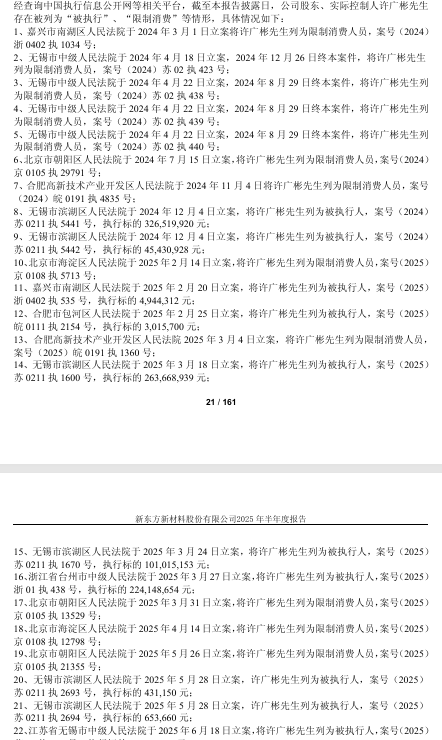
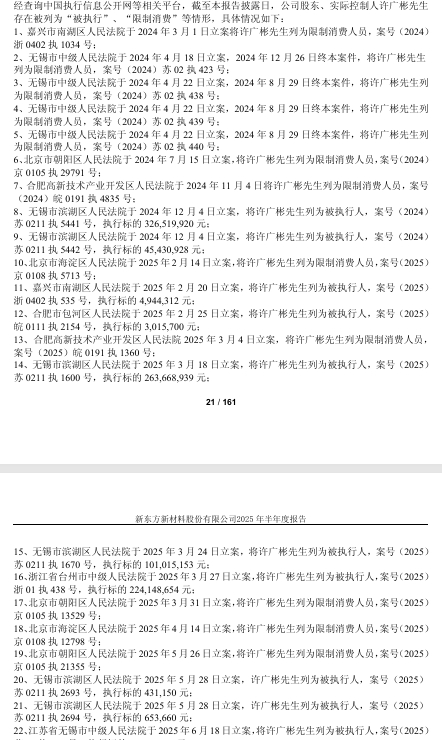
Core Viewpoint - 2025 is a tumultuous year for Dongfang Materials (603110.SH), marked by the loss of control by its actual controller Xu Guangbin due to debt issues, a significant drop in shareholding, and a new shareholder's violation of commitments, alongside declining revenues and profits in its core business of inks and adhesives, leading to an expected annual loss [1][21]. Shareholder Changes - Xu Guangbin's debt crisis has led to a drastic reduction in his shareholding from 13.54% to 1.34%, resulting in the loss of his position as the largest shareholder [3][5]. - Xu has been involved in 22 instances of judicial enforcement and consumption restrictions, severely impacting the company's operational stability and market confidence [3][23]. - The new shareholder, Jiangsu Teliang New Materials Technology Co., Ltd., acquired 12 million shares (5.96% of total shares) through judicial auction but violated a commitment not to increase or decrease holdings within 12 months shortly after the acquisition [6][26]. Business Performance - Dongfang Materials' core business of inks and adhesives, which accounts for over 90% of revenue, is facing significant challenges due to industry downturns and intense competition, leading to declining revenues and profits [11][29]. - For the first three quarters of 2025, the company reported revenues of 279 million yuan, a year-on-year decline of 7.41%, and a net profit attributable to shareholders of 3.19 million yuan, down 75% year-on-year [30]. - The company anticipates a net loss of 5.94 million to 7.11 million yuan for the entire year of 2025, a stark contrast to a net profit of 13.96 million yuan in 2024 [12][30]. Cross-Industry Ventures - In response to the pressures on its core business, Dongfang Materials has attempted to diversify into new areas, including the AI-driven computing power sector and investments in nanocarbon materials, but these efforts have been controversial and unprofitable [13][20]. - The computing power business, managed by two subsidiaries, reported combined revenues of only 13.16 million yuan with significant operating losses, indicating a lack of profitability [14][32]. - The investment in the nanocarbon materials company, which has a high debt ratio and has reported continuous losses, raises concerns about the viability and risk of such ventures [19][36].


财说丨东方材料亏损背后,接连跨界暗藏风险
Xin Lang Cai Jing· 2026-02-10 00:06
Core Viewpoint - 2025 is a tumultuous year for Dongfang Materials (603110.SH), marked by significant ownership changes, financial struggles, and operational challenges, leading to a projected annual loss [1][8]. Ownership Changes - The actual controller Xu Guangbin's shareholding plummeted from 13.54% to 1.34% due to debt issues, resulting in the loss of his status as the largest shareholder [3][4]. - Xu Guangbin faced 22 instances of judicial enforcement and consumption restrictions, severely impacting the company's stability and market confidence [1][3]. - New shareholder Teliang, after acquiring shares through judicial auction, violated a commitment not to increase or decrease holdings within 12 months, prompting regulatory scrutiny [5][6]. Financial Performance - Dongfang Materials' core businesses, ink and adhesive products, which account for over 90% of revenue, are suffering from industry downturns, leading to declining revenue and profits [8][9]. - For the first three quarters of 2025, the company reported revenue of 279 million yuan, a year-on-year decline of 7.41%, and a net profit of 3.19 million yuan, down 75% [9]. - The company anticipates a net loss of 5.94 million to 7.11 million yuan for the entire year of 2025, a stark contrast to a profit of 13.96 million yuan in 2024 [9][10]. Operational Challenges - Despite declining revenue, sales expenses increased by 10.55% to 24.67 million yuan in the first three quarters of 2025, indicating a misalignment in cost management [9][10]. - The company has not effectively optimized its product structure or improved technology, instead relying on cross-industry ventures that have not yielded positive results [10][11]. Cross-Industry Ventures - Dongfang Materials attempted to pivot into the AI and computing power sectors, but these efforts have not generated significant returns, leading to operational losses [11][12]. - The company invested 18 million yuan in a high-risk nanocarbon material firm, which has been consistently losing money and has a high debt ratio, raising concerns about its viability [14][15].
河北润旺达坚定选择跨界转型——融入国际先进制造体系
Jing Ji Ri Bao· 2026-02-09 23:05
Core Viewpoint - Hebei Runwangda has successfully transformed from a traditional sanitary ware manufacturer to a producer of high-end laboratory safety equipment, capitalizing on market gaps and its technical capabilities [1][3]. Group 1: Company Transformation - Founded in 1982, Hebei Runwangda initially thrived in the sanitary ware market with annual sales exceeding 100 million yuan, but faced challenges due to intense competition and price wars [1]. - The company shifted focus to laboratory equipment after recognizing the reliance on expensive imports for high-end safety gear during an international exhibition [1][3]. - The transition involved moving from standardized, mass production to small-batch, high-standard laboratory equipment, which presented significant challenges [2]. Group 2: Product Development and Innovation - The company faced difficulties in adapting traditional sanitary materials to withstand the corrosive environments of laboratories, leading to the development of a proprietary corrosion database [2]. - After extensive testing and failures, Hebei Runwangda successfully created laboratory faucets that can resist over 150 types of chemical agents and have a lifespan exceeding 600,000 uses, surpassing international standards [2]. - The company has achieved a significant leap in standards from "civilian grade" to "industrial safety grade," reflecting a complete overhaul of its production processes [2]. Group 3: Market Expansion and Recognition - In 2019, Hebei Runwangda debuted at an international exhibition, attracting attention from German manufacturers and securing its first international OEM order, marking its entry into the global advanced manufacturing system [3]. - The company has received positive feedback from top research institutions, with evaluations stating that its products match imported ones in performance while offering better cost-effectiveness [3]. - Hebei Runwangda has participated in the formulation of seven national and industry standards, gaining significant influence in the sector, and has expanded its product offerings to over 100 types, achieving annual sales growth from 2 million yuan to over 70 million yuan by 2025 [3].
萃华珠宝上市以来首度被“ST” 债务逾期45个银行账户已被冻结
Zheng Quan Ri Bao Wang· 2026-02-09 12:44
Core Viewpoint - Shenyang Cuihua Gold and Silver Jewelry Co., Ltd. (Cuihua Jewelry) is facing significant liquidity issues, leading to the freezing of multiple bank accounts and the implementation of risk warnings on its stock, which will be renamed to "ST Cuihua" starting February 10, 2026 [1][2]. Group 1: Financial Issues - Cuihua Jewelry has multiple bank accounts frozen due to overdue loans totaling 2.54 billion yuan, with 5.24 billion yuan in total bank loans, of which 2.34 billion yuan in principal is overdue [2][3]. - The company has a high debt load, with total debt increasing from 2.306 billion yuan at the end of 2022 to 4.307 billion yuan by the end of September 2025, and the debt-to-asset ratio rising from 58.06% to 68.78% during the same period [4]. - Short-term debt repayment pressure is significant, with short-term borrowings of 1.707 billion yuan and a total short-term repayment obligation exceeding 1.87 billion yuan, while available cash is only 438 million yuan [6][7]. Group 2: Business Transformation - Since its cross-industry transformation in 2022, Cuihua Jewelry has expanded its debt significantly, primarily due to its acquisition of a 51% stake in Sichuan Siterui Lithium Industry for 612 million yuan, entering the lithium salt business [4]. - The lithium segment has been underperforming, with losses of 186 million yuan in 2023 and 65.1 million yuan in 2024, despite promises of achieving a cumulative net profit of at least 300 million yuan from 2023 to 2025 [4]. Group 3: Operational Impact - The freezing of 45 bank accounts, including 4 basic accounts, has raised concerns about the company's operational capabilities, although the company claims that production and operations remain normal [3]. - High inventory levels, amounting to 3.723 billion yuan and nearly 60% of total assets, indicate that a significant amount of capital is tied up, which could hinder the company's short-term liquidity [5].

奋进“十五五” 阔步向未来|庆安 科技赋能激发医药产业新活力
Xin Lang Cai Jing· 2026-02-06 21:59
Group 1 - The pharmaceutical manufacturing industry in Qing'an County is focusing on technological innovation as a core driver for development, aiming for breakthroughs in formulation, intelligent upgrades, and cross-industry integration [1] - Heilongjiang Aolida Naide Pharmaceutical has invested nearly 50 million yuan in consistency evaluation for generic drugs, resulting in five products approved for market, including a unique product with a market share of 70% to 80% [1] - The company is also expanding its product matrix with new approvals expected this year, including oral solutions and small-volume injectables [1] Group 2 - Heilongjiang Zhonggui Pharmaceutical has established a high-level innovation platform recognized by the provincial government, with an annual investment of about 20 million yuan in technology innovation and new product development [2] - The company has received awards for its industrialization of oral solutions and has secured funding for major technological achievements, promoting a cycle of research, transformation, and industrialization [2] - Heilongjiang Ruige Pharmaceutical is undergoing a digital and intelligent transformation in traditional Chinese medicine manufacturing, enhancing production stability and increasing extraction rates by at least 10% [2] Group 3 - Heilongjiang Kelong Pharmaceutical is diversifying into the health beverage market, leveraging its pharmaceutical-grade production environment to create products from local resources, aligning with consumer trends and seeking new growth opportunities [3] - By 2026, Qing'an County aims to leverage technological innovation to drive high-quality development in key industries, contributing to the revitalization of Northeast China and the establishment of a modernized Heilongjiang [3]
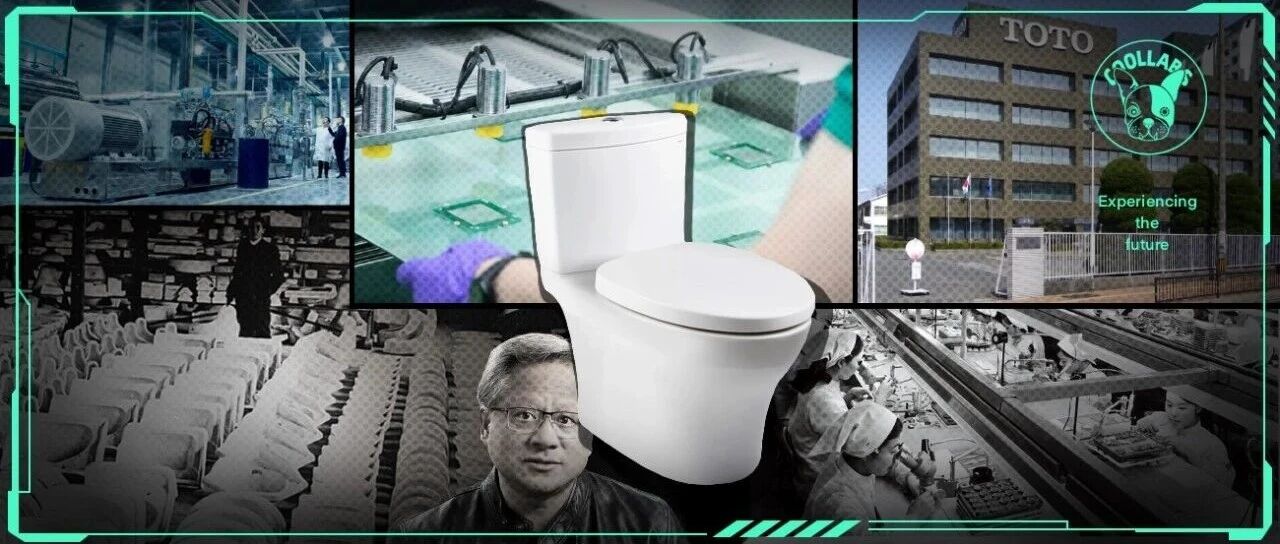
AI热潮带飞马桶厂?不起眼的日企,控制了芯片命脉
创业邦· 2026-02-06 00:08
Core Viewpoint - The article discusses how traditional companies, such as TOTO, have successfully transitioned into the semiconductor industry by leveraging their existing technologies and expertise, particularly in ceramics, to meet the growing demands of the AI and semiconductor markets [6][19]. Group 1: TOTO's Transformation - TOTO, a Japanese bathroom products company, saw its stock price surge by 11% due to its involvement in the semiconductor industry, despite its primary business being unrelated to AI [8]. - The company's success is attributed to its expertise in producing high-density, low-porosity ceramics, which are essential for semiconductor manufacturing processes [11][12]. - TOTO's pivot to semiconductor precision ceramics has become a significant growth engine, contributing 42% of its revenue with a profit margin of 40%, far exceeding the average of 7% across all departments [19]. Group 2: Broader Industry Trends - The semiconductor industry is increasingly adopting electrostatic chucks, which TOTO has developed, due to their ability to provide uniform force and reduce contamination risks during wafer processing [12][17]. - Other traditional Japanese companies, such as Ajinomoto and Kao, have also successfully transitioned into the semiconductor sector by utilizing their existing technologies to create essential materials for chip manufacturing [22][30]. - The article highlights that Japan's historical industrial strength and technological reserves have allowed these companies to adapt and thrive in the semiconductor market, even as their traditional businesses face challenges [34][37]. Group 3: China's Potential - The article suggests that China's industrial sectors are beginning to mature, with companies like Xingfa Group and Huitian New Materials emerging as players in the semiconductor supply chain by developing high-purity materials and specialized adhesives [39][43]. - The narrative emphasizes that China's industrial development, although historically delayed, is now gaining momentum, and the accumulated technological expertise will eventually lead to significant advancements in the semiconductor industry [49].