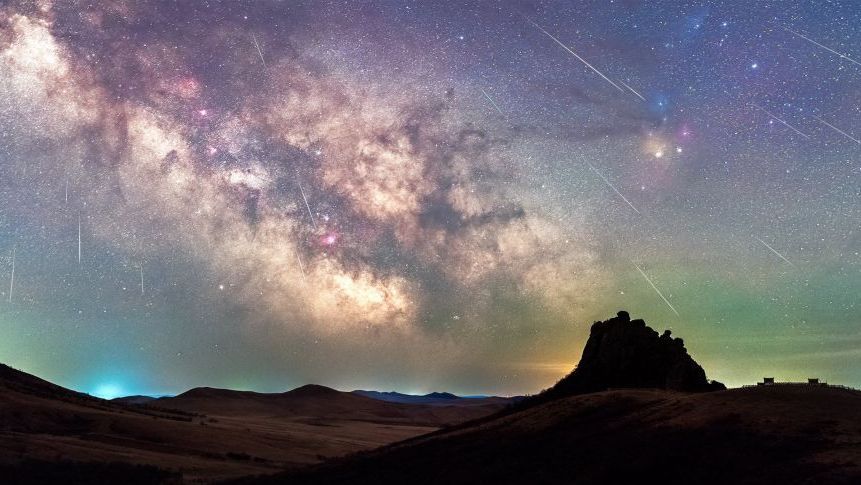
流星雨

Search documents
新知|宇宙“烟花秀”超震撼!“天外来客”为啥一路火花带闪电
Qi Lu Wan Bao· 2025-06-14 15:39
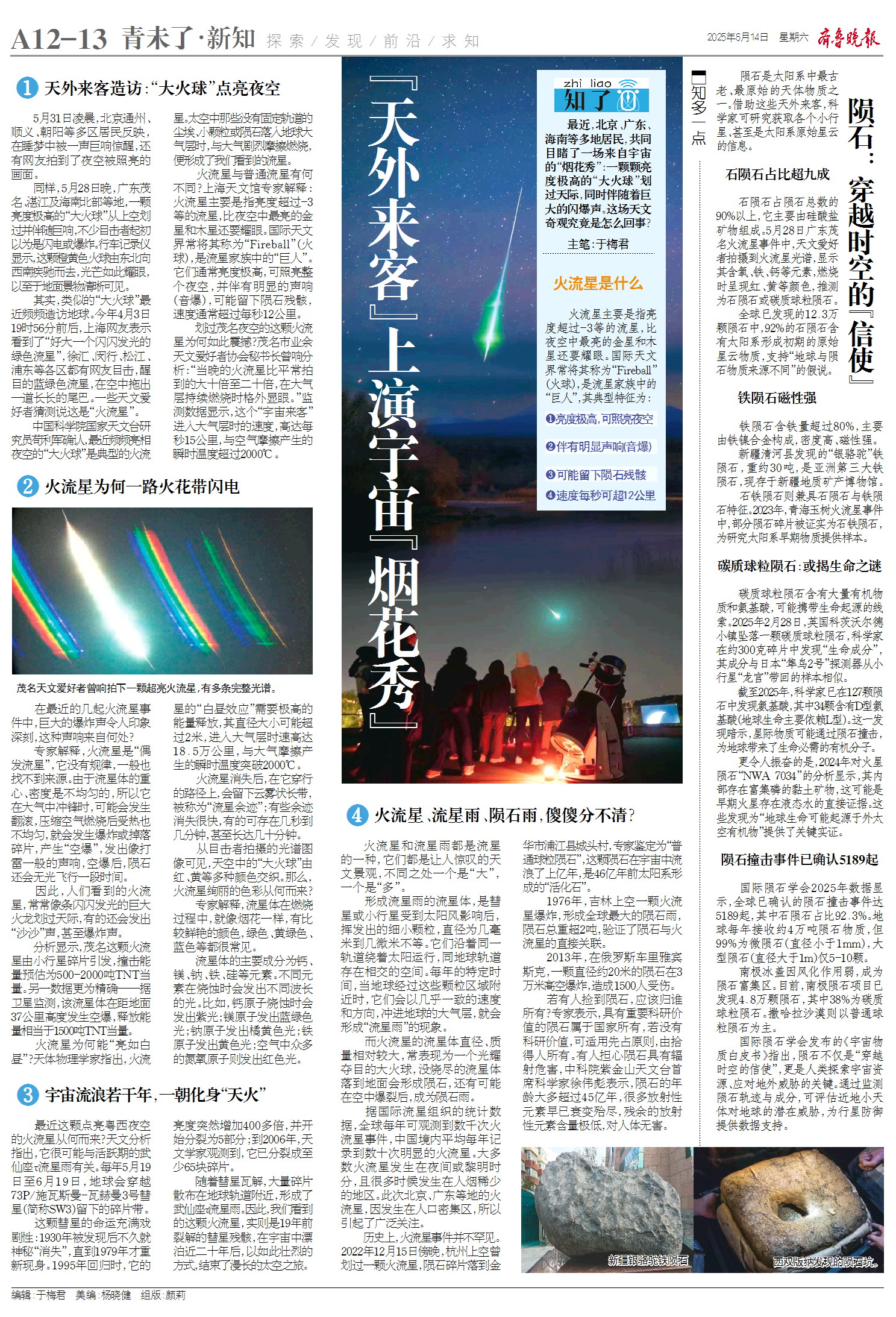
Core Points - A series of bright fireballs, or "fire meteors," have been observed across various regions in China, including Beijing, Guangdong, and Hainan, causing significant public interest and concern due to their brightness and accompanying loud explosions [7][9][11] - These fireballs are identified as typical fire meteors, which are significantly brighter than regular meteors, often exceeding a brightness of -3 magnitude, and can illuminate the night sky [9][11] - The recent fireball events are linked to the active Tau Aquariids meteor shower, which occurs when Earth passes through debris left by the 73P/Schwassmann-Wachmann 3 comet [18][20] Summary by Sections Fireball Observations - Residents in multiple cities reported witnessing bright fireballs in the night sky, with some initially mistaking them for lightning or explosions [7] - The fireball observed in Guangdong was noted to be 10 to 20 times larger than typical meteors, entering the atmosphere at a speed of 15 kilometers per second and generating temperatures exceeding 2000°C [11][12] Characteristics of Fire Meteors - Fire meteors are classified as "occasional meteors" with no predictable patterns, often resulting from irregularities in the meteor's density and structure, leading to explosive sounds upon atmospheric entry [12][13] - The energy released during these events can be substantial, with estimates ranging from 500 to 2000 tons of TNT equivalent, and specific events recorded energy releases of approximately 1500 tons of TNT [15] Composition and Coloration - The fireball's vibrant colors are attributed to the combustion of various elements such as calcium, magnesium, sodium, and iron, each emitting different wavelengths of light [17] - The fireball's diameter is estimated to exceed 2 meters, and its high-speed entry into the atmosphere results in a "daylight effect" due to the immense energy released [15][17] Historical Context and Meteor Showers - Historical records indicate that fire meteor events are not uncommon, with notable past occurrences leading to significant meteorite falls [26][38] - The Tau Aquariids meteor shower is a result of Earth passing through debris from a comet that has fragmented over time, contributing to the frequency of fireball sightings during this period [20][24]

星空有约|浪漫来袭!宝瓶座η流星雨6日迎来极大
Xin Hua She· 2025-05-04 15:52
Core Viewpoint - The Eta Aquariid meteor shower will reach its peak on May 6, providing an opportunity for enthusiasts to observe this celestial event [1][2]. Group 1: Meteor Shower Characteristics - The Eta Aquariid meteor shower is named after its radiant point near the star Eta Aquarii and occurs annually between April 19 and May 28 [1]. - The parent body of the Eta Aquariid meteor shower is the famous Halley's Comet, which also gives rise to the Orionid meteor shower later in the year [1]. - The meteor shower is classified as a medium-rate meteor shower, with a zenithal hourly rate (ZHR) of approximately 50, meaning that seeing three to five meteors per hour is considered good [1]. Group 2: Observation Conditions - For the Eta Aquariid meteor shower, the best observation time in the Northern Hemisphere is between 2:00 AM and 3:30 AM, as the radiant point rises around 2:00 AM [2]. - Despite the moderate meteor rate, the shower is noted for its strong visual appeal, with a higher likelihood of seeing meteors with long tails [2]. - Ideal observation conditions include areas with wide visibility, minimal obstructions, and low light pollution, and observers should not focus solely on the radiant point as meteors can appear in any part of the sky [2].
可能出现“火流星”!4月22日晚这场流星雨千万别错过
Yang Shi Xin Wen· 2025-04-21 16:16
Group 1 - The annual Lyra meteor shower will peak on April 22, with the maximum expected around 21:00 [3] - The active period for the Lyra meteor shower is from April 14 to April 30, with a historical zenith hourly rate (ZHR) stabilizing around 18 in recent years [3][7] - Observers are encouraged to find dark locations away from light pollution for optimal viewing [5] Group 2 - Meteor showers typically originate from comets or asteroids, with the Lyra meteor shower's parent body being comet C/1861 G1 [9] - Other notable meteor showers include the Quadrantids, Perseids, and Geminids, each with a zenith hourly rate exceeding 100 meteors [8][9] - The relationship between meteors, meteor showers, and meteor storms is defined by the frequency and intensity of meteors observed [12][13] Group 3 - Meteor colors vary based on their chemical composition and reaction temperatures, with different elements emitting distinct colors [14][15] - The Sextantids meteor shower occurs during the day, peaking around September 27, making it challenging to observe due to bright sunlight [20] - The Lyra meteor shower is characterized by bright meteors and fireballs, making it a worthwhile event for enthusiasts [3][5]