消费金融公司增资潮

Search documents
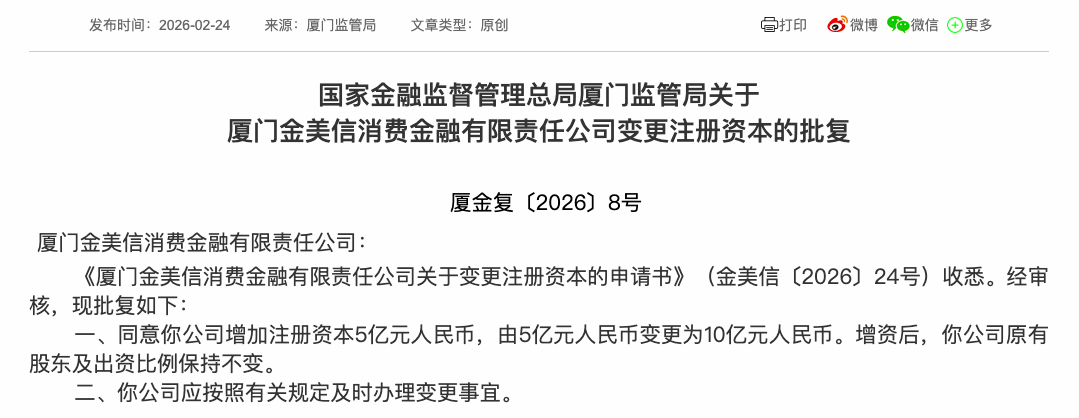
金美信获批增资至10亿,国美控股清空股权
2 1 Shi Ji Jing Ji Bao Dao· 2026-02-24 12:31
Group 1 - The core point of the article is that Xiamen Jinmeixin Consumer Finance Co., Ltd. has received approval to increase its registered capital from 500 million to 1 billion yuan, maintaining the original shareholders and their respective stakes [1][3] - The capital increase follows a significant adjustment in the company's shareholding structure, where China Trust Commercial Bank acquired a 16% stake and Jin Yuan Jin Kong acquired a 17% stake from Gome Holdings, leading to Gome's complete exit [3] - After the shareholding adjustment, both remaining shareholders now hold 50% each, contributing 250 million yuan each to the new capital [3] Group 2 - As of December 2024, Jinmeixin Consumer Finance reported total assets of 5.516 billion yuan, total liabilities of 4.702 billion yuan, and total equity of 814 million yuan, with a net profit of 20.56 million yuan, all meeting regulatory requirements [3] - Since the implementation of the "Consumer Finance Company Management Measures" in 2024, there has been a surge in capital increases among consumer finance institutions, driven by regulatory minimum thresholds and market expansion considerations [4] - At least seven consumer finance institutions have completed capital increases in 2025, with several companies raising their registered capital to 1 billion yuan, while others have seen significant increases in their capital [4]

年内 7 家消金公司完成增资 中型公司补充资本需求仍强
2 1 Shi Ji Jing Ji Bao Dao· 2025-12-18 12:01
Core Viewpoint - The consumption finance sector is experiencing a "capital increase wave" starting from 2024, driven by regulatory requirements and market considerations [1][6]. Group 1: Capital Increase Activities - Changsha Bank plans to increase capital in its subsidiary, Changyin 58 Consumer Finance, by up to 1.55 billion yuan, raising its ownership from 56.66% to 80.82% [1][2]. - At least seven consumer finance companies have completed capital increases this year, with several firms raising their registered capital to the 1 billion yuan threshold [3][4]. - Notable increases include Ningyin Consumer Finance's capital rising from 2.911 billion yuan to 3.6 billion yuan and Hubei Consumer Finance's from 1.0058 billion yuan to 1.3589 billion yuan [3]. Group 2: Regulatory Context - The "Management Measures for Consumer Finance Companies" effective from April 2024 mandates a minimum registered capital of 1 billion yuan [4][5]. - The new regulations also require major shareholders to hold at least 50% of the shares, up from 30%, to enhance accountability [5][6]. - Current data shows that five consumer finance companies still have registered capital below 1 billion yuan, and nearly half of the major shareholders do not meet the 50% ownership requirement [5]. Group 3: Market Considerations - Industry insiders suggest that the capital increases are not solely driven by regulatory compliance but also by strategic market choices from shareholders [6]. - Some leading companies are significantly increasing capital to expand credit offerings and capture high-quality customer segments, indicating a proactive growth strategy [6][7]. - Analysts predict that while the capital increase trend will continue, the pace will become more rational and differentiated, with medium-sized firms needing to maintain ROE levels and larger firms exploring various capital-raising methods [7].
再加码!南银法巴消金注册资本增至60亿,跻身行业第四
Nan Fang Du Shi Bao· 2025-12-16 12:03
Group 1 - The core point of the article is that Nanyin Fabai Consumer Finance Co., Ltd. has increased its registered capital from 5.215 billion to 6 billion yuan, ranking fourth among 31 licensed consumer finance companies in China [4][5][6] - The capital increase is attributed to a decision by Nanjing Bank, which contributed approximately 589.3 million yuan, maintaining its 64.16% shareholding [4][5] - This is the second capital increase for Nanyin Fabai within a year, following an increase from 5 billion to 5.215 billion yuan in September 2024, funded by a new shareholder, the International Finance Corporation [4][5] Group 2 - The increase in capital has directly improved the company's industry ranking, surpassing Industrial Bank Consumer Finance, which has a registered capital of 5.32 billion yuan [5][6] - Nanyin Fabai's management team has recently expanded with the appointment of two new deputy general managers, enhancing the company's leadership [7][9] - The company reported a significant increase in revenue and net profit for the first half of 2025, with revenue reaching 2.74 billion yuan, a 33.75% increase year-on-year, and net profit of 143 million yuan, nearly doubling from the previous year [10] Group 3 - The consumer finance industry is experiencing a capital increase trend due to regulatory changes that have raised the minimum registered capital requirement from 300 million to 1 billion yuan [11][12] - Many consumer finance companies are increasing their capital to comply with new regulations, with some institutions still falling short of the new minimum capital requirements [12] - The overall sentiment in the industry remains positive, with institutions recognizing the importance of compliance and the potential for sustainable growth in the consumer finance sector [12]