液滴微流控技术

Search documents
重庆大学王丹团队: 基于SERS的微滴高通量筛选平台开发高效有机酸生产菌株
合成生物学与绿色生物制造· 2026-01-16 04:14
Core Viewpoint - The article discusses the successful development of a high-throughput screening system based on Surface-Enhanced Raman Spectroscopy (SERS) by Professor Wang Dan's team at Chongqing University, which allows for real-time, label-free analysis of bacterial metabolites within microdroplets, providing an efficient and sustainable technology for green biomanufacturing [2][4]. Group 1: High-Throughput Screening Platform - The RH-RMSS platform utilizes SERS technology to directly detect metabolite concentrations without the need for cell staining or labeling, processing 180 microdroplets per second, significantly faster than traditional methods [4]. - The platform successfully screened high-yield strains for various organic acids, achieving yields of 1.61 times, 1.52 times, and 1.81 times that of the original strains for succinic acid (SA), D-lactic acid (D-PLA), and acrylic acid (AA), respectively [4]. - The system reveals key enzyme mutation mechanisms and implements multi-level metabolic optimization, achieving a maximum succinic acid yield of 138.92 g/L using optimized strains [4]. Group 2: System Validation and Performance - The RH-RMSS system demonstrated high accuracy (>98%) and efficiency in screening, effectively enriching high-yield strains from a large pool of mutants [10]. - The system's ability to accurately quantify organic acids within individual microdroplets was validated, establishing its reliability as a high-throughput screening tool [8]. - The research successfully transitioned from microdroplet screening to large-scale fermentation verification, showcasing the engineered strains' capability to utilize non-food biomass as a carbon source for succinic acid production [15]. Group 3: Mechanistic Insights and Optimization Strategies - The D210G mutation was shown to enhance the catalytic efficiency of the phosphoenolpyruvate carboxylase (PEPC) enzyme, which is crucial for achieving high succinic acid yields [11]. - The study highlights the synergistic effects of neutralizing agent optimization, RBS sequence optimization, and adaptive evolution on improving succinic acid production [14]. - The RH-RMSS platform is presented as a versatile tool adaptable for screening high-yield strains for various organic acids and other metabolites with characteristic Raman signals [18].


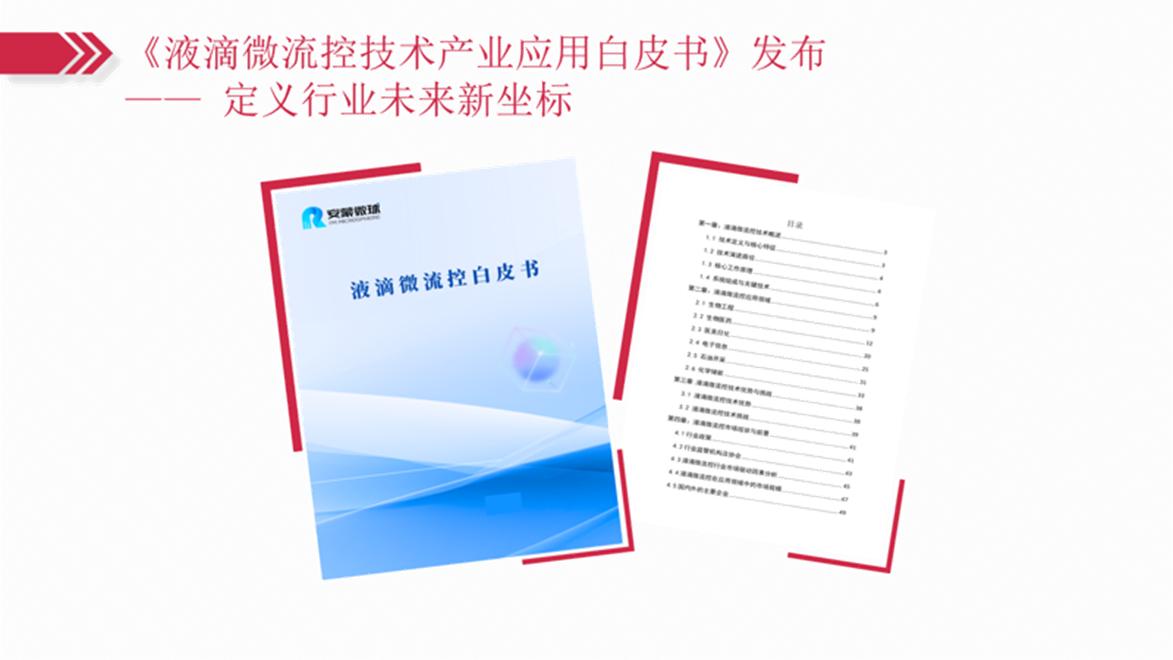
为液滴微流控未来发展路径提供精准导航,「安蒙微球」宣告发布“白皮书”
3 6 Ke· 2025-05-15 09:52
Core Viewpoint - The release of the "Droplet Microfluidics White Paper" by the Microfluidics and Advanced Materials Research Institute and Anmeng Microbeads marks a significant step in establishing industry standards and guiding the development of droplet microfluidics technology in China [1][4][6]. Group 1: Technology Overview - Droplet microfluidics technology allows precise control over the generation, transport, mixing, and reaction of droplets at a microscopic scale, utilizing advanced microfluidic chip design and fluid dynamics principles [3]. - This technology is likened to manipulating small droplets in a micro-scale environment, enabling high-speed experiments with minimal reagent usage, showcasing significant advantages in fields like biomaterials and chemical analysis [3][6]. Group 2: Industry Impact - The "Droplet Microfluidics White Paper" aims to provide quantifiable industry benchmarks for technology evaluation and product quality standards, serving as a guide for practitioners to seize industry opportunities and optimize strategic layouts [4][6]. - The white paper systematically summarizes the technical evolution and application status of droplet microfluidics, highlighting its advantages over traditional particle preparation methods and proposing innovative approaches for future industry development [6]. Group 3: Company and Research Institute - Anmeng Microbeads, established in July 2024, is recognized for its advanced microbead materials and has been included in the first batch of key pilot platforms by the Ministry of Industry and Information Technology [8]. - The Microfluidics and Advanced Materials Research Institute, initiated by a research team from Sichuan University and Anmeng Microbeads, aims to integrate original innovation with industrial application, responding to national strategic technology development plans [8].