清朗·整治短视频领域恶意营销乱象

Search documents
多个账号无底线博流量套路曝光!南都曾起底造黄谣植软广乱象
Nan Fang Du Shi Bao· 2025-07-17 03:50
Core Viewpoint - The Chinese internet regulatory authority is actively conducting a special campaign to address malicious marketing practices in the short video sector, leading to the closure or suspension of several accounts that violate public morals and ethics [1][2]. Group 1: Regulatory Actions - The campaign named "Clear and Bright: Rectifying Malicious Marketing in Short Video Sector" has resulted in the shutdown or suspension of accounts such as "岩岩爱海带苗" and "小崔崔" for posting content that severely violates public morals [1]. - Accounts on platforms like WeChat, Xiaohongshu, Douyin, and Kuaishou have been identified for disseminating inappropriate content, including harassment and explicit material [1]. Group 2: Malicious Marketing Tactics - The investigation revealed a "yellow rumor" marketing scheme that uses sensational headlines and provocative visuals to attract viewers, ultimately directing them to download dating apps [2]. - A complete industry chain has emerged around this "yellow rumor" tactic, involving recruitment of agents by dating app companies, which then subcontract to media firms for mass production and distribution of such content [2]. - Users are lured into downloading these apps with free chat options, but must pay to continue using the service, leading to additional revenue streams through training for paid chatting [2].
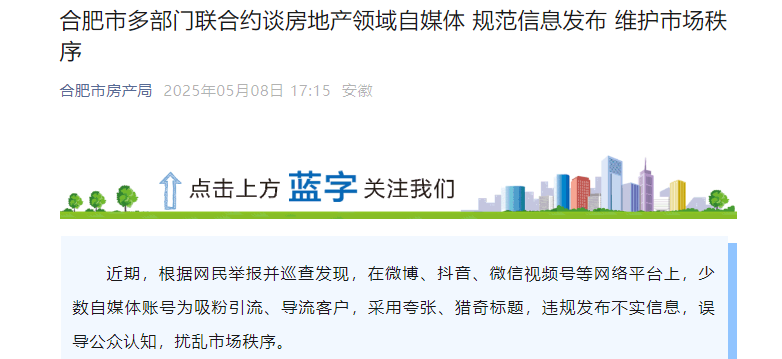
合肥多部门联合约谈房地产领域自媒体
Zheng Quan Shi Bao· 2025-05-08 14:40
Core Viewpoint - Recent actions have been taken in multiple regions to address illegal activities by certain real estate self-media accounts, aiming to create a healthy online environment and promote stable development in the real estate market [3][4]. Group 1: Regulatory Actions - The Hefei Municipal Housing Bureau announced a joint meeting with various departments to regulate the information published by real estate self-media accounts, emphasizing the need for accurate and factual reporting [3]. - The meeting highlighted that some self-media accounts have been spreading false information about housing policies and using sensationalist titles to attract attention, which undermines the stability of the real estate market [3][4]. - Authorities have previously conducted interviews with over 10 real estate agencies, urging them to manage their self-media accounts more effectively and report on rectification measures regularly [3]. Group 2: Compliance Requirements - Self-media account operators are required to adhere to laws and regulations such as the "Regulations on the Ecological Governance of Online Information Content" and the "Real Estate Advertising Release Regulations," ensuring that they provide an accurate reflection of the real estate market [4]. - The meeting stressed that self-media should act as responsible observers and participants in economic and social development, promoting accurate market information and avoiding sensationalism that could create panic [4]. Group 3: Industry Impact - Industry insiders noted that some real estate self-media accounts are using exaggerated and misleading information to attract followers and generate commissions, which disrupts the healthy development of the market and increases buyer hesitation [5]. - The Central Cyberspace Administration has initiated a three-month campaign starting April 15 to address malicious marketing practices in short videos, aiming to eliminate false information and maintain a healthy online space [5].