
港口一体化改革

Search documents
六年七阶亿吨跃升:山东港口高质量发展“解码”
Qi Lu Wan Bao· 2025-12-29 08:24
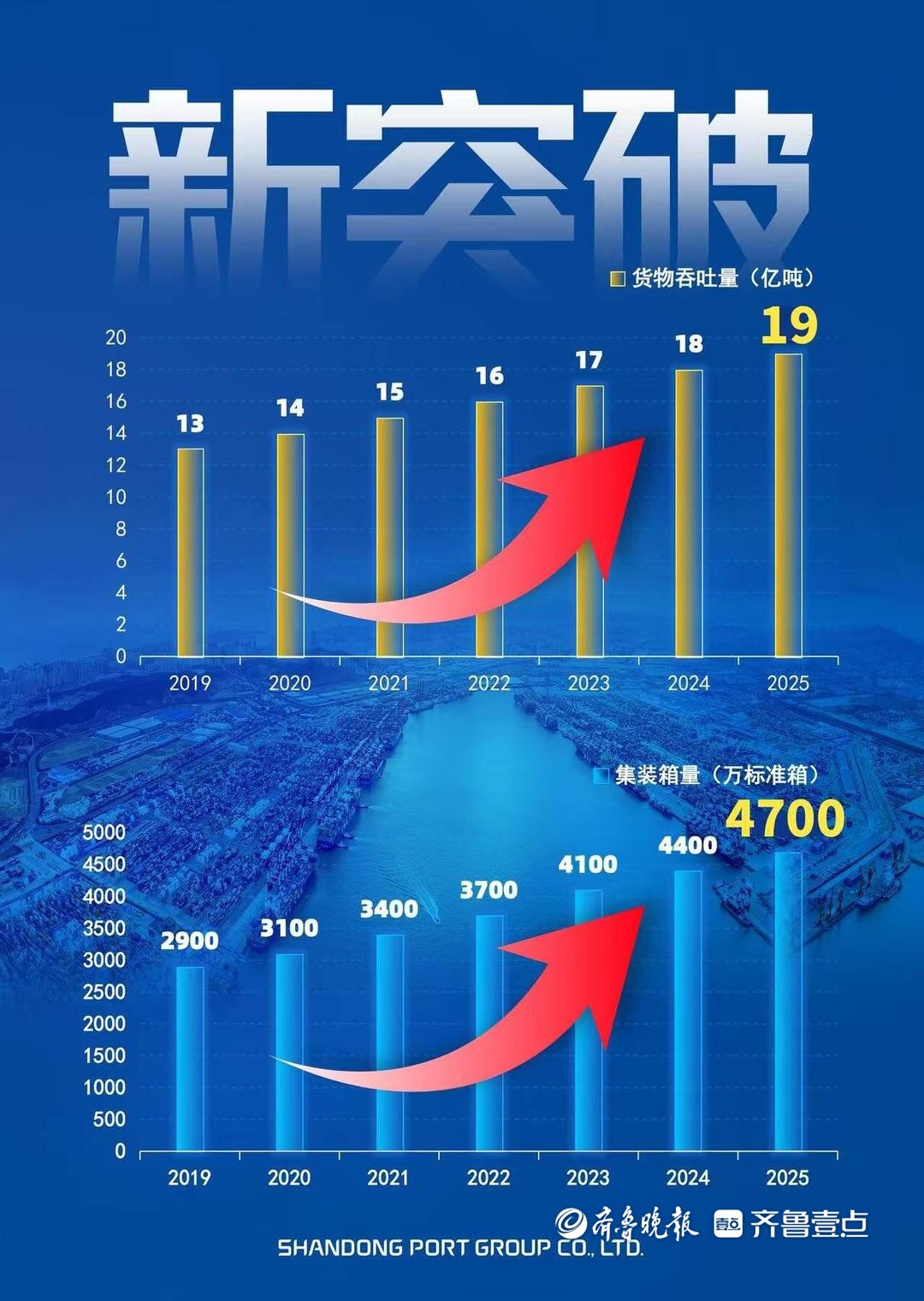
Core Insights - Shandong Port has achieved a remarkable milestone with cargo throughput exceeding 1.9 billion tons and container volume surpassing 47 million TEUs, solidifying its position as the world's largest and second-largest port respectively, showcasing high-quality development in the global shipping industry [1][11] Group 1: Structural Support Behind Growth - The rapid rise of Shandong Port is attributed to a combination of steady economic growth in the province, geographical advantages, integrated port collaboration, proactive supply chain service strategies, and continuous infrastructure investment [2][3] - Since its establishment in 2019, Shandong Port's cargo throughput has increased from nearly 1.3 billion tons to over 1.9 billion tons, and container volume has risen from approximately 30 million TEUs to 47 million TEUs, marking a cumulative increase of over 60% [2] Group 2: Economic and Geographical Advantages - Shandong's strategic location at the intersection of the Northeast Asia Economic Circle and the Bohai Economic Rim positions it as a crucial node for the Belt and Road Initiative and the most accessible maritime outlet for the Yellow River Basin [3] - The continuous improvement of Shandong's economy has become a fundamental driver for the port's throughput increase, providing stable cargo sources and optimizing cargo types [3] Group 3: Integrated Port Collaboration - Shandong Port has established an integrated and international development pattern, breaking down administrative barriers and regional limitations, which allows for resource sharing and collaborative operations among various ports [3][4] - The port's collaborative effect is a core element of its leap in development, enabling a shift from traditional "one port, one city" models to a more integrated and differentiated operational approach [3] Group 4: Supply Chain Service Transformation - Shandong Port is transitioning from a "single port operator" to a "comprehensive service provider," focusing on building a first-class supply chain service system that integrates logistics, commerce, finance, and information flows [4][10] - This transformation enhances the port's ability to support national strategies, regional economic development, and cost reduction for enterprises, thereby driving significant increases in cargo throughput and container volume [4] Group 5: Infrastructure Investment - Continuous and large-scale investments in infrastructure have been pivotal for Shandong Port's high-quality development, expanding berth capacity and improving berth standards to accommodate larger specialized vessels [5][4] - The port has established a robust infrastructure network, including numerous specialized terminals, which supports the handling of various cargo types and accounts for a significant portion of the province's foreign trade [5] Group 6: Structural Changes in Trade Dynamics - Shandong Port has experienced three structural changes: an increase in containerization rates, enhanced international transshipment capabilities, and a more developed multimodal transport system [8][9] - The rise in containerization reflects an increase in high-value goods, while the expansion of international routes and multimodal transport enhances the port's role as a key hub in global supply chains [8][9] Group 7: Global Trade and Regional Economic Impact - The growth of Shandong Port is expected to reshape global shipping resource allocation, enhance supply chain resilience, and solidify China's core position in the global shipping system [11][12] - The port's economic hinterland covers some of China's most active coastal regions and extends to the central and western provinces, facilitating efficient export channels for various goods and supporting high-quality development in both domestic and foreign trade [12]

打造苏州链接全球窗口
Su Zhou Ri Bao· 2025-11-25 00:42
Core Insights - The Southeast Asia heavy-lift container ship has commenced its maiden voyage from Suzhou Port Taicang Port Area, carrying nearly 100,000 cubic meters of "Made in China" goods to Indonesia's Gresik and Jakarta ports, operating on a bi-weekly schedule [1] - Suzhou Port is strategically located at the Yangtze River estuary, boasting the highest number of shipping routes along the Yangtze, serving as a critical support for the outward-oriented economy [1][2] Group 1: Port Development and Operations - By 2025, Suzhou Port aims to enhance its shipping network, focusing on customized services and increasing coverage for both domestic and foreign trade, with a target of completing 1.9 million TEUs in collaboration with Shanghai [2] - The port's integrated service platform will streamline operations, allowing for a unified login for business transactions across various port areas [2] - The port's container throughput is expected to exceed 10 million TEUs by 2024, making it the first inland port in China to achieve this milestone, with a projected growth of over 60% compared to the end of the 13th Five-Year Plan [2] Group 2: Trade and Economic Impact - Suzhou Port has accelerated its transformation into a trade hub, focusing on various commodities, and has established itself as the largest automobile export port and grain oil import port along the Yangtze River [3] - The port's foreign trade "new three samples" are expected to exceed 800,000 TEUs by 2025, with a year-on-year growth of over 50%, including over 12,000 TEUs of energy storage cabinets exported [3] - The main revenue from trade has increased from 100.5 billion yuan at the end of the 13th Five-Year Plan to 200 billion yuan, with an average annual growth rate of 19.8% [3] Group 3: Business Environment and Support - Suzhou Port has established a rapid response mechanism for enterprises, enhancing customs clearance efficiency and providing green channels for key commodities [4] - The port has implemented measures to support local foreign trade enterprises, including waiving storage fees for over 5,000 TEUs and ensuring that no export containers are left behind [4] - The port authority aims to leverage its geographical advantages to enhance global connectivity and support high-quality development in Suzhou [4]