多式联运体系

Search documents
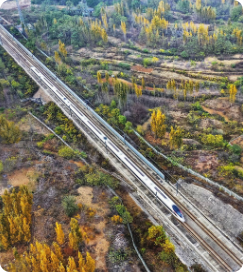
长三角农历新年首趟中欧班列从义乌开出
Xin Lang Cai Jing· 2026-02-17 09:07
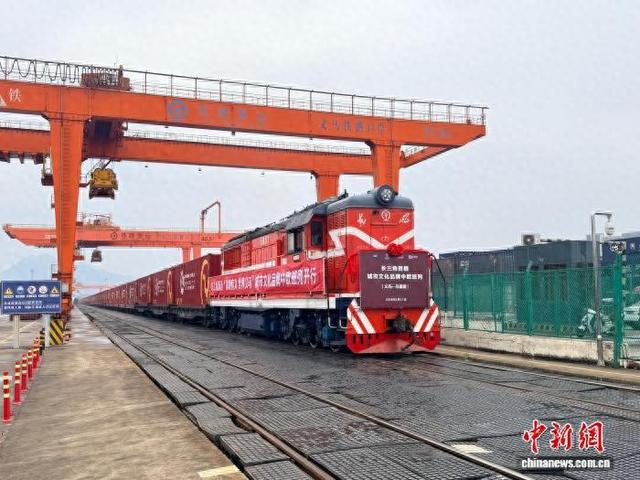
Core Points - The first China-Europe freight train of the Year of the Horse from Yiwu departed on February 17, carrying 110 standard containers of cultural products, daily necessities, and medical equipment, expected to reach Madrid, Spain in approximately 18 days [1][3] - During the Spring Festival holiday, Yiwu's China-Europe freight trains maintained regular operations, with over 40 trains planned to run during the 9-day holiday, averaging about 5 trains per day [2] - The train service aims to promote Yiwu's cultural brand, featuring the slogan "Have feelings and righteousness, World Yiwu," and highlights the city's six virtues: loyalty, filial piety, benevolence, trustworthiness, chivalry, and integrity [2] - Since 2026, Yiwu's China-Europe freight trains have dispatched over 220 trains, transporting more than 22,000 standard containers to over 160 cities in more than 50 countries across Eurasia, including Russia, Poland, Germany, and Kazakhstan [2] - The source of goods for Yiwu's China-Europe freight trains has expanded from local and surrounding cities to include various regions in Zhejiang, the Yangtze River Delta, and the Guangdong-Hong Kong-Macau Greater Bay Area, enhancing regional economic development [2]

两会“新”观察丨打通铁水联运“最后一公里”
He Nan Ri Bao· 2026-01-27 23:17
Core Insights - Inland waterway transportation serves as a crucial link between inland and ocean transport markets, significantly reducing costs and enhancing long-distance transport of bulk goods and foreign trade [1] - The construction of a "waterway expressway" is becoming increasingly important for regional economic development, particularly in addressing bottlenecks in inland waterway transport [1] Group 1: Economic Impact - The development of inland waterway transport is a key strategy for economic provinces to strengthen their advantages and address shortcomings [1] - The city of Zhoukou has made significant investments in port infrastructure, leading to a cargo throughput exceeding 50 million tons for two consecutive years [1] - Zhoukou Port's container throughput has surpassed 1 million TEUs, establishing it as a major inland port in Henan and the Huai River basin [1] Group 2: Strategic Recommendations - Suggestions have been made to advance the construction of dedicated railway lines to Zhoukou Port, enhancing intermodal transport and solidifying its status as a key inland port [2] - The integration of port development with urban planning is recommended to create a synergistic relationship that promotes economic growth [2] - The Henan provincial government aims to optimize water transport facilities and promote high-quality development of inland ports as part of its strategic initiatives for 2026 [2]
事关进出口货物多式联运业务,海关总署解读
Xin Lang Cai Jing· 2026-01-25 14:08
Background - The announcement by the General Administration of Customs aims to support the development of multimodal transport for import and export goods, specifically focusing on sea-rail and water-water transfer modes, to enhance logistics efficiency and reduce costs [1][2]. Significance of the Announcement - The pilot program for multimodal transport is expected to play a crucial role in building a modern logistics system in China, facilitating the efficient integration of transport resources and seamless organization of transport, thereby forming a modern logistics operation system that connects domestic and international markets [1]. Measures Interpretation - The pilot program covers sea-rail and water-water multimodal transport modes, with domestic transport being either rail or water, and international transport being by water. Other types of multimodal transport will be gradually improved and expanded based on the stability of current models [2]. - The announcement is based on the Customs Regulations for Transit Goods, allowing customs to supervise multimodal transport goods without requiring separate declarations from enterprises [2]. - Customs encourages enterprises within the pilot scope to adopt multimodal transport operations and supports the use of integrated national customs clearance or multi-stage transit methods for customs procedures [2]. - Before transmitting multimodal transport data to customs, operators or their agents must apply for data transmission permissions from the relevant customs authorities [3]. - Multimodal transport goods must be loaded, stored, and transferred at customs-supervised locations, except when the same operator provides domestic transport services [3]. - Operators can adjust transfer locations during transport by sending updated logistics information to customs for approval [3]. - For flexibility in domestic transport, containers under the same multimodal transport bill can be processed for departure and arrival in batches, with the timing of departure information transmission adjusted accordingly [3]. - Support is provided for the splitting and assembling of goods, allowing operators to apply for changes to transport documents as needed [4]. - If goods are canceled for export after customs clearance, operators can terminate the multimodal transport application without returning the goods to the origin [5].
重庆加速织密“空中丝路” 2030年国际航线将超70条
Xin Lang Cai Jing· 2026-01-11 17:16
Core Viewpoint - The Chongqing government has announced the "Implementation Plan for Promoting the Construction of the Air Silk Road," aiming to enhance international connectivity and establish Chongqing as a significant international aviation hub by 2030, with over 70 international routes and an annual passenger throughput of 5 million [4][11]. Current Achievements - As of the end of 2025, Chongqing has established 38 international passenger routes and 21 international cargo routes, achieving full coverage of RCEP member countries [5]. - The annual passenger throughput at Jiangbei Airport is projected to reach 50.1 million, with international passenger throughput increasing by 30.7% to 2.31 million [5]. - Cargo throughput is expected to reach 54,850 tons, with international cargo volume growing by 20.09% to 18,290 tons [5]. - Infrastructure improvements include the expansion of Jiangbei, Wanzhou, and Qianjiang airports, increasing annual passenger capacity from 46.5 million to 84 million [6]. Future Plans - Chongqing plans to focus on expanding international routes, particularly to Europe and Southeast Asia, and aims to increase international passenger transfer efficiency [8]. - The city will implement policies to facilitate smoother customs processes and enhance the ease of doing business for international trade [9]. - The development of the air logistics and manufacturing sectors is prioritized, with plans to attract foreign investment and promote cross-border e-commerce [9][10]. Benefits for Citizens and Businesses - Increased international flight options will enhance travel convenience for citizens, while improved airport services will streamline the travel experience [11]. - Businesses will benefit from reduced logistics costs and improved supply chain resilience through the "Air Corridor + Cross-Border E-Commerce" model [11]. - The growth of the aviation and logistics sectors is expected to create numerous job opportunities across various skill levels [11].

潍坊:以“港”谋城 叩开万亿未来
Da Zhong Ri Bao· 2025-12-31 06:17
Core Insights - The construction of a 50,000-ton channel at Weifang Port marks a significant breakthrough towards achieving the goal of becoming a "billion-ton port" and supports Weifang's ambition to become a trillion-yuan city [1][2] Group 1: Port Development and Economic Impact - Weifang Port is a core strategic resource for the city, with projected growth rates for throughput, container throughput, and foreign trade exports of 10.1%, 7.6%, and 31.1% respectively by 2025, positioning it as an important economic growth driver [1] - The new channel, with a length of 66 kilometers and a design depth of -13.6 meters, is expected to increase annual throughput capacity by over 40 million tons and save local enterprises over 1.5 billion yuan in logistics costs annually [2][3] Group 2: Multi-Modal Transport System - The ambition of Weifang Port extends beyond just deep-water channels; it aims to establish a seamless multi-modal transport system integrating road, rail, sea, and river transport [2] - A new railway connecting the port to the Jiaozhou-Jinan railway line is planned, enhancing the port's role as a strategic hub linking inland areas with global markets [2] Group 3: Supply Chain and Innovation - The port's development is attracting businesses to consolidate key supply chain activities near the port, exemplified by the establishment of a marine equipment manufacturing base [3] - Innovative projects, such as the integration of wave barriers with offshore wind farms, are expected to reduce maintenance costs significantly and create additional revenue streams for the port [3]
六年七阶亿吨跃升:山东港口高质量发展“解码”
Qi Lu Wan Bao· 2025-12-29 08:24
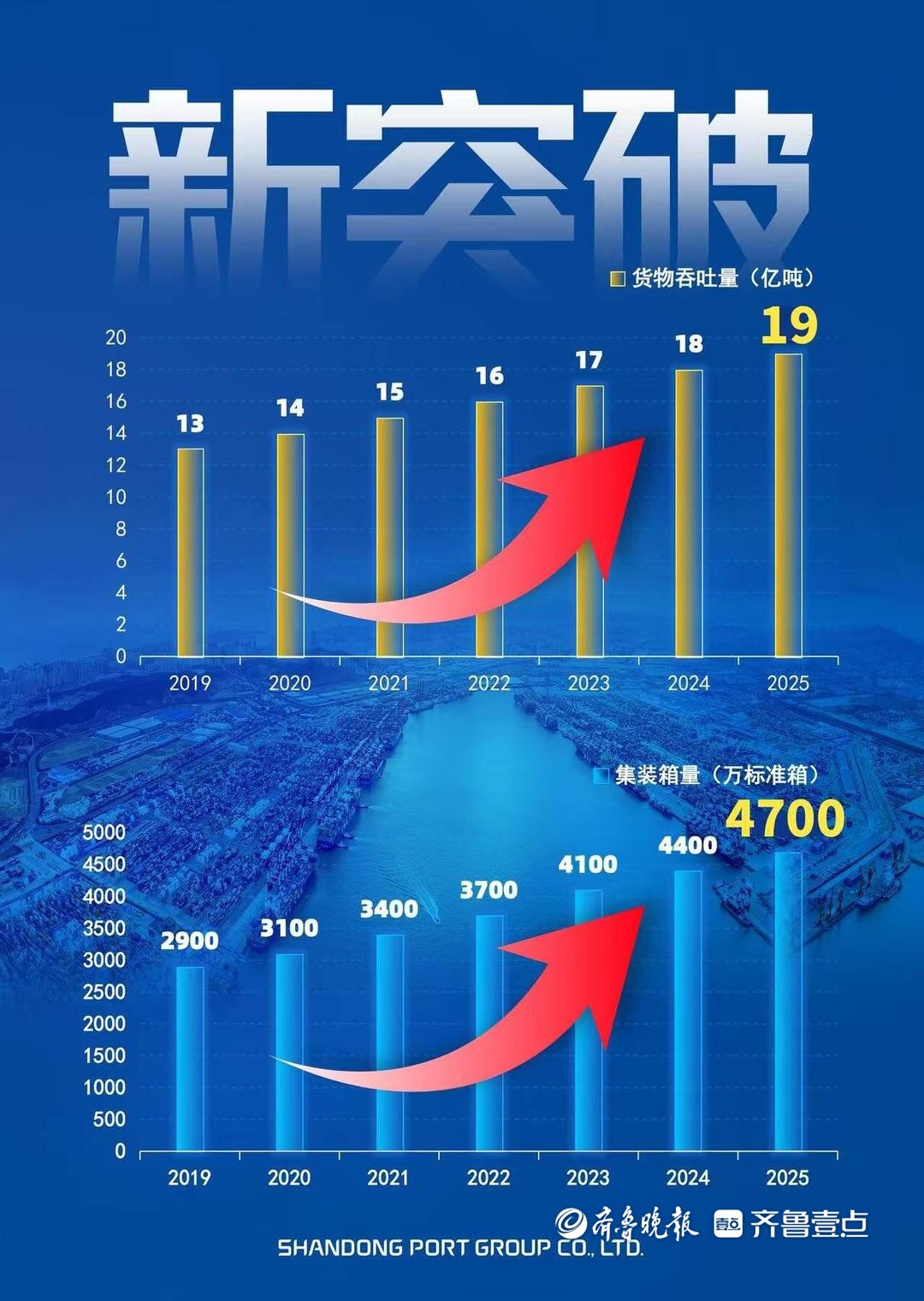
Core Insights - Shandong Port has achieved a remarkable milestone with cargo throughput exceeding 1.9 billion tons and container volume surpassing 47 million TEUs, solidifying its position as the world's largest and second-largest port respectively, showcasing high-quality development in the global shipping industry [1][11] Group 1: Structural Support Behind Growth - The rapid rise of Shandong Port is attributed to a combination of steady economic growth in the province, geographical advantages, integrated port collaboration, proactive supply chain service strategies, and continuous infrastructure investment [2][3] - Since its establishment in 2019, Shandong Port's cargo throughput has increased from nearly 1.3 billion tons to over 1.9 billion tons, and container volume has risen from approximately 30 million TEUs to 47 million TEUs, marking a cumulative increase of over 60% [2] Group 2: Economic and Geographical Advantages - Shandong's strategic location at the intersection of the Northeast Asia Economic Circle and the Bohai Economic Rim positions it as a crucial node for the Belt and Road Initiative and the most accessible maritime outlet for the Yellow River Basin [3] - The continuous improvement of Shandong's economy has become a fundamental driver for the port's throughput increase, providing stable cargo sources and optimizing cargo types [3] Group 3: Integrated Port Collaboration - Shandong Port has established an integrated and international development pattern, breaking down administrative barriers and regional limitations, which allows for resource sharing and collaborative operations among various ports [3][4] - The port's collaborative effect is a core element of its leap in development, enabling a shift from traditional "one port, one city" models to a more integrated and differentiated operational approach [3] Group 4: Supply Chain Service Transformation - Shandong Port is transitioning from a "single port operator" to a "comprehensive service provider," focusing on building a first-class supply chain service system that integrates logistics, commerce, finance, and information flows [4][10] - This transformation enhances the port's ability to support national strategies, regional economic development, and cost reduction for enterprises, thereby driving significant increases in cargo throughput and container volume [4] Group 5: Infrastructure Investment - Continuous and large-scale investments in infrastructure have been pivotal for Shandong Port's high-quality development, expanding berth capacity and improving berth standards to accommodate larger specialized vessels [5][4] - The port has established a robust infrastructure network, including numerous specialized terminals, which supports the handling of various cargo types and accounts for a significant portion of the province's foreign trade [5] Group 6: Structural Changes in Trade Dynamics - Shandong Port has experienced three structural changes: an increase in containerization rates, enhanced international transshipment capabilities, and a more developed multimodal transport system [8][9] - The rise in containerization reflects an increase in high-value goods, while the expansion of international routes and multimodal transport enhances the port's role as a key hub in global supply chains [8][9] Group 7: Global Trade and Regional Economic Impact - The growth of Shandong Port is expected to reshape global shipping resource allocation, enhance supply chain resilience, and solidify China's core position in the global shipping system [11][12] - The port's economic hinterland covers some of China's most active coastal regions and extends to the central and western provinces, facilitating efficient export channels for various goods and supporting high-quality development in both domestic and foreign trade [12]
经济大省挑大梁│江苏南京:从“十字路口”到“世界接口”
Xin Lang Cai Jing· 2025-12-21 14:32
Core Viewpoint - Nanjing is enhancing its status as an international transportation hub through the development of a multi-modal transport system that integrates air, rail, and maritime logistics, significantly improving its connectivity and operational capacity in the Yangtze River Delta and beyond [1][12]. Air Transport Hub - Nanjing Lukou International Airport has achieved "super-large airport" status, with a passenger throughput capacity of 50 million annually after the completion of Terminal 1 renovations and ongoing expansion projects [6][8]. - The airport is expected to handle 6.5 million passengers and 90,000 tons of cargo annually after the completion of its third-phase project, with a projected cargo throughput growth of 13.4% by 2025 [8][12]. - The introduction of new international routes, including direct flights to Paris, enhances the airport's competitive edge and connectivity [6][8]. Rail Transport Hub - The Nanjing North Station project, set to begin construction in September 2024, will feature a larger capacity than Nanjing South Station, with an expected annual passenger volume of 36.5 million [4][5]. - The high-speed rail network is evolving into a "grid" pattern, significantly reducing travel times between major cities, such as a 3.5-hour journey from Nanjing to Beijing [3][5]. - By the end of 2025, Nanjing's railway operational mileage is projected to reach 510 kilometers, connecting all prefecture-level cities in the province and 25 provincial capitals nationwide [5][12]. Maritime Transport Hub - The successful launch of the Arctic shipping route has reduced transportation time from 36 days to 26 days, enhancing the competitiveness of Jiangsu's manufacturing sector [9][11]. - Nanjing Port has established a comprehensive near and far sea shipping network, with 20 routes connecting to regions such as Japan, Southeast Asia, and the Middle East [10][12]. - Ongoing infrastructure improvements at Nanjing Port, including the expansion of rail connections, aim to increase cargo handling capacity and enhance the port's role as a key logistics hub [11][12]. Multi-Modal Transport System - Nanjing's "air-rail-water-road" multi-modal transport system is a unique feature that facilitates seamless logistics operations, with a projected rail-water transport volume of 142,000 TEUs by 2024 [13]. - The integration of various transport modes is expected to create synergistic effects, enhancing the overall efficiency and capacity of Nanjing's logistics network [13].
河南省邮政条例
He Nan Ri Bao· 2025-12-19 00:00
Core Viewpoint - The "Henan Province Postal Regulations" has been approved and will take effect on March 1, 2026, aiming to enhance postal services, market supervision, and user rights protection while promoting high-quality development in the postal industry [2][45]. Group 1: General Principles - The regulations are designed to ensure universal postal services, strengthen market supervision, and protect communication security and user rights [3]. - The development of the postal industry must be integrated into national economic and social development plans, with corresponding financial responsibilities assigned to local governments [4]. Group 2: Planning and Construction - Provincial postal management departments are responsible for developing provincial postal industry development plans [8]. - Local governments must include postal and express service infrastructure in land use and transportation planning [10][11]. Group 3: Postal Services - Postal enterprises are required to provide universal services for letters and packages, ensuring timely delivery and maintaining service quality [14][15]. - Postal enterprises must maintain their facilities and ensure they are operational [17]. Group 4: Express Services - Companies must obtain licenses to operate express services and comply with regulations regarding service quality and user rights [21][22]. - Express service providers are prohibited from using unlicensed entities for operations and must maintain transparency in service offerings [23]. Group 5: Safety Assurance - Postal and express companies must implement safety production responsibilities and establish risk management systems [25]. - User identity verification is mandatory for mailing services, and companies must use standard safety inspection equipment [26][34]. Group 6: Development Promotion - The government is encouraged to support collaboration between postal services and transportation sectors to enhance logistics efficiency [38]. - There is a push for digital transformation and the adoption of advanced technologies in the postal industry [41][42]. Group 7: Supervision and Management - Postal management departments are tasked with establishing a supervision system based on random inspections to ensure compliance [47][48]. - Companies must report operational and service quality data to postal management authorities [39]. Group 8: Legal Responsibilities - Violations of the regulations can result in fines and penalties, emphasizing the importance of compliance in the postal and express service sectors [52][54].
岷江彭山尖子山航电枢纽工程下闸蓄水 将现“西湖级”湖面
Si Chuan Ri Bao· 2025-12-16 09:29
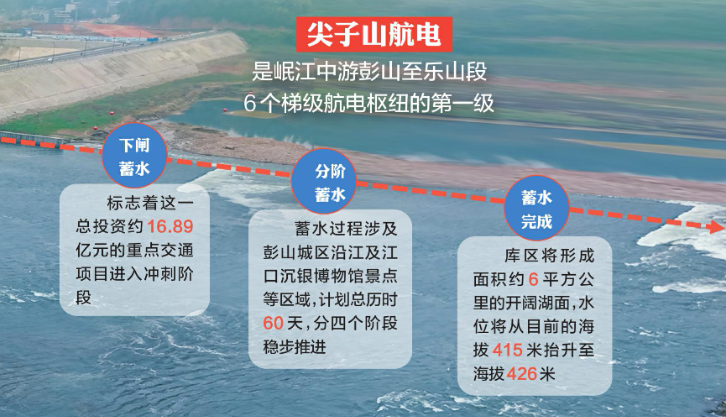
Core Insights - The completion of the dam construction at the Minjiang Pengshan Jianzi Mountain Hydropower Project marks a significant step towards the operational phase of this key provincial transportation project [1][2] - The project, with a total investment of approximately 1.689 billion yuan, integrates navigation and hydropower, while also addressing water environment management and flood control [1][2] Economic Benefits - The reservoir created by the project is expected to have an annual power generation capacity of approximately 285 million kilowatt-hours, benefiting local residents and businesses with stable clean energy [2] - The project will enhance flood control standards to withstand floods with a return period of 50 years, providing a protective barrier for urban areas against heavy rainfall and flooding [2] Navigation Value - The hydropower project will establish a four-level navigation channel capable of accommodating two 500-ton vessels simultaneously, significantly improving the navigation capacity of the Minjiang River [3] - This development will facilitate the establishment of a multi-modal transportation system in the Chengdu metropolitan area, reducing logistics costs for businesses by enabling water transport of bulk goods [3] Tourism Development - The newly formed lake will integrate with local tourist attractions, creating a "golden waterway tourism line" that connects various scenic spots, enhancing the region's cultural and natural tourism offerings [4] - Future plans include the construction of passenger terminals and the promotion of water sports, further integrating tourism and sports industries in the area [4]
岷江彭山尖子山航电枢纽工程 下闸蓄水 将现“西湖级”湖面
Si Chuan Ri Bao· 2025-12-16 00:23
Core Viewpoint - The successful completion of the reservoir filling at the Mijiang Pengshan Jianzi Mountain Navigation and Hydropower Hub marks a significant milestone for this key provincial transportation project, which is now entering the final stages before power generation [4]. Investment and Financial Summary - The total investment for the Mijiang Pengshan Jianzi Mountain Navigation and Hydropower Hub project is approximately 1.689 billion yuan [4]. - The expected annual power generation capacity of the project is around 285 million kilowatt-hours, with a total installed capacity of 69 megawatts [5]. Environmental and Safety Benefits - The reservoir filling process will raise the water level by 11 meters, reaching a normal water level of 426 meters above sea level, creating a lake area of about 6 square kilometers, comparable to West Lake in Hangzhou [5]. - The flood control standard for the reservoir area is designed to withstand a 1 in 50-year flood event, enhancing urban flood safety through improved water regulation capabilities [5]. Navigation and Logistics Impact - The hub will establish a four-level navigation channel capable of accommodating two 500-ton vessels simultaneously, significantly improving the navigation capacity of the Mijiang River [6]. - The project will facilitate the development of a multi-modal transport system in the Chengdu metropolitan area, linking water transport with rail and road networks, thus enhancing logistics efficiency [6]. Cost Reduction for Enterprises - Companies in Chengdu, Deyang, Mianyang, and Meishan will benefit from reduced logistics costs, as water transport is significantly cheaper than road and rail options, with costs being approximately 1/6 of road transport and 1/3 of rail transport [7]. Tourism Development - The newly formed lake will integrate with local tourist attractions, creating a "golden waterway tourism line" that connects various scenic spots, enhancing cultural and recreational opportunities [8]. - Future plans include the development of a passenger terminal cluster and the promotion of water sports, contributing to the integration of tourism and sports industries [8].