湿地恢复

Search documents
近5年,三江源国家公园水源涵养量年均增长6%以上 “中华水塔”生态屏障,这样加固(生态治理中的中国智慧)
Ren Min Ri Bao· 2025-10-30 22:27
Core Viewpoint - The 20th Central Committee of the Communist Party emphasizes the importance of strengthening ecological security barriers, with specific measures taken in the Qinghai Golog Tibetan Autonomous Prefecture to protect the source of the Yangtze, Yellow, and Lancang rivers, known as the "Chinese Water Tower" [1] Group 1: Glacier Protection - The Animaqing Mountain, which has over 120 square kilometers of glaciers, provides approximately 35% of the water source for the upper reaches of the Yellow River, serving as a crucial ecological barrier for the Sanjiangyuan region [3][4] - Local measures include three-dimensional glacier monitoring and artificial water augmentation to protect glaciers, with the snow accumulation period extended and glacier melting rates effectively reduced [6] Group 2: Black Soil Desertification Control - The restoration of black soil wasteland and degraded grasslands has been a focus, with 5.1664 million acres of such areas treated in Golog Prefecture [8] - The Deerni Copper Mine has completed ecological restoration, and innovative methods have been employed to restore vegetation at high altitudes, including the use of composite soil made from local materials [7][8] Group 3: Wetland Restoration - Golog Prefecture has implemented a collaborative restoration approach for grasslands, watersheds, and wetlands, increasing the number of lakes from 4,000 to over 5,800 through continuous governance [9] - The region aims to restore 100,000 acres of wetlands during the 14th Five-Year Plan period, with an average annual increase of over 6% in water source conservation capacity in the Sanjiangyuan National Park [9]
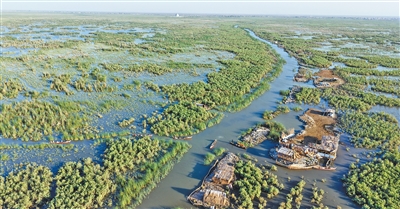
湿地恢复 传统延续
Ren Min Ri Bao· 2025-06-11 22:11
Core Viewpoint - The Mesopotamian Marshes, located at the confluence of the Euphrates and Tigris rivers in southern Iraq, are experiencing a revival due to government efforts to protect the wetlands and promote tourism, following decades of decline caused by climate change and other factors [4]. Group 1: Environmental and Ecological Aspects - The Mesopotamian Marshes are one of the largest inland delta systems in the world, showcasing a unique ecological landscape with winding rivers and lush vegetation [2]. - The area was designated as a UNESCO World Heritage site in 2016, highlighting its global ecological significance [4]. Group 2: Socioeconomic Impact - Local fishermen, such as Khalid Jassim, have shifted from traditional fishing to providing tour guide services for visitors, indicating a transition towards tourism as a primary source of income [4]. - The shrinking of wetland areas over the past decades has led to significant outmigration of local populations, but recent protective measures have encouraged some residents to return and engage in traditional industries like tourism [4].