潜动作学习

Search documents
LatBot:中科院团队提出潜在动作蒸馏,提升机器人VLA小样本迁移效率
具身智能之心· 2025-12-04 00:04
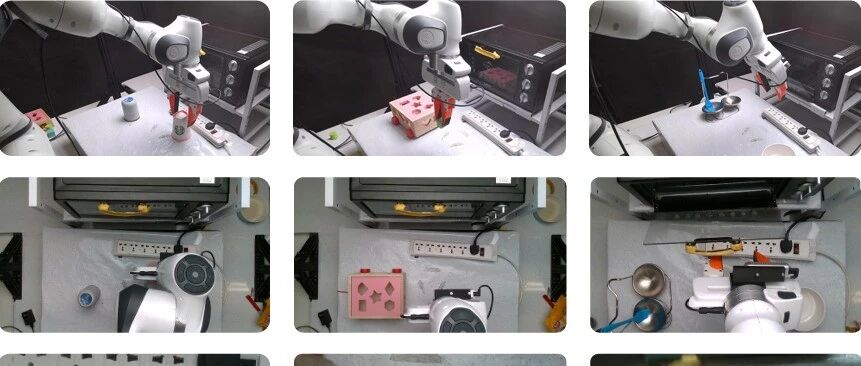
Group 1 - The core viewpoint of the article emphasizes the importance of latent action learning in vision-language-action (VLA) models, aiming to extract compressed motion semantics from continuous frames to create a universal representation independent of robotic entities [2] - Existing latent action models (LAM) face three main challenges: lack of task instruction guidance, insufficient utilization of multi-frame information, and an overemphasis on visual appearance changes without physical perception [2] Group 2 - The proposed method involves decoupling latent action representation into two complementary learnable tokens: scene tokens for capturing passive environmental changes and motion tokens for encoding active robotic movements [4][7] - A unified decoder is designed to condition latent actions, jointly guiding future frame reconstruction and inter-frame action generation, initialized from a pre-trained image generation model [5] Group 3 - The knowledge distillation strategy for transferring latent action knowledge to the VLA model includes two loss components: latent action alignment loss and reasoning retention loss, ensuring the student model learns physical perception while retaining reasoning capabilities [8][9] - The overall distillation objective balances latent action alignment and reasoning retention, with a specific focus on fine-tuning to convert latent representations into executable robotic actions [9] Group 4 - Experimental results demonstrate the proposed framework's superior performance in both simulation and real robot environments, particularly in few-shot transfer scenarios across five complex tasks [10][12] - The combination of decoupled latent action representation and unified action decoder significantly enhances success rates, validating the effectiveness of the design [13] Group 5 - The article concludes that through task instruction guidance, multi-frame input utilization, and the integration of physical priors, a universal and transferable latent action representation can be learned [18] - Future directions include extracting additional latent tokens from larger and more diverse operation videos to further expand the VLA model's capabilities in complex, long-range, multi-entity robotic tasks [18]