
潮汐瓦解事件

Search documents
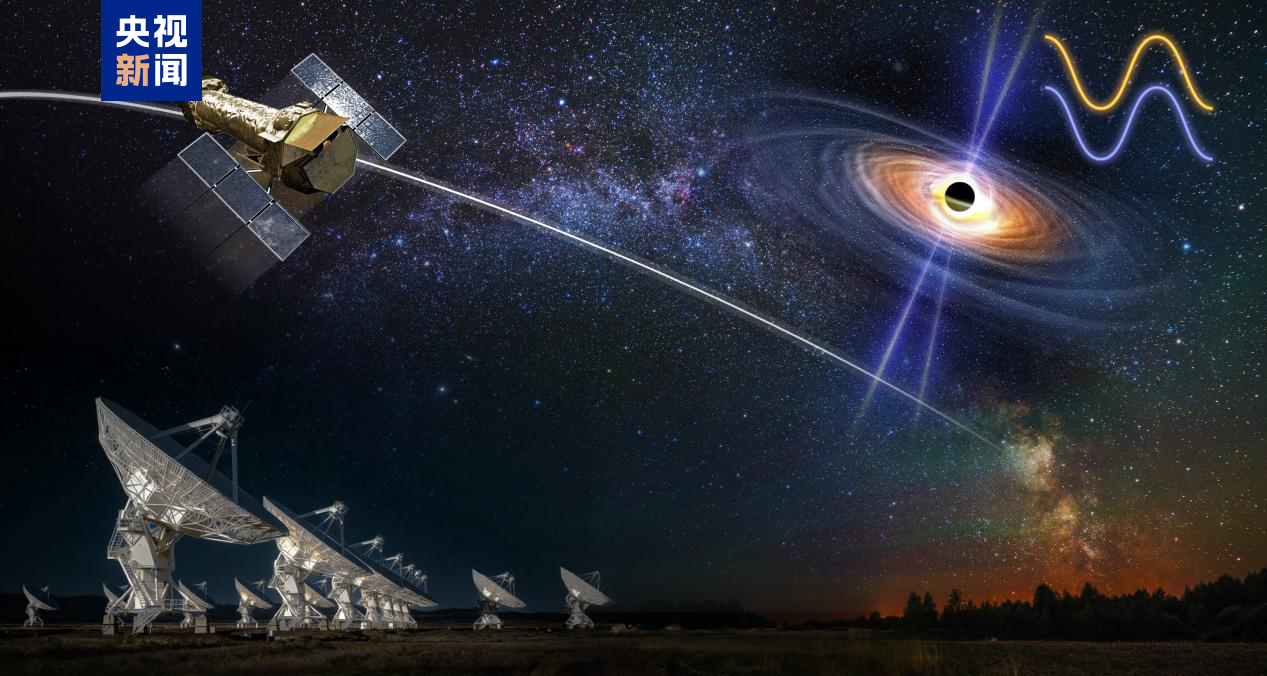
黑洞吸积盘和喷流“共舞”最有力证据发现
Ke Ji Ri Bao· 2025-12-12 01:31
Core Insights - The research team has provided strong evidence that the accretion disk and jets of a black hole "dance" in sync during the process of the black hole consuming a star, offering crucial insights into the formation mechanisms of black hole accretion and jets [1][2]. Group 1: Research Findings - The study focused on the tidal disruption event (TDE) AT2020afhd, located 120 million light-years away in the galaxy LEDA 145386, revealing significant findings [2]. - After 215 days of optical observation, the X-ray brightness of the event exhibited dramatic fluctuations every 19.6 days, with an amplitude exceeding 10 times, while the radio wave brightness also fluctuated with an amplitude over 4 times, indicating a synchronized oscillation between the accretion disk and jets [2]. - The phenomenon suggests that the accretion disk and jets operate as a cohesive unit, akin to a spinning top, moving rhythmically in response to the black hole's activity [2]. Group 2: Theoretical Implications - The observed "dance" may be linked to the "Lense-Thirring effect" predicted by general relativity, where a rotating black hole drags the surrounding spacetime, causing the tilted accretion disk and the perpendicular jets to oscillate together [2]. - This research marks the first time evidence of the coordinated motion of the accretion disk and jets has been captured on the same timescale [2]. Group 3: Future Research Directions - The phenomenon may be more common than previously thought, with past observational limitations hindering its discovery [3]. - Ongoing and future projects like the Sky Survey and Einstein Probe are expected to conduct extensive, multi-band, and high-frequency monitoring across the sky, likely leading to the discovery of more such events and enhancing the understanding of black hole accretion physics [3].
黑洞吸积盘与喷流研究取得最新进展
Yang Shi Xin Wen· 2025-12-11 11:24
Core Viewpoint - The research led by the National Astronomical Observatories of the Chinese Academy of Sciences provides strong observational evidence of the co-rotation of black hole accretion disks and jets during the tidal disruption event (TDE) AT2020afhd, published in the journal "Science Advances" [1][4]. Group 1: Tidal Disruption Event (TDE) Overview - TDEs occur when a star approaches a supermassive black hole at the center of a galaxy and is torn apart by tidal forces, resulting in a hot accretion disk that emits strong radiation, serving as a crucial window for studying black hole activation and relativistic jets [1]. - The specific TDE AT2020afhd is located at the center of galaxy LEDA 145386, approximately 120 million light-years from Earth, and was discovered in January 2024 due to a significant increase in brightness [1]. Group 2: Observational Findings - The research team conducted a year-long, multi-band monitoring campaign using various telescopes, including the Swift space X-ray telescope and ground-based optical telescopes, to observe the TDE [1][3]. - Analysis revealed significant quasi-periodic oscillations in X-rays with a period of approximately 19.6 days and an amplitude exceeding 10 times, alongside synchronous changes in the radio band with an amplitude over 4 times, indicating a rigid connection between the accretion disk and the jet [3]. Group 3: Physical Mechanism and Implications - The observed co-rotation of the accretion disk and jet is likely due to the Lense-Thirring effect, where a rotating black hole drags surrounding spacetime, causing the tilted accretion disk and perpendicular jet to precess [3]. - This research marks the first clear observation of accretion disk-jet co-rotation in a black hole system, highlighting the challenges of long-term monitoring, which has been rare in previous studies focused on the early stages of TDEs [3][4]. Group 4: Future Research Directions - The developed model for accretion disk-jet co-rotation successfully reproduced the X-ray and radio light curves and provided clear constraints on the system's geometry, black hole spin, and jet velocity [4]. - The phenomenon may be more common than previously thought, and with ongoing deep, multi-band, and high-frequency monitoring efforts, more examples are expected to be discovered, enhancing the understanding of black hole accretion physics [4].

新研究揭示迄今观测的最亮黑洞爆发可能成因
Xin Hua She· 2025-11-11 01:35
Core Insights - Researchers from Caltech and other institutions have observed the brightest black hole eruption known to date, with peak brightness exceeding 10 trillion times that of the Sun [1][2] - The event is believed to be caused by a star with a mass over 30 times that of the Sun being torn apart and consumed by a supermassive black hole [1][2] Group 1 - The eruption was first detected in 2018 by the Zwicky Transient Facility and the Catalina Real-time Transient Survey, but its significance as a supermassive black hole eruption was not initially recognized [1] - The brightness of the celestial body increased approximately 40 times within months of its discovery, remaining exceptionally bright until 2023, indicating an unusual energy release process [1] - The event is located about 10 billion light-years away, and researchers utilized the Keck Observatory in Hawaii for further observations [1] Group 2 - The black hole responsible for the event is situated in an active galactic nucleus, which is a highly energetic astrophysical system formed by a supermassive black hole consuming surrounding material [2] - The scale of this super eruption allowed it to be identified despite the potential masking effects of the active galactic nucleus's own flaring activity [2] - Ongoing observations will focus on whether the brightness of the star will gradually dim or if it will erupt again after interacting with surrounding gas and dust [2]
科研人员发现一恒星与黑洞相遇后“幸存”
Xin Hua She· 2025-07-30 02:53
Core Insights - An international research team led by Tel Aviv University has observed a star surviving a tidal disruption event caused by a supermassive black hole, returning to the vicinity of the black hole approximately two years later, marking a rare phenomenon [1] Group 1: Research Findings - The study published in the Astrophysical Journal Letters indicates that nearly every large galaxy's center contains a supermassive black hole with a mass ranging from millions to billions of times that of the Sun [1] - Tidal disruption events occur when a star wanders close to a black hole, resulting in the star being torn apart and producing a bright flare, providing a brief observational window for scientists [1] - The researchers observed a flare named "AT 2022dbl" in 2022 and captured a nearly identical flare in the same location two years later, confirming that the star was not completely consumed by the black hole [1] Group 2: Future Observations - The research team plans to observe whether a third flare will occur in early 2026, which would support the hypothesis that the second flare also resulted from partial disruption of the star [2] - If a third flare is not observed, it may indicate that the second flare signifies the complete disruption of the star [2]