
超大质量黑洞

Search documents
宇宙中的神秘“小红点”是什么?
Ke Ji Ri Bao· 2026-01-16 02:16
Core Insights - The James Webb Space Telescope has detected a series of unusual "red dots" in the early universe, which are not typical galaxies but emit a faint red glow, suggesting they may hold significant information about cosmic evolution [1][2] - Initial hypotheses proposed that these objects could either be young galaxies forming stars or supermassive black holes, but their spectral characteristics do not align with known models for either category [1][2] Group 1 - The spectral features of these red dots match a theoretical scenario where photons interact with dense gas clouds around black holes, leading to energy loss and a redshift effect [2] - The actual size of these black holes may be only one percent of previous estimates, indicating that they are in an early developmental stage rather than being fully matured cosmic entities [2] - The study raises questions about the weak X-ray emissions from these bodies, which could be due to gas absorption or unique black hole accretion processes [2] Group 2 - The ongoing observations by the James Webb Space Telescope and future advanced telescopes aim to uncover the growth history of these black holes, exploring how they evolve from small seeds to central gravitational forces in galaxies [2][3] - The findings represent the first insights into the "childhood" of black holes, with these red dots serving as a mysterious clue in understanding their early development [3]
韦布望远镜发现早期宇宙超大质量黑洞
Xin Hua She· 2025-11-21 02:49
Core Insights - The European Space Agency reported the discovery of an actively growing supermassive black hole in a galaxy just 570 million years after the Big Bang, which could reveal key mechanisms behind the origins of black holes and galaxies [1] Group 1: Discovery Details - Researchers utilized the James Webb Space Telescope's near-infrared spectrograph to detect faint light from the distant galaxy CANUCS-LRD-z8.6 [1] - Analysis of the galaxy's spectral features indicates the presence of an accreting black hole that is growing at a rate exceeding expectations [1] Group 2: Characteristics of the Galaxy - The galaxy is described as very dense and has not yet produced a significant amount of heavy elements, confirming its status as an early-stage galaxy [1] - The gas within the galaxy shows signs of strong ionization from high-energy radiation and rapid rotation around a central source, which are key characteristics of an accreting supermassive black hole [1] Group 3: Implications for Black Hole Growth - Notably, the mass of the black hole in this galaxy is disproportionately large compared to the stellar mass, suggesting that black holes may grow faster than their host galaxies in the early universe [1] - This observation challenges the previously established correlation between the mass of supermassive black holes and their host galaxies, indicating that black holes could form and accelerate growth even in relatively small galaxies during the early universe [1]
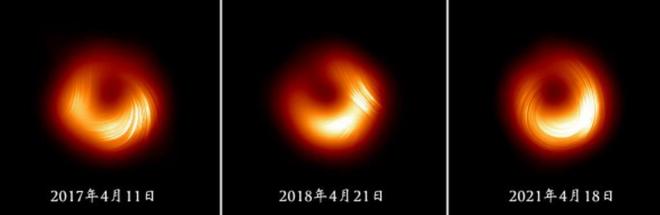
M87星系中心超大质量黑洞新图像发布
Huan Qiu Wang Zi Xun· 2025-09-19 03:01
Core Insights - The Event Horizon Telescope (EHT) collaboration, involving the Shanghai Astronomical Observatory, has released new images of the supermassive black hole at the center of the M87 galaxy, revealing the evolution of polarized radiation over time [1][3]. Group 1: Research Findings - Scientists have discovered extended radiation connecting the black hole's ring structure to the base of its jets for the first time in EHT data [3]. - The M87 black hole is located 55 million light-years from Earth and has a mass approximately 6.5 billion times that of the Sun [3]. - The polarization direction of the black hole changed significantly from 2017 to 2021, indicating a reversal in 2021 after being stable in 2018 [3]. Group 2: Implications of Findings - The evolution of polarization reflects the turbulent environment around the black hole, with magnetic fields playing a crucial role in how matter falls into the black hole and how energy is released [3]. - Powerful jets like those from M87 influence star formation and energy distribution on a large scale, contributing to galaxy evolution [3]. - The latest findings provide important insights into the mechanisms behind extreme cosmic phenomena, acting as a unique "laboratory" for research [3]. Group 3: Technological Advancements - The EHT has enhanced its observational capabilities, improving sensitivity and imaging clarity with the addition of new telescopes in 2021 [4]. - Upgrades to existing telescopes, including those in Greenland and the James Clerk Maxwell Telescope, have further improved data quality [4].

最古老黑洞已有133亿岁“高龄”
Ke Ji Ri Bao· 2025-08-12 07:23
Core Insights - An international team of astronomers led by scientists from the University of Texas at Austin has discovered a supermassive black hole that existed just 500 million years after the Big Bang, with a mass equivalent to 300 million suns, setting a record for the oldest known black hole at 13.3 billion years old [1][2] Group 1 - The discovery was made using the James Webb Space Telescope, which captured spectral data from the galaxy CAPERS-LRD-z9, revealing its unique "little red dot" characteristics typical of galaxies formed in the early universe [1] - The supermassive black hole is identified as the source of the galaxy's unexpected brightness, and it is capable of generating immense light and energy by compressing and heating the material it consumes [1][2] Group 2 - The findings regarding the galaxy may help explain the bright red appearance of "little red dot" galaxies, potentially due to a thick gas cloud surrounding the black hole that distorts light into redder wavelengths [2] - The existence of such a massive black hole in the early universe provides valuable opportunities to study the evolutionary history of these celestial bodies, suggesting either an extraordinarily high "primitive weight" at birth or a growth rate significantly faster than current models predict [2]
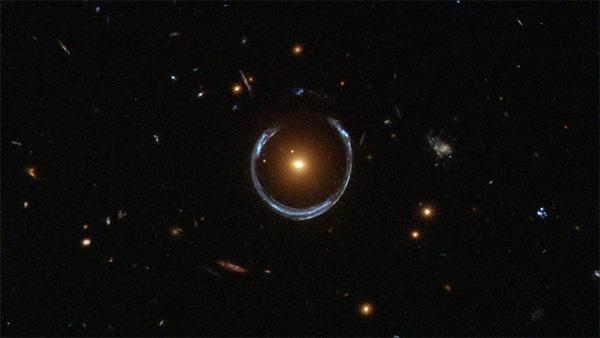
迄今最大?科学家发现质量为太阳363亿倍的黑洞
Guan Cha Zhe Wang· 2025-08-08 06:56
Core Insights - Astronomers have discovered a black hole with a mass approximately 36.3 billion times that of the Sun, potentially the largest black hole detected to date [1][3] Group 1: Discovery and Measurement - The black hole is located in the "Cosmic Horseshoe" galaxy, which is one of the most massive known galaxies [1] - The research team, led by Professor Thomas Collett from the University of Portsmouth, measured the speed of stars orbiting the black hole and the degree of light bending caused by its gravity to confirm its existence [3] - The black hole's mass was determined through a combination of these measurements, with stars moving at speeds nearly reaching 400 kilometers per second [3] Group 2: Implications and Context - The discovery aligns with previous research indicating that a supermassive black hole must exist at the center of the "Cosmic Horseshoe" for the model of dark matter distribution to match observational data [3] - This black hole is categorized as a "sleeping" black hole, meaning it is not actively accreting material, and its detection relies solely on its immense gravitational influence [3][4] - The findings provide new insights into the relationship between supermassive black holes and their host galaxies, suggesting that the black hole may have formed from the merger of supermassive black holes from satellite galaxies [4]
科研人员发现一恒星与黑洞相遇后“幸存”
Xin Hua She· 2025-07-30 02:53
Core Insights - An international research team led by Tel Aviv University has observed a star surviving a tidal disruption event caused by a supermassive black hole, returning to the vicinity of the black hole approximately two years later, marking a rare phenomenon [1] Group 1: Research Findings - The study published in the Astrophysical Journal Letters indicates that nearly every large galaxy's center contains a supermassive black hole with a mass ranging from millions to billions of times that of the Sun [1] - Tidal disruption events occur when a star wanders close to a black hole, resulting in the star being torn apart and producing a bright flare, providing a brief observational window for scientists [1] - The researchers observed a flare named "AT 2022dbl" in 2022 and captured a nearly identical flare in the same location two years later, confirming that the star was not completely consumed by the black hole [1] Group 2: Future Observations - The research team plans to observe whether a third flare will occur in early 2026, which would support the hypothesis that the second flare also resulted from partial disruption of the star [2] - If a third flare is not observed, it may indicate that the second flare signifies the complete disruption of the star [2]
国际团队观测到一超大质量黑洞喷射出子弹般气体团块
news flash· 2025-05-18 05:05
Core Insights - An international team, including researchers from the University of Tokyo, has observed a supermassive black hole ejecting gas blobs at high speeds, located approximately 2 billion light-years from Earth [1] Group 1 - The research was published in the latest issue of the journal Nature, highlighting the significance of the findings in understanding black hole dynamics [1] - The Japan Aerospace Exploration Agency announced that the study aims to clarify the relationship between supermassive black holes and their host galaxies, which is still not fully understood [1] - The key to unraveling this mystery lies in the "wind" emitted by black holes into the surrounding space, which may influence galaxy evolution [1]