火星生命探索

Search documents
在火星上寻找生命,有新发现!
Xin Hua Wang· 2026-01-02 13:18
Core Insights - A new study identifies the largest 16 ancient river basins on Mars, considered the most promising areas for the search for extraterrestrial life [2] Group 1: Research Findings - The identified regions on Mars are shaped by large river systems, similar to Earth's most fertile ecosystems, which host a diverse range of species [2] - Researchers from the University of Texas at Austin analyzed previously published data on Martian valleys, lakes, and river features, discovering 19 major valleys, streams, lakes, canyons, and sediment groups, with 16 forming interconnected basins of at least 100,000 square kilometers [2] - These large river basins, while only covering about 5% of Mars' surface area, contribute approximately 42% of the river-erosion sediment on Mars, making them key targets for finding evidence of past life [2]


在火星上寻找生命,有新发现
Zhong Guo Ji Jin Bao· 2026-01-01 17:05
Core Insights - A new study identifies the largest 16 ancient river basins on Mars as the most promising areas for searching for extraterrestrial life [1][2] - These regions, shaped by large river systems, are believed to have once harbored liquid water, creating conditions favorable for life [1] Group 1: Research Findings - The research was conducted by scientists from the University of Texas at Austin, who analyzed previously published data on Martian valleys, lakes, and river features [1] - The study found 19 major valleys, streams, lakes, canyons, and sediment groups on Mars, with 16 of them forming interconnected basins of at least 100,000 square kilometers [1] - Although these large basins account for only about 5% of Mars' surface area, they contribute approximately 42% of the river-erosion sediments on the planet [1] Group 2: Implications for Life Search - Large river systems are believed to transport more nutrients, which can help sustain diverse ecosystems [1] - The interaction between water and rock increases with distance, leading to more chemical reactions that may indicate signs of life [1] - These sediment-rich locations are considered primary targets for finding evidence of past life, although further research is needed to accurately determine the final deposition locations of these sediments [1]
新研究发现火星上寻找生命的最佳地点
Xin Hua She· 2026-01-01 07:47
Core Insights - Mars has been identified as a prime target for extraterrestrial life research, with a new study pinpointing the largest 16 ancient river basins as the most promising areas for finding life [1] Group 1: Research Findings - The study reveals that Mars has 19 major valleys, streams, lakes, canyons, and sediment groups, with 16 of these forming interconnected basins covering at least 100,000 square kilometers each [1] - These large river systems are believed to have provided favorable conditions for life by transporting nutrients, similar to Earth's most fertile ecosystems [1] - Although these large basins account for only about 5% of Mars' surface area, they contribute approximately 42% of the river-erosion sediment on Mars, making them key targets for evidence of past life [1]
解开“火星生命之谜”还得多久?
Ke Ji Ri Bao· 2025-10-23 09:15
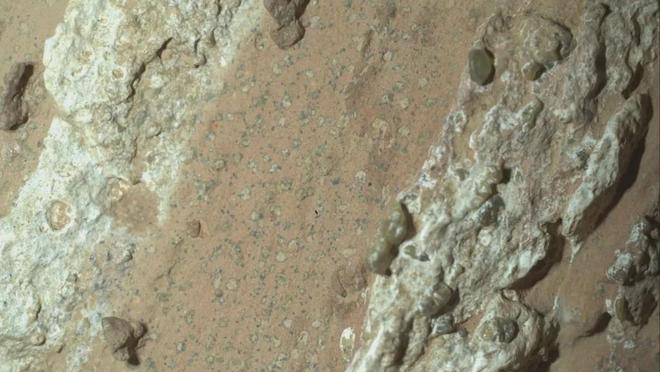
Core Insights - NASA's Perseverance rover has made significant discoveries that suggest the possibility of ancient microbial life on Mars, particularly in the Jezero Crater [1][2] - The findings include unique rock samples that may contain evidence of biological activity dating back 3.5 billion years [1][3] Group 1: Discovery Details - The Perseverance rover identified a rock layer called "Bright Angel" in the Nerretwa Canyon, which may have formed in a water-rich environment [2][3] - The rover found green spots, referred to as "poppy seeds," containing a phosphorus-rich mineral called blue iron ore [2][3] - The "Chiawa Falls" rock sample contains small circular structures known as "leopard spots," which are composed of iron minerals that could indicate past microbial activity [2][3] Group 2: Scientific Interpretation - Researchers are cautious in labeling these findings as definitive signs of life, preferring the term "potential biosignatures" [3][4] - The study emphasizes the need for multiple lines of evidence to confirm any signs of life, as non-biological processes could produce similar mineral formations [4][5] - The current evidence is considered indirect, and further analysis is required to establish a direct link to ancient life [3][5] Group 3: Future Exploration - Returning Martian samples to Earth is deemed crucial for validating the findings and conducting more advanced analyses [5][6] - Various countries, including China, are advancing their Mars exploration missions, with plans for sample return missions to further investigate potential life signs [6][7] - The European Space Agency's Rosalind Franklin rover is also set to join the Mars exploration efforts, highlighting the global interest in uncovering the mysteries of Martian life [7]
美国航天局宣布:在火星上发现生命迹象,“这是最明显的一次”!NASA局长:正研究如何带回样本,会找白宫要钱!此前被特朗普削减预算
Mei Ri Jing Ji Xin Wen· 2025-09-11 12:59
Core Points - NASA's Perseverance rover has discovered what is considered the "most obvious signs of life" on Mars, marking a significant milestone in Mars research over the past 30 years [1][2] - The discovery involves organic carbon and iron compounds found in the Jezero crater, which are similar to chemical structures on Earth that indicate the presence of life [2][4] Group 1: Discovery Details - The samples collected by the Perseverance rover show unusual spots and seed-like shapes in ancient Martian rocks, suggesting the possibility of past microbial life [2][4] - The features, referred to as "leopard spots," were found in the mudstone of the Jezero crater, an area that was once home to a river billions of years ago [2][4] - Chemical substances such as iron and phosphorus detected in the rocks are indicative of the decomposition of organic matter, a hallmark of early life on Earth [4][5] Group 2: Scientific Implications - Scientists believe that the samples' texture, chemical, and mineral characteristics warrant consideration of the possibility of life [6] - The discovery has prompted discussions among scientists about the need for more advanced laboratory facilities on Earth to analyze the samples thoroughly [6][7] Group 3: Future Plans and Challenges - NASA's Mars sample return mission has been delayed due to budget overruns and complexity, with a target to bring samples back to Earth between 2035 and 2039 [8][10] - NASA is exploring cost-effective commercial partnerships and plans to finalize the mission's structure by mid-2026 [8] - The agency's future missions include the Artemis program, which aims to establish a sustainable human presence on the Moon [11]

“火星上发现新的生命迹象”
Guan Cha Zhe Wang· 2025-09-11 06:31
Core Viewpoint - NASA's Perseverance rover has discovered unique mudstones on Mars, which may provide the clearest signs of potential ancient life on the planet, characterized by distinctive markings referred to as "leopard spots" and "poppy seeds" [1][3][4] Group 1: Discovery Details - The mudstones, approximately 3.5 billion years old, were found in the Bright Angel Formation, an area previously shaped by river activity [7] - The features observed in the rocks could be explained by biological processes if they were found on Earth, suggesting a possible link to ancient Martian microorganisms [3][4][7] - NASA has classified these findings as "potential biosignatures," warranting further investigation to determine their biological origin [1][3] Group 2: Scientific Implications - The analysis indicates that a series of chemical reactions occurred in the sediment, potentially involving interactions between mud and organic materials, leading to the formation of new minerals [7][8] - While natural geological processes could also explain the mineral formation, the absence of high temperatures in the rocks suggests a biological influence [7][8] - The only definitive way to confirm the microbial origin of these minerals would be to return the samples to Earth for analysis, a plan currently facing budget cuts [3][8] Group 3: Future Missions - NASA's plans for a Mars sample return mission are uncertain due to budget constraints outlined in the proposed 2026 fiscal budget [3][8] - In contrast, China's Tianwen-3 mission aims to launch in 2028 and return samples by 2031, potentially achieving a historic milestone in Mars exploration [10]