
热核聚变

Search documents
合锻智能2025年预亏扩大,中标核聚变项目
Jing Ji Guan Cha Wang· 2026-02-12 01:29
Core Insights - The company is expected to report a net loss of between 180 million to 260 million yuan for the year 2025, indicating an increase in losses compared to the previous year [1] Financial Performance - The company announced on January 24, 2026, that it anticipates a net profit loss attributable to shareholders of 180 million to 260 million yuan for 2025, with losses expected to widen year-on-year [1] Project Development - On January 23, 2026, the company won a bid for the "BEST Shielding Layer System Stainless Steel Shielding Block Procurement Project" related to fusion energy, with a contract value of approximately 36.81 million yuan. The project has entered the execution phase, and subsequent delivery progress will be closely monitored [1] Industry Policy Landscape - The "Atomic Energy Law," set to be implemented in 2026, explicitly encourages the development of thermal nuclear fusion, which may have a long-term impact on the company's involvement in fusion-related business [1]

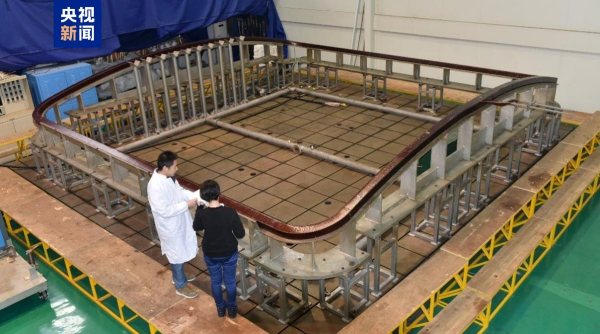
【央视新闻】国际热核聚变实验堆校正场线圈采购包任务在合肥竣工交付
Yang Shi Xin Wen· 2025-12-29 03:02
Core Insights - The completion of the procurement package for the ITER correction field coils marks a significant milestone in the international nuclear fusion project, with all manufacturing tasks finalized and delivered in Hefei [1] - The correction field coils consist of three groups of 18 coils, crucial for the magnetic system of the ITER device, impacting plasma operation parameters directly [1] - The entire procurement package was developed and manufactured independently by China, with a project timeline of 15 years, establishing a robust support system for research and application in the fusion field [1] Group 1 - The last batch of four coils' completion signifies the successful conclusion of the ITER correction field coil project [1] - The correction field coils are distributed evenly across the top, middle, and bottom areas of the ITER main device [1] - The successful development and timely installation of these coils are critical for the operational parameters of the ITER plasma [1] Group 2 - The project team has built a comprehensive support system that includes standards, patents, and multiple specialized laboratories [1] - This achievement provides strong support for China's fundamental research and applications in the field of fusion [1]

【中国新闻网】中国交付国际热核聚变实验堆重要磁体系统
Zhong Guo Xin Wen Wang· 2025-12-29 03:02
Core Insights - The International Thermonuclear Experimental Reactor (ITER) correction field coil procurement package has completed all manufacturing tasks, with the final four coils successfully delivered [1] - The correction field coils consist of three groups of 18 coils, distributed evenly across the top, middle, and bottom regions of the ITER device, and are crucial to the magnetic system of the ITER device [1] - The successful development and timely installation of the correction field coils directly impact the plasma operating parameters of the ITER device [1] Company Contributions - The ITER correction field coil procurement package was entirely developed and manufactured by China, with the project team spending 15 years on research and development before completion [1] - The project team has also established a comprehensive support system that includes standards, patents, and multiple specialized laboratories, providing strong support for China's research and application in the fusion field [1] - The Hefei Institute of Physical Science, part of the Chinese Academy of Sciences, is a key unit of the ITER China working group, responsible for numerous procurement packages and engineering assembly, accounting for the majority of China's share in the ITER project [1]
高功率电磁波源及其系统研讨活动在京举办
Ke Ji Ri Bao· 2025-09-15 09:29
Core Insights - The seminar on high-power electromagnetic wave sources and systems was held in Beijing, supported by the China Association for Science and Technology and organized by the China Society of Technology Economics, with participation from over 20 experts from universities, research institutes, and enterprises [1] Group 1: Research and Development Progress - The seminar featured key reports, including one by Professor Gong Yubin from the University of Electronic Science and Technology, discussing advancements in terahertz radiation sources based on two-dimensional electron gas and micro vacuum electronic terahertz sources [1] - Chief Scientist Feng Jinjun from China Electronics Technology Group Corporation shared research results on millimeter-wave terahertz traveling wave tubes and their applications in high-speed wireless communication and satellite radar [1] - Professor He Wenlong presented on the development of megawatt high-power cyclotron tubes for nuclear fusion heating, highlighting progress in terahertz cyclotron amplifiers and free electron extreme ultraviolet lasers [1][2] Group 2: Key Challenges and Innovations - Terahertz wave sources face challenges such as insufficient output power, limited bandwidth, and poor system stability, which restrict their application in high-end research and engineering [2] - The team achieved significant progress by introducing helical waveguide technology, resulting in a high-power (10 kW) and wideband (20 GHz) traveling wave amplifier design [2] - The megawatt-level long-pulse cyclotron tube designed for nuclear fusion represents a core technological breakthrough, marking the first successful application in this field in China [2] Group 3: Expert Recommendations and Future Directions - Experts emphasized the importance of finding key applications for high-power electromagnetic wave sources in healthcare and other industries [3] - Recommendations included accelerating technology iteration and industrialization, fostering interdisciplinary talent development, and enhancing collaboration within the industry to promote the overall development of high-power electromagnetic wave source technology in China [3][4] - Future research should focus on disruptive technologies with significant industrial applications, such as laser-driven free electron extreme ultraviolet lasers and medical high-gradient accelerators, while promoting the integration of research, education, and application [4]