熬人模式

Search documents
出差时突发疾病,上海知名科创投资人朱旭东离世
Xin Lang Cai Jing· 2026-01-27 04:57
Core Viewpoint - The news reports the passing of Zhu Xudong, a prominent figure in the semiconductor investment sector, who died on January 25, 2026, at the age of 62 due to an illness while on a business trip in Haikou [1][5][12]. Company Overview - Shanghai Semiconductor Equipment Materials Industry Investment Management Co., Ltd. (referred to as "Shanghai Semiconductor Investment") was established in January 2018 and completed registration with the Asset Management Association of China on July 25, 2018 [4][11]. - The company focuses on investments in the semiconductor equipment, materials, and components sectors, managing over 8 billion yuan (approximately 1.2 billion USD) across various funds and having invested in over 50 semiconductor projects covering the entire industry chain [4][11]. Zhu Xudong's Contributions - Zhu Xudong was a doctoral graduate from Tongji University and held various leadership roles in the Shanghai Pudong New Area, including Chairman of Shanghai Pudong Science and Technology Investment Co., Ltd. from 2012 [4][12]. - He played a pivotal role in the acquisition and investment of significant high-tech companies, contributing to the development of China's semiconductor industry by addressing key shortcomings such as technology gaps and ecosystem deficiencies [6][12]. - Under his leadership, Shanghai Semiconductor Investment became a major platform for investments, focusing on long-term partnerships and strategic acquisitions to enhance technological capabilities within the semiconductor sector [14]. Investment Strategy - Zhu Xudong's investment philosophy, termed the "endurance model," emphasizes the importance of patience, human-centric investment, and strategic decision-making [14]. - The model highlights the significance of investing in the right people and maintaining a long-term commitment to the growth of the companies in which investments are made [14].

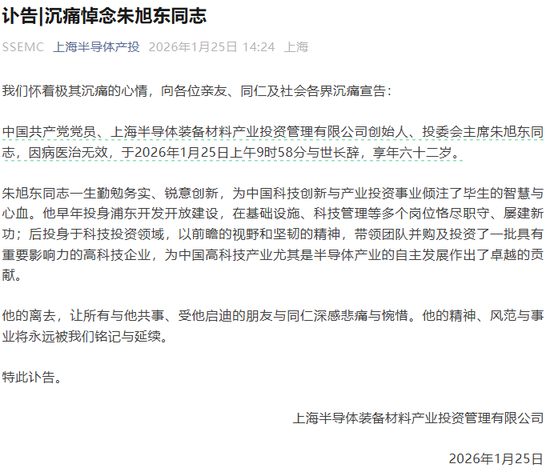
出差时突发疾病,上海知名科创投资人离世
母基金研究中心· 2026-01-27 04:14
Core Viewpoint - The article discusses the passing of Zhu Xudong, the founder and chairman of the Shanghai Semiconductor Equipment Materials Industry Investment Management Co., who significantly contributed to the semiconductor industry in China through strategic investments and leadership [2][5][6]. Company Overview - Shanghai Semiconductor Equipment Materials Industry Investment Management Co. was established in January 2018 and focuses on investing in the semiconductor equipment, materials, and components sectors, managing over 8 billion yuan in assets and having invested in more than 50 semiconductor projects across the entire industry chain [4][5]. - The company manages the Shanghai Semiconductor Equipment Materials Industry Investment Fund and several project-based funds, covering areas such as equipment, materials, components, EDA, design, manufacturing, and testing [4]. Zhu Xudong's Contributions - Zhu Xudong, a PhD from Tongji University and a senior engineer, held various leadership roles in technology and investment sectors before founding the company. He was instrumental in the establishment of the Shanghai Semiconductor Equipment Materials Industry Investment Fund and led significant investments in high-tech companies [4][5][6]. - He identified key shortcomings in China's semiconductor industry, such as the lack of technology, leading companies, and ecosystem, and initiated privatization efforts for overseas semiconductor firms [6]. - Zhu's investment strategy included a focus on long-term partnerships with key individuals in the industry, exemplified by his support for companies like Aojie Technology, which successfully went public on the STAR Market [7]. Recent Developments - Zhu Xudong's recent passing occurred during a business trip, which shocked many in the industry, highlighting his active role in project evaluations and investments until his last days [5][6]. - The company expressed its commitment to continue Zhu's vision and contributions to the semiconductor industry, emphasizing his impact on the autonomous development of China's high-tech sector [5].