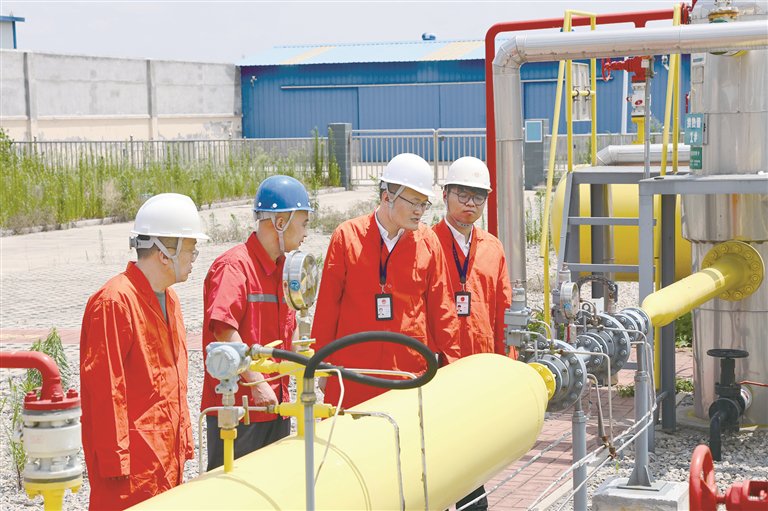
燃气安全治理

Search documents
从地下到灶台,把“生命线”织成“放心网”
Xin Lang Cai Jing· 2026-01-06 22:38
Core Viewpoint - The city is actively enhancing gas safety through comprehensive upgrades to both underground pipelines and indoor facilities, ensuring a more reliable and secure gas supply for residents [1][5]. Group 1: Pipeline Renovation - The city has completed the renovation of 2,625 kilometers of old gas pipelines, focusing on systematic upgrades rather than simple replacements, to eliminate underground hazards and ensure surface safety [2][5]. - The renovation process emphasizes minimal disruption to residents, employing strategies such as "less excavation, quick repair, and early gas supply" [2]. - New technologies, including laser detectors and pressure sensors, have been integrated into the pipeline system to monitor operational parameters continuously [2]. Group 2: Indoor Facility Upgrades - Since 2022, the city has upgraded gas facilities in 6.08 million households, achieving a completion rate of 99.5%, enhancing safety at the most vulnerable points in gas usage [3]. - The upgrades include replacing rubber hoses with metal corrugated pipes and installing automatic shut-off valves to prevent gas leaks [3]. - The implementation of IoT gas meters allows for real-time monitoring and alerts for abnormal gas usage, improving safety measures [3]. Group 3: Emergency Response and Smart Monitoring - The city has established a robust emergency response system with five city-level emergency teams to ensure preparedness during critical situations [5]. - A smart gas monitoring platform has been developed to utilize big data for intelligent hazard warnings and emergency coordination, shifting from reactive to proactive safety measures [5]. - The integration of underground pipeline management, indoor facility upgrades, monitoring, and emergency response creates a comprehensive safety network for gas supply [5][6].
深度关注 | 拧紧燃气安全“责任阀”
Zhong Yang Ji Wei Guo Jia Jian Wei Wang Zhan· 2025-07-24 00:34
Core Viewpoint - The Shandong Provincial Commission for Discipline Inspection and Supervision is enhancing supervision to ensure the effective implementation of gas safety responsibilities, emphasizing the importance of gas safety for public welfare and economic development [3][4][6]. Group 1: Gas Safety Governance - The Shandong Provincial Government has initiated a safety governance program for urban gas pipeline facilities, which is a key political supervision focus [3][4]. - The province has a significant number of gas users, totaling 31 million households and a pipeline network of 310,000 kilometers, indicating a high level of risk management required [4][5]. - The governance involves comprehensive inspections and updates, with 21,300 kilometers of municipal gas pipelines and over 3,600 gas stations inspected, and 3,605 kilometers of pipelines updated [5][6]. Group 2: Responsibility and Coordination - The supervision system aims to ensure that both primary and regulatory responsibilities are effectively implemented, with a focus on collaboration among various departments [6][7]. - The Shandong Provincial Commission emphasizes the need for a coordinated approach among 18 functional departments to avoid responsibility ambiguity and ensure effective pressure transmission [7][8]. - The integration of supervision efforts has led to the establishment of communication mechanisms between different departments, enhancing the efficiency of oversight [8][9]. Group 3: Public Engagement and Feedback - The local government has been actively analyzing public complaints related to gas services, identifying key issues such as service delays and safety hazards [9][10]. - A data-driven approach has been adopted to monitor and evaluate the effectiveness of gas service improvements, resulting in a reduction of monthly complaints from 317 to 109 and an increase in satisfaction from 75% to 82% [11][12]. - The implementation of new technologies, such as high-precision methane detection and AI monitoring systems, has improved the ability to manage gas safety risks [12][13]. Group 4: Industry Standards and Practices - The province is reforming the distribution of liquefied petroleum gas (LPG) to enhance safety, including standardized delivery and mandatory inspections [14][15]. - Gas delivery personnel are now trained to conduct safety inspections during deliveries, ensuring compliance with safety standards [15]. - The establishment of a comprehensive regulatory platform for LPG distribution aims to ensure traceability and accountability throughout the supply chain [15].