环保涂料

Search documents
百川股份:公司产品有出口到国外,价格有竞争优势
Ge Long Hui· 2026-02-09 13:34
Core Viewpoint - The company indicates that there is an increasing demand for TMP, primarily used in UV-curable coatings, which are more environmentally friendly due to the absence of VOC emissions [1] Group 1 - TMP is mainly utilized in UV-curable coatings, which are more environmentally friendly as they do not emit VOCs [1] - There is a growing downstream demand for TMP products [1] - The company exports its products internationally and has a competitive pricing advantage [1]

分解甲醛 96.5%!德国美阁乐除醛漆实测,150年品牌+七重保障筑牢健康防线
Zhong Guo Neng Yuan Wang· 2025-12-27 03:10
Core Viewpoint - The increasing consumer concern over indoor air quality, particularly regarding formaldehyde emissions from home renovations, is shifting the focus from aesthetic and cost considerations to "hardcore environmental protection + authoritative certification" in paint selection. This trend has led to the rise of functional formaldehyde-removing paints, with European brands like Megerle gaining attention for their long-standing commitment to environmental safety and multiple international certifications [1]. Group 1: Brand Heritage and Core Environmental Philosophy - Megerle, established in 1874 in Germany, is one of the oldest paint brands, founded with a vision for environmental protection, earning numerous patents for eco-friendly innovations [3]. - The brand has gained recognition in Europe, particularly in high-demand environments such as homes, schools, and hospitals, with over 26,000 kindergartens using Megerle paints, reflecting its reputation for safety and environmental quality [3]. - Key milestones in Megerle's history include the success of its high-gloss eco-friendly paint before World War II, the launch of the first water-based decorative paint in 1960, and the development of a patented formaldehyde-removing paint in 1990, marking a significant advancement in environmental technology [3]. Group 2: FTH Formaldehyde Removal Technology and International Certifications - The core technology of Megerle's formaldehyde-removing paint is the "FTH Formaldehyde Removal Technology," which involves a continuous catalytic reaction process to capture and decompose formaldehyde [4][5]. - The process includes five steps: capturing formaldehyde, converting it to semi-acetal amine, breaking down the harmful structure, decomposing it into carbon dioxide and water, and maintaining a continuous cycle of decomposition, effectively reducing indoor formaldehyde levels [5]. - This technology has received multiple international environmental certifications, including "ELF," "France A+," "Blue Angel," and "European Flower," ensuring compliance with high environmental standards in both Europe and China [7]. Group 3: Comprehensive Product System and Customer Assurance - Megerle has developed a comprehensive product system focused on formaldehyde removal and environmental protection, including imported and domestic formaldehyde-removing latex paints with high purification efficiency (90.4% and 91.1% respectively) [8]. - The product line extends to formaldehyde-free paints and includes a complete "air-purifying formaldehyde removal wall system" with various supporting materials, ensuring a holistic approach to indoor air quality [8]. - To build market trust, Megerle offers a seven-fold assurance commitment addressing common consumer concerns, including a tenfold compensation guarantee for ineffective formaldehyde removal [9]. Group 4: Market Application and Industry Recognition - Megerle's products are particularly suited for environments with high environmental standards, such as home renovations, schools, and hospitals, and have gained industry recognition in the old house renovation market [10]. - The brand was awarded the "Outstanding Enterprise in Ecological Renovation" at the 2025 Pan-Home Renovation Industry Conference, highlighting its position and innovative strength in the renovation sector [10]. Group 5: Brand Value and Product Characteristics - Megerle's brand value is rooted in nearly 150 years of environmental commitment and a focus on product safety, establishing a strong foundation of trust [11]. - The unique "FTH Formaldehyde Removal Technology" distinguishes Megerle's products from traditional paints, providing a functional advantage [11]. - The product range ensures a cohesive and comprehensive approach to environmental effectiveness, supported by a clear and robust after-sales guarantee system to alleviate consumer concerns [11]. Conclusion - The competition in the paint industry has returned to its environmental essence, with authoritative certifications and genuine formaldehyde removal capabilities becoming core competitive advantages. Megerle's long-standing commitment to environmental protection, innovative FTH technology, and comprehensive product systems respond effectively to consumer demands for healthy living environments [12].

粉末涂料白炭黑价格市场行情分析与供需状况
Sou Hu Cai Jing· 2025-09-15 10:16
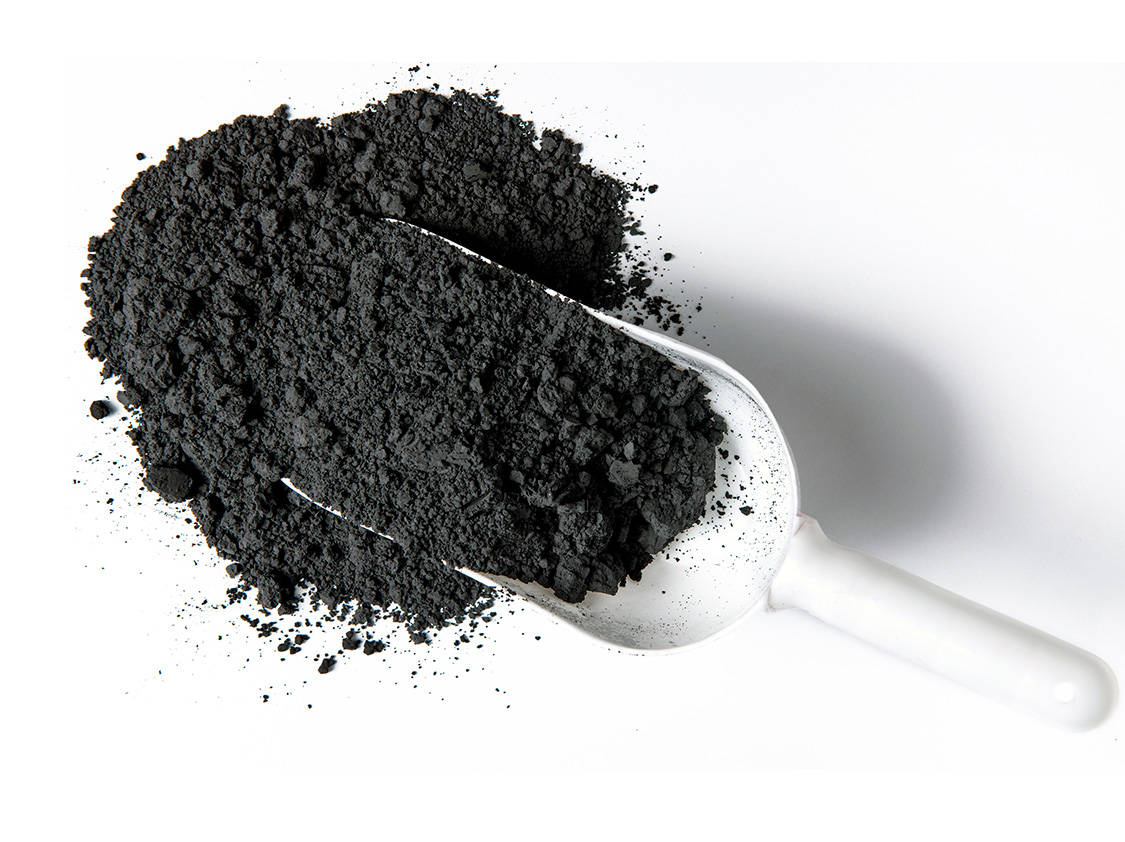
Core Insights - The price of powdered coating silica (white carbon black) has been experiencing fluctuations due to various influencing factors, including raw material costs, market supply and demand dynamics, and government policies [2][3]. Group 1: Price Influencing Factors - The production cost of white carbon black is significantly affected by changes in raw material prices, as its production involves complex processes including procurement, processing, and transportation [2]. - The increasing demand for powdered coatings, particularly in high-demand sectors such as automotive and construction, is driving up the price of white carbon black [2][4]. - Government policies and environmental regulations in different regions can also impact the pricing of white carbon black, including tax policies and environmental standards [2]. Group 2: Price Trends - Over the past five years, the price of white carbon black has shown an upward trend, particularly from 2016 to 2018 when market supply was tight, leading to significant price increases [3]. - In recent years, as market supply has increased, the price of white carbon black has started to stabilize after a period of decline [3]. Group 3: Supply and Demand Situation - The rapid development of the automotive and construction industries has led to a sustained increase in market demand for powdered coatings, thereby increasing the demand for white carbon black [4]. - The production capacity and supply chain limitations of white carbon black have resulted in an inability to fully meet market demand, contributing to rising prices [4].
2025年中国粉末涂料用聚酯树脂行业政策、发展历程、SWOT、供需规模、竞争格局、代表企业及发展趋势研判:市场空间日趋扩大,产能快速增长加剧市场竞争[图]
Chan Ye Xin Xi Wang· 2025-08-23 23:42
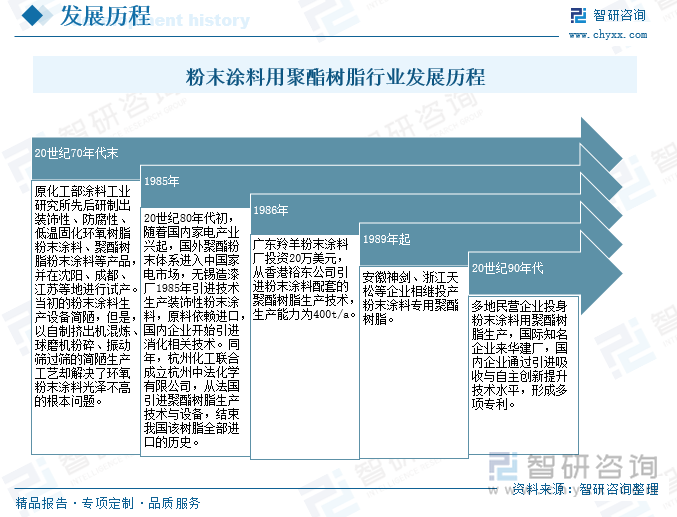
Core Viewpoint - The demand for polyester resins in China's powder coating industry is continuously rising due to the expanding applications in various sectors such as construction, automotive, home appliances, and electronics, leading to a significant market growth [1][7]. Industry Definition and History - Powder coatings are a new type of solid powder coatings composed of solid resins, pigments, fillers, and additives, which do not contain solvents [2]. - The polyester resin industry in China began developing in the late 1970s, with significant growth occurring from the late 1990s to the early 2000s, and has now entered a mature phase [3]. Current Industry Status Global Market - The global market for powder coating polyester resins is projected to reach USD 4.605 billion by 2024, with Asia accounting for USD 2.689 billion, representing 58.39% of the market share [5]. Chinese Market - In China, the demand for powder coating polyester resins is expected to grow to 1.239 million tons and a market size of CNY 13.649 billion in 2024, with further growth anticipated in 2025 [7][9]. SWOT Analysis - The powder coating polyester resin industry aligns well with global environmental policies due to its high solid content and zero VOC emissions, creating significant market opportunities [11]. Development Environment and Policies - The Chinese government has implemented various policies to promote the sustainable development of the powder coating polyester resin industry, focusing on environmental protection and increasing technical standards [13][14]. Competitive Landscape Major Companies - The industry has seen increased concentration, with major production companies located in Anhui, Zhejiang, Shanghai, and Guangdong, accounting for over 70% of the total production [15]. Representative Enterprises - Companies like Shenjian New Materials and Zhejiang Guanghua Technology are leading players in the market, with significant production capacities and market shares [17][19]. Industry Development Trends - The demand for powder coatings is expected to grow due to increasing environmental awareness and the push for carbon neutrality, particularly in sectors like new energy vehicles [22][23]. - The industry is likely to experience a shift towards high-performance products, with a focus on durability and corrosion resistance, driven by the evolving needs of the market [22].


立邦环境友好船舶防污涂料国内首用
Zhong Guo Hua Gong Bao· 2025-07-22 03:46
Core Viewpoint - Nippon Paint's AQUATERRAS, an eco-friendly self-polishing antifouling coating, has been successfully applied for the first time in China, enhancing operational efficiency and reducing environmental impact for Wan Hai Shipping's vessel [1][2] Group 1: Product Innovation - AQUATERRAS is the first antifouling coating in China that does not contain biocides, utilizing environmentally friendly formulations and polymer technology to repel marine organisms [1] - The coating significantly reduces fuel consumption by 14.7% compared to the market average, thereby lessening the environmental burden [1] Group 2: Collaboration and Market Impact - Since 2016, Nippon Paint has collaborated with Wan Hai, providing energy-saving and emission-reducing coating solutions for over 30 vessels [2] - The partnership has expanded from new shipbuilding to dry-docking services, marking a significant step in promoting low-carbon marine ecology [2] - Nippon Paint aims to leverage its innovative technology to offer efficient and eco-friendly coating solutions to more local shipowners, supporting the sustainable development of China's shipping industry [2]
趋势研判!2025年中国聚天门冬氨酸酯防腐涂料行业全景分析:应用领域的越来越广,市场需求稳定扩大,中国有望成为最大生产和消费市场[图]
Chan Ye Xin Xi Wang· 2025-07-09 01:33
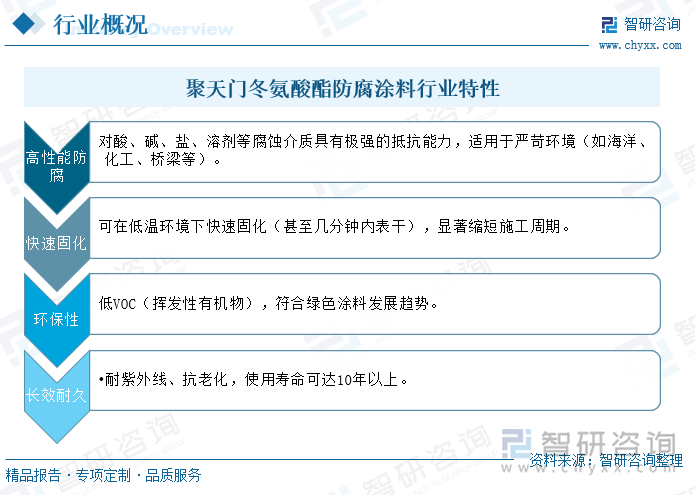
Core Viewpoint - The market for polyaspartic acid ester anti-corrosion coatings is expanding due to increasing demand and environmental regulations, with significant growth expected in production and market size in China and globally [1][4][6]. Group 1: Industry Definition and Characteristics - Polyaspartic acid ester anti-corrosion coatings, also known as polyaspartic coatings, utilize a new structure of polyaspartic acid ester as the main resin and aliphatic isocyanate as the curing agent, providing long UV resistance and rapid curing [2][4]. - These coatings exhibit high weather resistance, strong adhesion, and excellent chemical stability, making them suitable for heavy-duty anti-corrosion applications in various sectors [2][4]. Group 2: Current Industry Status - The global market for polyaspartic acid ester anti-corrosion coatings is projected to grow from $87 million in 2017 to $295 million in 2024, with an expected market size of $326 million in 2025 [4]. - In China, the production of polyaspartic acid ester anti-corrosion coatings is expected to reach 10,798 tons in 2024, with a demand of 11,057 tons and a market size of approximately 72.98 million yuan [6][12]. Group 3: Industry Development Environment - The industry is supported by government policies aimed at promoting environmentally friendly materials and reducing VOC emissions, which are crucial for sustainable development [10][11]. - Recent policies include tax incentives and support for research and development, aimed at enhancing the competitiveness of the industry [11]. Group 4: Industry Competition Landscape - The polyaspartic acid ester anti-corrosion coatings industry is characterized by a low concentration of market share among major players, with companies like Shanghai Hailong Saineng New Materials Co., Ltd. and Jiangsu Lanling Polymer Materials Co., Ltd. leading the market [12][13]. - The industry is experiencing rapid growth, but the overall market share of individual companies remains relatively small, indicating opportunities for consolidation and increased competition [12]. Group 5: Industry Development Trends - The industry is expected to see advancements in technology and product performance, with a focus on developing coatings with enhanced anti-corrosion and environmental properties [15]. - Future trends indicate a shift towards functionalization, greening, and efficiency in product offerings, positioning China as a leading market for production and consumption of these coatings [15].