环境空气质量

Search documents
直通部委|去年空气质量为有监测记录以来最优 《死亡证明》电子证照具有同等法律效力
Xin Lang Cai Jing· 2026-02-27 10:11
Group 1: Environmental Quality - By 2025, China's air quality is expected to reach the best level since monitoring began, with PM2.5 average concentration at 28 micrograms per cubic meter, 89.3% of days classified as good, and only 0.9% of days experiencing heavy pollution [1] Group 2: Electric Vehicle Infrastructure - As of January 2026, China has a total of 20.698 million electric vehicle charging facilities, marking a year-on-year increase of 49.6%. Public charging facilities account for 4.801 million, with a growth of 31.2%, while private charging facilities reached 15.897 million, up by 56.1% [2] Group 3: Foreign Exchange Risk Management - The People's Bank of China will reduce the foreign exchange risk reserve requirement for forward foreign exchange sales from 20% to 0% starting March 2, 2026, aimed at promoting foreign exchange market development and supporting enterprises in managing exchange rate risks [3] Group 4: Cross-Strait Relations - The Taiwan Affairs Office has stated that it will not allow "Taiwan independence" advocates and their relatives to profit from investments in mainland China, emphasizing the need to maintain peace and stability across the Taiwan Strait [4] Group 5: Safety Regulations - The Ministry of Emergency Management will enhance oversight of the public disclosure of safety accident investigation reports, ensuring timely and complete transparency to uphold public rights and improve safety governance [5] Group 6: Traditional Chinese Medicine - By the end of 2025, 475 traditional Chinese medicine production bases will have passed inspections, covering nearly 1.24 million acres and supplying 101 types of medicinal materials to 215 production enterprises [6] Group 7: Education and Health - The Ministry of Education has mandated that students engage in at least 2 hours of comprehensive physical activity daily, alongside implementing mandatory labor education and enhancing mental health education for teachers [7] Group 8: Death Certification - Starting July 1, 2026, medical institutions will use a nationally unified "Death Certificate," which must be issued promptly and accurately, ensuring legal validity for both paper and electronic versions [8]
2025年全国环境空气质量实现历史最优
Zhong Guo Xin Wen Wang· 2026-02-27 06:12
Core Viewpoint - By 2025, the national air quality in China is expected to achieve its best historical level, with significant improvements in key pollution metrics [1] Group 1: Air Quality Improvements - The average concentration of PM2.5 in cities at or above the prefecture level is projected to reach 28.0 micrograms per cubic meter [1] - The proportion of days with good air quality is expected to reach 89.3%, excluding the impact of dust storms [1] - The proportion of heavily polluted days is anticipated to be only 0.9% [1] Group 2: Pollution Reduction Metrics - Over the past five years, six pollutants, including sulfur dioxide, nitrogen oxides, carbon monoxide, ozone, PM2.5, and PM10, have shown a decline [1] - Compared to 2020, the five major pollutants are expected to decrease by approximately 15% to 20% by 2025, achieving historical lows [1]
生态环境部公布2025年10月全国环境空气质量状况
Zhong Guo Xin Wen Wang· 2025-11-26 07:32
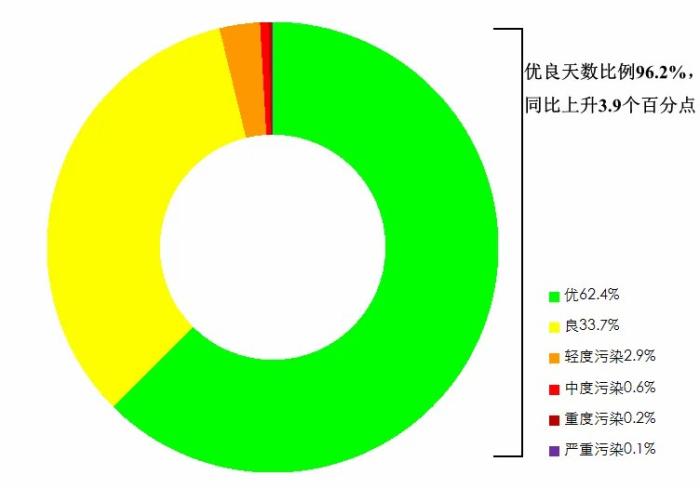
Core Insights - The Ministry of Ecology and Environment released the national air quality status for October 2025, indicating significant improvements in air quality across various regions of China [1]. Overall Situation - In October, the average PM2.5 concentration across 339 cities was 23.5 micrograms per cubic meter, a year-on-year decrease of 17.5% [2]. - The average PM10 concentration was 39 micrograms per cubic meter, down 18.8% year-on-year [2]. - Ozone (O3) levels averaged 103 micrograms per cubic meter, a decrease of 16.9% [2]. - Sulfur dioxide (SO2) averaged 7 micrograms per cubic meter, down 12.5% [2]. - Nitrogen dioxide (NO2) averaged 18 micrograms per cubic meter, a decrease of 18.2% [2]. - Carbon monoxide (CO) averaged 0.8 milligrams per cubic meter, remaining stable year-on-year [2]. - The proportion of days with good air quality was 96.2%, an increase of 3.9 percentage points year-on-year [2]. - The proportion of days with heavy pollution was 0.3%, an increase of 0.1 percentage points year-on-year [2]. - Days exceeding standards due to dust storms accounted for 0.9%, with heavy pollution days at 0.1% [2]. Key Regions Beijing-Tianjin-Hebei and Surrounding Areas - The average PM2.5 concentration was 34.7 micrograms per cubic meter, a decrease of 37.1% year-on-year [6]. - Ozone levels averaged 104 micrograms per cubic meter, down 30.7% [6]. - The proportion of good air quality days was 88.8%, an increase of 19.0 percentage points [6]. - Heavy pollution days were at 0.8%, a decrease of 0.6 percentage points [6]. - No days of exceeding standards due to dust storms were reported [6]. Yangtze River Delta - The average PM2.5 concentration was 23.2 micrograms per cubic meter, a decrease of 16.2% year-on-year [7]. - Ozone levels averaged 124 micrograms per cubic meter, down 10.8% [7]. - The proportion of good air quality days was 96.7%, an increase of 3.8 percentage points [7]. - No heavy pollution days were reported [7]. Fenwei Plain - The average PM2.5 concentration was 28.9 micrograms per cubic meter, a decrease of 33.7% year-on-year [8]. - Ozone levels averaged 91 micrograms per cubic meter, down 34.1% [8]. - The proportion of good air quality days was 96.5%, an increase of 8.4 percentage points [8]. - No heavy pollution days were reported [8]. Key Cities - Among 168 key cities, the top 20 cities with the best air quality included Guiyang, Kunming, and Suining [10]. - The bottom 20 cities with the worst air quality included Baoding, Shijiazhuang, and Zhuzhou [10]. - The top 20 cities with the lowest PM2.5 concentrations included Lhasa, Zhoushan, and Suining [10]. - The bottom 20 cities with the highest PM2.5 concentrations included Baoding, Handan, and Zhuzhou [10].