
现代化农业

Search documents
浙江庆元:一颗“金果果”甜了日子、富了乡村
Xin Hua Wang· 2025-12-22 07:39
Core Viewpoint - The development of the sweet pomelo industry in Qingyuan County, Zhejiang Province, has significantly improved the local economy and living standards, transforming it into a representative industry for rural revitalization [1][2][3] Group 1: Industry Growth - The sweet pomelo industry in Qingyuan has grown to cover over 20,000 acres, with an annual production of 16,200 tons and a total output value of 194 million yuan [1] - The introduction of the sweet pomelo variety began in 1998, combining the advantages of oranges and pomelos, which laid a solid foundation for industrialization [1] Group 2: Employment and Income - The industry has created employment opportunities for over 3,400 people, with individual farmers earning around 20,000 yuan annually from their work in the orchards [2] - The local community has seen significant improvements, with 80% of households building new homes and the village collective income projected to reach 1.7 million yuan in 2024 [1] Group 3: Infrastructure and Technology - A new cold chain storage and logistics center has been established to enhance the entire supply chain, maximizing fruit utilization and reducing waste [2] - Collaboration with various institutions has led to the formation of a skills service team to support industry planning, resource allocation, and market expansion [2] Group 4: Brand Development - The "Qingyuan Sweet Pomelo" brand has been actively promoted since receiving national geographical indication certification in 2022, with initiatives to enhance brand value through live-streaming sales and support for local producers [2]
柑橘正上市 这个特色村为啥还不慌
Si Chuan Ri Bao· 2025-11-19 02:39
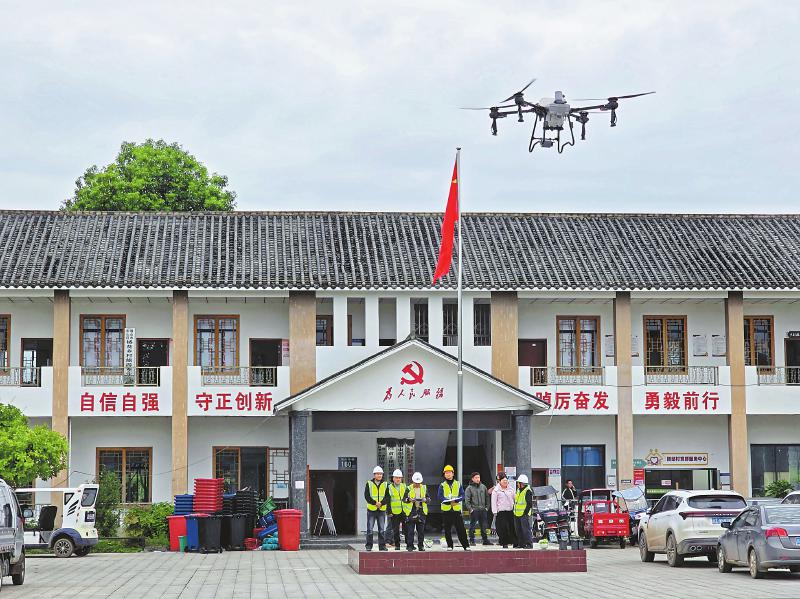
Core Viewpoint - The article highlights the modernization efforts in agriculture within Tuanjie Village, Pengshan District, Meishan City, focusing on the adoption of drone technology and infrastructure improvements to enhance citrus production and market competitiveness [3][5][6]. Group 1: Agricultural Modernization - Tuanjie Village is training over 10 farmers to obtain agricultural drone pilot licenses, which will significantly improve efficiency in citrus harvesting [3][5]. - The village has implemented a water and fertilizer integration system, costing over 13 million yuan, allowing precise irrigation for each tree, with farmers contributing an average of 600 yuan [6]. - The village's citrus production is expected to reach 60 million pounds this year, showcasing the effectiveness of modern agricultural practices [6]. Group 2: Quality Improvement and Branding - Tuanjie Village aims to transition from passive supply to active pricing by differentiating its citrus varieties, including the development of a new variety that reduced fruit splitting from 80% to 10% [7][8]. - The village plans to upgrade its citrus sorting facility, increasing daily sorting capacity from 2 million to 5 million pounds, enhancing the quality and marketability of its products [8]. - Efforts are underway to establish a brand for Meishan citrus, leveraging e-commerce to increase sales from the current 10% to 30%, thereby gaining more pricing power in the market [9].

内蒙古:用好土地建好粮仓
Jing Ji Ri Bao· 2025-11-04 22:21
Core Insights - Inner Mongolia has focused on becoming a key national agricultural and livestock product production base, achieving a grain output of 82.01 billion jin in 2024, ranking sixth in the country, with expectations for another bumper harvest this year [1][2] Group 1: Agricultural Infrastructure and Technology - The region has implemented high-standard farmland construction as a foundational project for agricultural development, with Baotou City completing 1.6303 million acres of high-standard farmland, aiming for a total of 7.3939 million acres by 2027 [2][3] - The introduction of technologies such as Beidou navigation and integrated water and fertilizer systems has significantly improved agricultural production efficiency, with individual farmers managing up to 1,000 acres and achieving notable yield increases [2][3] Group 2: Saline-Alkali Land Management - Inner Mongolia is actively addressing the challenges of saline-alkali land through targeted improvement strategies, with 240 million acres of saline-alkali land upgraded during the 14th Five-Year Plan period [3][4] - The transformation of saline-alkali land has led to increased crop yields, with reports of sunflower yields rising from 200 jin to an expected 350 jin per acre after improvements [4][5] Group 3: Economic Impact and Community Benefits - The shift to high-standard farmland and the introduction of cooperative farming models have resulted in increased incomes for local farmers, with reports of collective incomes reaching 100,000 yuan in certain villages [2][3] - The comprehensive utilization of saline-alkali land has not only improved ecological conditions but also provided new income streams for local herders through the cultivation of specialized forage crops [3][4]
德康农牧202509004
2025-09-04 14:36
Summary of Dekang Agriculture and Animal Husbandry Conference Call Company Overview - **Company**: Dekang Agriculture and Animal Husbandry - **Industry**: Pig Farming Key Points and Arguments Business Model and Strategy - Dekang has established a low-investment, high-turnover, and high-return farming system by transforming industry challenges into advantages, achieving a pig farming profit of approximately 403 RMB per head in 2024, with ROE and ROIC at 38% and 29% respectively, significantly outperforming peers [2][3] - The company has adopted a "No. 2 Farm" model, which is a light-asset, low-cost, and high-efficiency cooperative farming approach that reduces capital expenditure and enhances production efficiency [2][12] Financial Performance - In 2024, Dekang's total breeding cost is projected to be 13.6 RMB per kilogram, with a slaughter volume increasing from 1.37 million heads in 2020 to 8.78 million heads in 2024, reflecting a compound annual growth rate of 44%, far exceeding the industry average of 0.2% [2][5] - The company has maintained a research and development expense ratio of approximately 1.2% from 2018 to 2024, indicating a strong commitment to breeding innovation [4][10] Breeding and Technology - Since 2013, Dekang has built a core breeding group, introducing advanced breeding technologies and equipment, resulting in a breeding capacity that supports over 30 million piglets [2][6] - The company has achieved significant improvements in breeding efficiency, with a notable reduction in feed-to-meat ratios and earlier market readiness for pigs, enhancing profitability [10] Talent Management and Incentives - Dekang emphasizes talent incentives, with an average salary of 149,000 RMB per employee in 2024, higher than the industry average of 123,000 RMB, and an executive average salary of 810,000 RMB, also above the industry average [7] Future Development Directions - The company plans to continue promoting its light-asset model and enhance its epidemic prevention systems while advancing AI precision farming technologies [8] - Dekang aims to maintain its leading position in biotechnology through ongoing investments in breeding research and development [9] Market Position and Competitive Advantages - Dekang has been recognized for its effective epidemic prevention measures, being designated as a "disease-free zone" by the Ministry of Agriculture in multiple locations since 2021, which supports stable growth [13][14] - The company’s innovative farming model and strong financial performance position it well for future growth, making it a focal point for investors [14] Additional Important Insights - The "No. 2 Farm" model allows for a more efficient production process, with a focus on training and strict entry requirements for farm operators to ensure high-quality output [12] - Dekang's strategic focus on the southwestern region of China, where 7 out of 10 core pig farms are located, has contributed to its competitive edge in the market [5]
冷凉蔬菜基地有个“电管家”
Ke Ji Ri Bao· 2025-07-02 03:47
Core Insights - The establishment of a stable electricity supply has significantly improved agricultural productivity in the Yangjuan Village cold-resistant vegetable base, with a reported 60% increase in overall output due to the adoption of electrified equipment [1][2] - The local power company, State Grid Haidong Power Supply Company, has actively engaged with farmers to understand their electricity needs and has implemented tailored services to ensure reliable power supply for agricultural activities [2] Group 1 - The cold-resistant vegetable base in Yangjuan Village has 309 greenhouses and has transitioned from a challenging irrigation situation to a modern agricultural setup with stable water supply [1] - The power company installed 108 poles, laid 17.023 kilometers of 0.4 kV lines, and set up four 100 kVA transformers to facilitate the irrigation needs of the vegetable base [1] - The introduction of a 45 kW water pumping device was necessary due to increased water demand following the expansion of the base [1] Group 2 - The electrification of equipment has not only enhanced productivity but also created job opportunities for over 50 local villagers [2] - The power company has established a proactive communication strategy with farmers, including regular equipment check-ups and safety assessments to mitigate electrical hazards [2] - The initiative has transformed previously barren land into a productive agricultural area, contributing to local economic development [2]