琼崖抗日

Search documents
星火聚孤岛 团结御外侮
Hai Nan Ri Bao· 2025-08-15 03:55
Core Viewpoint - The article highlights the historical significance of the Qiongya Anti-Japanese Independent Team's formation during the Second Sino-Japanese War, emphasizing the collaboration between the Communist Party and the Nationalist Party in resisting Japanese aggression in Hainan [7][8][12]. Group 1: Historical Context - The Qiongya region became a focal point for Japanese military strategy due to its proximity to key locations and resources, leading to a united front between the Nationalist and Communist forces to combat the invasion [11][12]. - The collaboration was marked by a significant event on December 5, 1938, when the Qiongya Red Army guerrilla team was officially restructured into the Qiongya Anti-Japanese Independent Team, with over ten thousand local citizens participating in the ceremony [12][13]. Group 2: Key Figures and Events - The handshake between Feng Baiju, the Qiongya Special Committee Secretary, and Wang Yi, the Nationalist Commander, symbolized the difficult yet crucial alliance formed to resist Japanese forces [10][12]. - The Qiongya Anti-Japanese Independent Team quickly gained momentum, expanding from over 300 members to more than 1,000 by March 1939, and later evolving into the Qiongya Column of the People's Liberation Army, which contributed significantly to the revolutionary efforts in the region [14]. Group 3: Community Involvement - The article illustrates the active participation of local youth and citizens in the anti-Japanese efforts, including the formation of the "Young Soldiers" unit, which consisted of children aged 13 to 16 who were eager to join the fight [18][19]. - The support from the local population was crucial, with various communities forming self-defense units and providing resources to the anti-Japanese forces, showcasing a collective effort against the invasion [20].

“抗日模范乡”咸来——“最后一碗米”送同志
Hai Nan Ri Bao· 2025-08-11 02:05
Core Points - The article highlights the historical significance of the Hainan region during the Anti-Japanese War, focusing on the resilience of the local population against Japanese forces [4][5][6] - It recounts personal testimonies from survivors, particularly Chen Wenguan, who vividly describes the atrocities committed by Japanese troops and the community's efforts to resist [5][7][10] - The narrative includes accounts of significant battles, such as the successful ambush at Luobandpu, which boosted local morale and showcased the effectiveness of guerrilla tactics [8][9] Summary by Sections - **Historical Context**: The Hainan region served as a crucial base for anti-Japanese activities, with local residents actively participating in resistance efforts against Japanese occupation [4][5] - **Personal Accounts**: Survivors like Chen Wenguan provide detailed recollections of the violence inflicted by Japanese forces, including bombings and massacres, which devastated local communities [5][6][7] - **Military Engagements**: The article describes key military actions, such as the Luobandpu ambush, where local forces successfully defeated Japanese troops, enhancing the reputation of the anti-Japanese units [8][9] - **Community Support**: The local population's solidarity is emphasized, with accounts of villagers contributing food and resources to support the anti-Japanese efforts, reflecting a strong communal spirit [10][11]
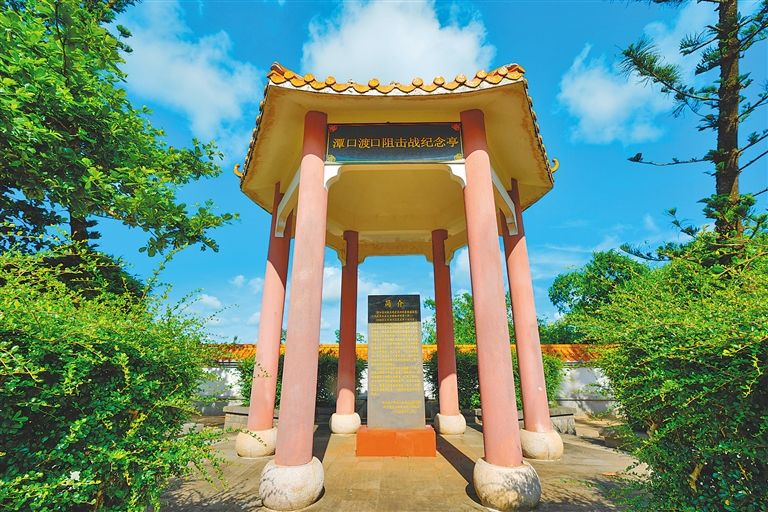
86年前,琼崖抗日独立队在潭口渡口阻击东进日军
Hai Nan Ri Bao· 2025-06-27 01:53
Core Viewpoint - The article commemorates the significance of the Tan Kou ferry resistance battle, which marked the first armed resistance led by the Communist Party in Qiongya against Japanese invasion during World War II, highlighting the bravery and sacrifice of the Qiongya Anti-Japanese Independent Team [3][8]. Summary by Sections Historical Context - The Japanese military had long coveted Qiongya due to its strategic location and resources, with plans dating back to the late 19th century to use Hainan as a base for expansion [4]. - On February 10, 1939, the Japanese launched a significant invasion, landing thousands of troops at Tan Kou with naval and aerial support, quickly overwhelming the Nationalist forces [4][5]. The Battle - The Qiongya Anti-Japanese Independent Team, consisting of over 300 members, was ordered to resist the advancing Japanese forces at Tan Kou, despite being outnumbered and outgunned [5][6]. - The team utilized the advantageous terrain to set up ambushes, successfully delaying the Japanese advance and protecting fleeing civilians [6][7]. Aftermath and Impact - The battle, although small in scale, had a profound impact on local morale and the growth of the Qiongya Anti-Japanese Independent Team, which expanded from 300 to over 1,000 members by March 1939 [8]. - The resistance fostered a strong sense of community support for the team, as local villagers actively participated in the war effort and maintained loyalty to the revolutionary cause [9]. Legacy - The Tan Kou ferry resistance battle is remembered as a pivotal moment in the local history, symbolizing the fight for national sovereignty and the sacrifices made by the local population [9][10]. - The article emphasizes the importance of preserving this historical memory and the ongoing efforts to educate future generations about the sacrifices made during this period [9][10].