甲烷氧化

Search documents
5600万年前北极海洋加剧全球变暖谜底揭开
Ke Ji Ri Bao· 2025-09-27 08:06
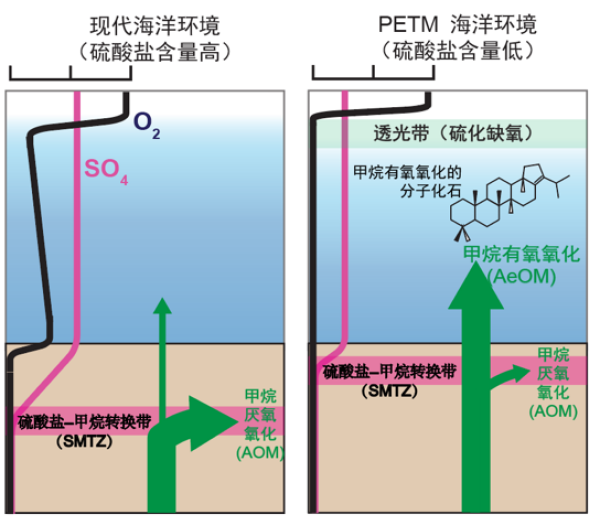
Core Insights - The research reveals that subtle changes in ocean sulfate concentrations can act as a "chemical switch" affecting methane consumption, which has significant implications for global climate change [1][2]. Group 1: Methane and Climate Change - Methane is the second-largest greenhouse gas after carbon dioxide, with a significant amount stored as hydrates on the ocean floor [1]. - In modern oceans, approximately 90% of methane is utilized by microorganisms in sediments under anoxic conditions, using sulfate as a "fuel" and producing alkaline substances that mitigate ocean acidification [1]. - During the Paleocene-Eocene Thermal Maximum (PETM) around 56 million years ago, the sulfate concentration in Arctic seawater was less than one-third of modern levels, leading to a shift in methane decomposition processes [2]. Group 2: Microbial Activity and Methane Oxidation - A lack of sulfate during the PETM resulted in the activation of oxygen-loving bacteria that rapidly "burned" methane, contrasting with the slow-burning process seen in modern oceans [2]. - The research team successfully reconstructed the methane oxidation process from 56 million years ago by detecting specific molecular traces left by ancient bacteria [2]. - The study indicates that during the PETM, the concentration of CO2 in Arctic seawater was 200-700 ppm higher than the global average, transforming the Arctic from a carbon sink to a carbon source [2]. Group 3: Geological Influences on Climate - Geological activities such as crustal movements, rock formation, continental weathering, and volcanic eruptions directly influence ocean sulfate levels, thereby affecting methane decomposition methods [3]. - The research suggests that the historical low sulfate levels in ancient oceans may have significantly impacted global carbon cycles and climate [3]. - With the rapid warming and freshening of modern Arctic waters, similar methane oxidation mechanisms could be reactivated, potentially leading to a shift from efficient methane utilization to rapid burning [3].
【科技日报】海水硫酸盐含量揭开5600万年前北极海洋加剧全球变暖谜底
Ke Ji Ri Bao· 2025-09-26 01:25
Core Insights - The research reveals that subtle changes in ocean sulfate concentrations during the Paleocene-Eocene Thermal Maximum (PETM) 56 million years ago acted as a "chemical switch" that altered methane consumption, significantly impacting global climate change [1][2] Group 1: Methane Dynamics - Methane, the second-largest greenhouse gas after carbon dioxide, is primarily stored in the ocean floor as hydrates [1] - In modern oceans, approximately 90% of methane is utilized by microorganisms in sediments under anoxic conditions, using sulfate as a "fuel" to efficiently convert methane while producing alkaline substances that mitigate ocean acidification [1][4] - During the PETM, the concentration of sulfate in Arctic seawater was less than one-third of modern levels, leading to a shift in methane oxidation pathways [2][4] Group 2: Microbial Activity - A significant increase in the activity of methane-oxidizing bacteria that prefer oxygen was observed during the PETM, indicating a transition from slow combustion to rapid burning of methane [2] - The research team successfully reconstructed the methane oxidation process from 56 million years ago by detecting specific molecular traces left by ancient bacteria [2] Group 3: Carbon Cycle Implications - The study found that CO2 levels in Arctic seawater during the PETM were 200-700 ppm higher than the global average, indicating a shift from being a carbon sink to a carbon source [4] - Geological activities such as tectonic movements and volcanic eruptions directly influence ocean sulfate levels, which in turn determine methane decomposition methods [4] Group 4: Modern Relevance - The research highlights the potential for similar methane oxidation mechanisms to be reactivated due to rapid warming and freshening of modern Arctic waters, which could lead to a shift from efficient methane utilization to rapid burning [4] - This study serves as a crucial warning regarding the potential risks of greenhouse gas emissions in the context of modern Arctic climate changes [4]