电力电量平衡

Search documents
电力系统潮流计算
广东电力交易中心· 2026-02-05 09:15
Investment Rating - The report does not explicitly state an investment rating for the industry Core Insights - The report emphasizes the importance of power flow calculations in understanding the distribution of electric power within the grid and its impact on market transactions [13][19] - It highlights the necessity of accurate demand forecasting for effective power system management and market operations [52][53] - The report discusses the implications of power flow distribution on market transactions, including the influence on generation scheduling and cost optimization [26][34] Summary by Sections Power Flow Calculation Principles - Power flow calculations represent the overall situation of electric power transmission in the network, including power injection at nodes, transmission power, losses, and voltage levels [13][19] - The report outlines methods for solving power flow equations, including AC and DC methods, detailing their advantages and disadvantages [17][37] Power System Balance - The concept of power balance encompasses both instantaneous and energy balance, ensuring that supply meets demand at all times [59][60] - The report stresses the importance of maintaining adequate reserve capacity to handle fluctuations in demand and system faults [57][68] Generation Planning Principles - Generation planning involves determining the operational status and output of units based on power balance and safety constraints [88][92] - The report details the process of adjusting generation plans in real-time to respond to demand changes and system conditions [111][112] Real-time Operation and Control - Real-time management is crucial for maintaining system stability and ensuring that power supply meets demand [112][114] - The report discusses the need for automatic control systems to adjust generation output in response to real-time conditions [115][123]
电网应对尖峰时刻有新选择!能源保供“资源池”扩充“护航”电力电量平衡
Yang Shi Wang· 2025-08-03 05:41
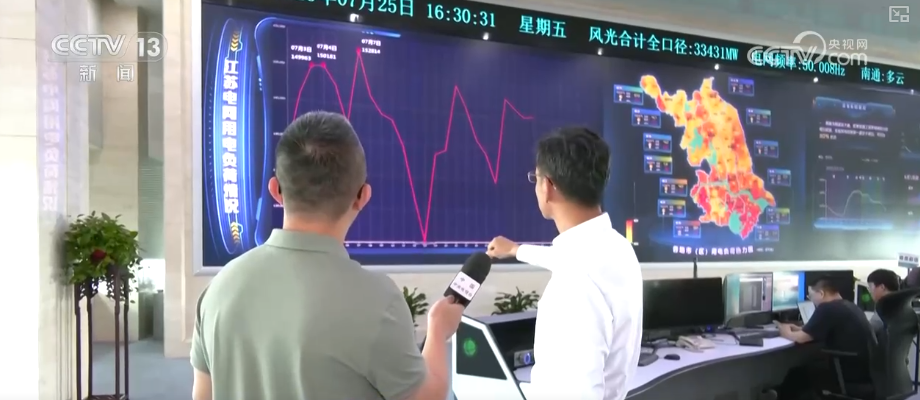
Group 1 - The article highlights the unprecedented rise in electricity demand due to continuous high temperatures across various regions in China, particularly in Jiangsu, where electricity load has reached historical highs [1][2][4] - As of July 3, 2025, electricity load surpassed 150 million kilowatts for the first time, reaching 152.8 million kilowatts on July 7, which is 5.75 million kilowatts higher than the same period in 2024 [4][6] - The peak electricity load in 2025 occurred over 20 days earlier than in 2024, remaining above 140 million kilowatts, driven by increased use of air conditioning and cooling systems [6][9] Group 2 - The internet data service industry has significantly contributed to the increase in electricity consumption, with major data centers expanding their capacity and switching to more energy-intensive cooling systems [11][13] - Despite the high electricity demand, many companies, including a battery manufacturing firm, did not receive notifications to adjust their production schedules, allowing them to operate normally during peak times [14][16] - New energy storage systems have been rapidly deployed, with a total installed capacity exceeding 91 million kilowatts, providing a quick response to peak demand and alleviating pressure on the grid [18][19] Group 3 - Nationwide, over 10 provinces have implemented large-scale new energy storage systems during the summer peak, with the maximum power call exceeding 44 million kilowatts, enhancing electricity supply capabilities [21] - The total installed capacity of renewable energy in China has surpassed 1.6 billion kilowatts, making it the largest power source in the country [22][30] - In industrial parks, distributed photovoltaic systems have been installed, significantly reducing reliance on the main grid and achieving over 95% utilization of renewable energy [27][30] Group 4 - The coal power sector is actively participating in balancing the grid, adjusting output based on renewable energy generation, which has increased its share of total electricity generation to 35.2%, up 2.1 percentage points from 2024 [30][32] - The Chinese government is employing multiple strategies, including stable coal power supply and enhanced grid infrastructure, to ensure electricity balance during peak demand periods [32]