
电商黑灰产

Search documents
威胁猎人:2025年全球电商业务欺诈风险研究报告
Sou Hu Cai Jing· 2026-02-06 11:32
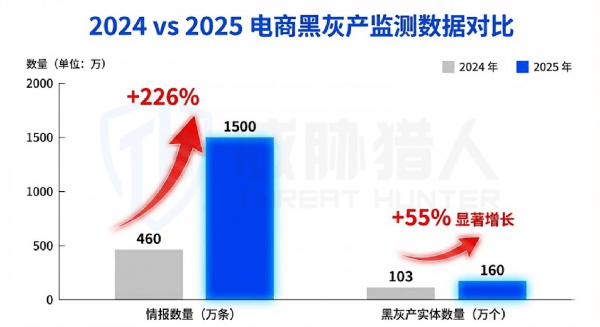
Core Insights - The report indicates a significant surge in global e-commerce fraud risks, with 15 million risk clues identified in 2025, marking a 226% year-on-year increase, and 1.6 million related accounts captured, up 55% [10][13][11] - The primary regions contributing to these risks are Europe, China, and the United States, which together account for over 70% of global e-commerce fraud clues [15][21] - The operational model of fraud has evolved to a "global channel for lead generation + localized channels for transactions," indicating a sophisticated cross-regional attack chain [17][19] Group 1: Key Trends in E-commerce Fraud - The first trend is the AI-driven "evidence industrialization," where generative AI technology allows for the mass production of identity materials and appeal evidence, significantly increasing the success rate in audits and appeals [11][33] - The second trend is the escalation of logistics fraud risks, which have evolved from simple fulfillment violations to supporting counterfeit sales and malicious refunds through various deceptive practices [12][40] - The third trend involves the humanization of attack resources, where real individuals are engaged in critical processes like registration and appeals, utilizing genuine devices and networks to lower risk detection rates [12][48] Group 2: Attack Lifecycle and Risk Scenarios - E-commerce platforms face a full lifecycle attack system, with seller-side attacks focusing on account acquisition, supply of prohibited goods, and transaction settlements, characterized by process-oriented and scalable features [28][27] - Buyer-side attacks revolve around accounts, platform subsidies, payment, and after-sales rules, aiming to maximize platform subsidies and product value extraction [30][31] - Typical risk scenarios include brand counterfeiting, malicious refunds, marketing arbitrage, and logistics fraud, which are interconnected and form a systemic counteraction [50][51] Group 3: Market Dynamics and Pricing - There is a notable pricing disparity in the black market for seller and buyer accounts, influenced by platform location, merchant tier systems, and operational permissions, with higher prices reflecting greater scarcity and stricter risk controls [19][20] - The black market for e-commerce fraud is characterized by cross-regional attacks, where criminal groups leverage the internet's borderless nature to coordinate activities across different countries [21][23] - The report highlights that fraud tactics are increasingly sophisticated, with black market operations adapting to platform characteristics and consumer behavior to ensure profitability [58][59]


全球电商业务欺诈风险激增226%,AI伪造与物流作弊等六大趋势引关注
Sou Hu Cai Jing· 2026-02-04 08:37
Core Insights - The report reveals a significant escalation in e-commerce fraud, transitioning from "single-point violations" to "full lifecycle attacks," with 15 million risk indicators detected globally in 2025, marking a 226% year-on-year increase [1] Group 1: Trends in E-commerce Fraud - Trend 1: The industrialization of AI-generated evidence poses severe challenges to verification mechanisms, with the number of black market groups involved in AI facial fraud increasing from 116 to 361 within a year, a growth of over three times [4] - Trend 2: Logistics cheating has evolved into a foundational support for black market operations, embedded in high-risk scenarios like brand counterfeiting and malicious refunds, affecting at least 14 countries and regions [5] - Trend 3: The introduction of real human participants in attacks complicates multi-account governance, as black market operations recruit real users to perform actions that closely mimic genuine user behavior [6] Group 2: Globalization and Specialization of Fraud - Trend 4: Brand counterfeiting has become globalized, with counterfeit goods covering high-value categories such as apparel, cosmetics, electronics, and health products, achieving profit margins of 40%-73% [7][8] - Trend 5: Malicious refunds have developed into a specialized industry, with risk indicators peaking at 23,099 in September 2025, and black market commissions reaching 20%-30% of refund amounts [9] - Trend 6: The networked nature of global attacks has become the norm, with criminal groups collaborating across regions to enhance operational efficiency and concealment [10] Group 3: Recommendations for E-commerce Platforms - E-commerce platforms are urged to establish a multi-layered intelligence-driven defense system, moving from a single defensive strategy to a comprehensive approach that compresses the return on investment for black market operations [10]
平安产险青海:警惕电商黑灰产三大乱象!
Sou Hu Cai Jing· 2025-08-20 17:15
Core Insights - The e-commerce industry is experiencing rapid growth, but it is also facing significant challenges due to illegal activities that harm consumer rights and disrupt fair market competition [1][2] Group 1: E-commerce Fraud and Legal Actions - From January 2024 to June 2025, over 10,000 individuals are expected to be prosecuted for crimes related to the e-commerce sector [1] - The sale of counterfeit and substandard goods through e-commerce platforms remains a persistent issue, with lower infringement costs and more concealed sales channels compared to traditional methods [1] - Notable cases include individuals selling substandard fertilizers and counterfeit liquor, with sales amounts exceeding 7 million yuan and 2.7 million yuan respectively [1] Group 2: Personal Information Violations - The e-commerce sector is facing significant issues related to the leakage of personal information, as it involves various fields such as communication, logistics, and retail [1] - Cases of individuals illegally obtaining and selling personal information have been reported, including one individual selling over 300,000 cross-border shopping order details [1] Group 3: Live Streaming Scams - There is a growing concern regarding scams conducted through e-commerce live streaming platforms, where fraudsters exploit the difficulty in verifying the authenticity of products [2] - Specific cases involve individuals posing as agents for luxury brands and using fake certifications to sell low-quality products, promising high buy-back prices to lure consumers [2]

警惕电商黑灰产三大乱象
Jin Rong Shi Bao· 2025-07-28 13:46
Core Viewpoint - The rapid growth of the online industry has led to significant issues within the e-commerce sector, including the rise of illegal activities that harm consumer rights and disrupt fair market competition. From January 2024 to June 2025, over 10,000 individuals are expected to be prosecuted for crimes related to e-commerce [1]. Group 1: Common Illegal Activities - The sale of counterfeit and inferior goods through e-commerce platforms remains prevalent, with lower infringement costs and more concealed sales channels compared to traditional methods. For instance, an individual named Yuan sold over 7 million yuan worth of substandard fertilizer using registered trademarks through nine online stores [2]. Another case involved Xu, who sold counterfeit liquor worth over 2.7 million yuan without proper authorization [2]. - Personal information leakage in the e-commerce sector is a significant concern, as many practitioners illegally obtain and sell consumer data. For example, an individual named Cheng sold over 300,000 cross-border shopping order details obtained through his position in an e-commerce company [3]. Another case involved Zhang, who exported and sold large amounts of shopping cache data from his company's e-commerce platform [3]. - Fraudulent activities through e-commerce live streaming are on the rise, where criminals exploit the difficulty in verifying product authenticity. For instance, individuals named Du and Shi posed as agents for a luxury jewelry brand, selling unverified products under false pretenses and promising high buy-back prices, only to disappear after receiving payments [3].