石窟艺术

Search documents
凭景区门票免费!栖霞山这个展有看头
Xin Lang Cai Jing· 2026-02-20 13:28
Core Viewpoint - The exhibition titled "Hu-Han Integration: Digital Rebirth" showcases the artistic dialogue between the Qixia Mountain and Longmen Grottoes, highlighting the cultural significance and historical evolution of these two major stone carvings from different Chinese dynasties [1][6]. Group 1: Exhibition Overview - The exhibition marks a 1500-year dialogue between Northern and Southern civilizations, initiated by the first carving at Qixia Mountain in 489 AD, which reflects the artistic exchange between the North Wei and Southern Dynasties [1][6]. - The Qixia Mountain features 250 existing caves and over 520 statues, while the Longmen Grottoes boast 2,345 caves and approximately 100,000 statues, bringing together the essence of both sites for a comprehensive artistic experience [2][6]. Group 2: Technological Integration - The exhibition employs high-precision 3D scanning and AI restoration technology to digitally revive damaged artifacts, allowing visitors to experience the historical beauty of the Longmen sculptures and Qixia Mountain's famous "East Flying Celestial" [2][3]. Group 3: Expert Engagement - Renowned scholars from institutions like Peking University and the Chinese Academy of Social Sciences will conduct public lectures during the exhibition, providing insights into the history of the grottoes, the evolution of their artistic styles, and the cultural integration of Hu and Han [3]. Group 4: Digital Experience and Accessibility - The exhibition will utilize various media formats, including short videos, articles, and live broadcasts, to create an online viewing experience, allowing audiences to engage with the exhibition remotely [5]. - A ticketing policy allows visitors to enter the exhibition for free with a same-day ticket to the Qixia Mountain scenic area, enhancing the cultural tourism experience [5].
云冈研究院院长杭侃谈石窟艺术之美:理解中国文化的一把钥匙
Xin Lang Cai Jing· 2026-01-11 11:01
Core Viewpoint - The book "Remarkable Caves: A Panoramic Interpretation of China's Top Ten Caves" aims to provide an in-depth understanding of Chinese cave art, highlighting its historical, aesthetic, and social significance through the analysis of ten representative caves [1][3]. Group 1: Book Overview - The book is authored by 11 authoritative scholars and focuses on notable caves such as Dunhuang Mogao Caves, Yungang Grottoes, and Longmen Grottoes, analyzing their artistic value and cultural connotations from various perspectives [3][5]. - It combines high-definition images with vivid text to guide readers through time, showcasing the grandeur of royal caves and the simplicity of folk caves, while decoding the cultural messages behind murals, sculptures, and architecture [3][5]. Group 2: Academic Insights - Professor Hang Kan emphasizes that cave art is a key to understanding Chinese culture, introducing the "Three Views" and "Five Dimensions" framework for analyzing cave art [3]. - The "Three Views" include macro site selection, meso positioning, and micro construction, while the "Five Dimensions" encompass history, art, science, culture, and society [3]. Group 3: Cultural Impact - The lecture presented by Hang Kan not only provided professional depth but also infused humanistic warmth, illustrating the innovative dissemination and inheritance of China's major caves in the context of cultural tourism and AI trends [3]. - The book serves as a significant work under the "Star Creator Publisher" project by Central South Publishing, aiming to popularize and transmit excellent traditional Chinese culture in an accessible yet rigorous manner [5].

了不起的洛阳城丨洛阳石窟 不只龙门
He Nan Ri Bao· 2025-07-23 01:00
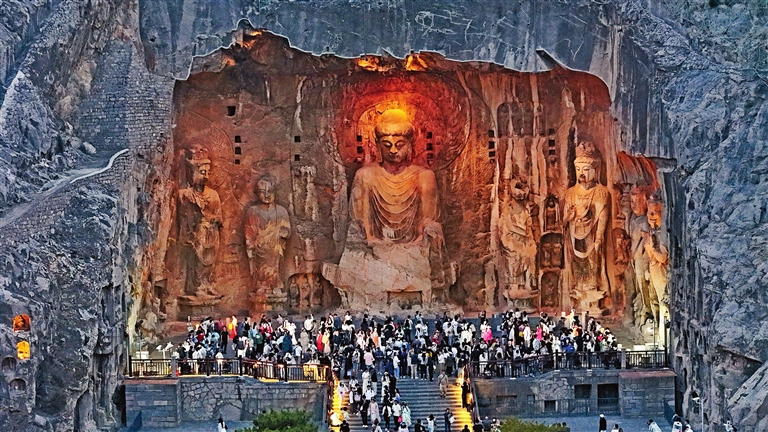
Core Insights - The article emphasizes the significance of the Longmen Grottoes as a pinnacle of Chinese stone carving art and a UNESCO World Heritage site, highlighting its historical and cultural importance in the context of the Luoyang region [4][10]. Summary by Sections Longmen Grottoes - Longmen Grottoes, located in the southern suburbs of Luoyang, is recognized as one of the world's largest stone carving art treasures, featuring 2,345 niches and nearly 110,000 statues, making it the largest stone carving art repository globally [9][10]. - The site has been praised by UNESCO as the "highest peak of Chinese stone carving art" and is part of the three major grottoes in China alongside Dunhuang Mogao Grottoes and Yungang Grottoes [10]. Cultural Significance - The article discusses the cultural heritage of the Luoyang region, particularly the lesser-known "satellite grottoes" that share artistic styles with Longmen Grottoes, contributing to a comprehensive understanding of Central Plains Buddhist grotto art [4]. - The Longmen Grottoes and its surrounding sites reflect the evolution of Buddhist art in China, showcasing the integration of local cultural elements over centuries [4][32]. Recent Discoveries - A recent discovery of a Tang Dynasty round sculpture of a Bodhisattva adds to the historical value of the Longmen Grottoes, providing new material for research on the site [4]. - The article highlights the ongoing efforts to protect and preserve these cultural treasures, as emphasized by President Xi Jinping during his visit [4]. Other Grottoes - The article mentions several other grottoes in the Luoyang area, such as the Lüzhai Grottoes, which date back over 200 years before the Longmen Grottoes, and the Wanfoshan Grottoes, known for their complete relief sculptures that reflect the political and religious fusion of the Northern Wei period [5][20][23]. - The Xiewang Grottoes and the Hutu Temple Grottoes are also noted for their artistic significance and preservation efforts, showcasing the diversity of stone carving styles in the region [6][15]. Preservation Efforts - The article discusses the relocation and preservation of certain grottoes due to modern infrastructure projects, emphasizing the importance of maintaining cultural heritage in the face of development [7][11][16]. - The ongoing research and educational initiatives surrounding these grottoes aim to enhance public awareness and appreciation of this rich cultural legacy [7][32].