
硬创新

Search documents
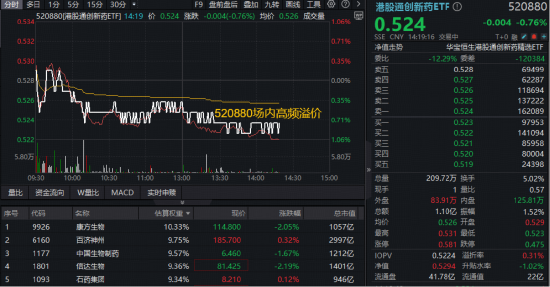
三连涨后首度回调,港股通创新药ETF(520880)跌近1%高频溢价!机构:关注“硬创新”+“强出海”创新药资产
Xin Lang Cai Jing· 2025-12-22 06:46
Core Viewpoint - The Hong Kong Stock Connect innovative drug sector experienced its first pullback after three consecutive gains, with the popular Hong Kong Stock Connect innovative drug ETF (520880) dropping nearly 1% in the afternoon, indicating active buying interest despite the decline [1][8]. Group 1: Market Performance - The innovative drug sector saw a majority of leading stocks decline, with Kangfang Biopharma and China National Pharmaceutical Group both dropping over 2%, while several others, including Yunding Xinyao and Nuocheng Jianhua, fell more than 3% [1][8]. - The Hong Kong Stock Connect innovative drug ETF (520880) has a significant concentration in leading stocks, with the top ten holdings accounting for over 72% of the index [4][12]. Group 2: Policy and Industry Support - Xi'an recently released a plan to enhance the biopharmaceutical industry's capabilities from 2025 to 2027, focusing on breakthroughs in key drug development technologies in areas such as stem cell drugs and peptide drugs [3][10]. - Various regions, including Beijing, Shanghai, Chongqing, and Sichuan, have introduced policies to promote high-quality development in the innovative drug sector this year [3][10]. - Changjiang Securities noted that the pharmaceutical industry is experiencing a policy cycle, with comprehensive support policies for the innovative drug sector gradually being implemented [9]. Group 3: Investment Opportunities - Investors are encouraged to consider the Hong Kong Stock Connect innovative drug ETF (520880) and its associated funds as a low-entry point opportunity, particularly focusing on "hard innovation" assets and those with strong overseas potential [9][11]. - The index tracked by the ETF, the Hang Seng Hong Kong Stock Connect Innovative Drug Select Index, offers three unique advantages: it is purely focused on innovative drug companies, has a high concentration of leading firms, and employs measures to control risks associated with less liquid stocks [11][12]. - For those looking to mitigate volatility while investing in innovative drugs, the only drug ETF in the market (562050) and its associated funds are recommended, which also include a significant allocation to traditional Chinese medicine [12][13].

今日视点:中小企业搞创新要“软硬”一齐抓
Zheng Quan Ri Bao· 2025-08-24 23:04
Core Viewpoint - The Ministry of Industry and Information Technology emphasizes the importance of innovation for small and medium-sized enterprises (SMEs) to achieve high-quality development, focusing on both "hard innovation" and "soft innovation" to enhance competitiveness and adapt to market changes [1][2]. Group 1: Hard Innovation - Hard innovation is crucial for SMEs to strengthen core competitiveness, involving investments in new materials, technologies, and smart production equipment [2][3]. - Many SMEs have successfully enhanced product competitiveness and gained market share through hard innovation, establishing a solid foundation for long-term development [2]. - SMEs face challenges in funding, technology, and talent when pursuing hard innovation, necessitating support from capital markets through listings and mergers [2][3]. Group 2: Soft Innovation - Soft innovation encompasses management, business model, and corporate culture improvements, which are key drivers of enterprise development [3]. - The rise of social media provides new marketing channels, prompting SMEs to adopt precise positioning and personalized marketing to enhance brand awareness [3]. - Both hard and soft innovations must work in tandem for SMEs to thrive in competitive markets and achieve sustainable development [3]. Group 3: Future Outlook - By the end of 2024, the number of SMEs in China is expected to exceed 60 million, reflecting a trend of simultaneous quantity and quality improvement [4]. - Continuous innovation is essential for SMEs to contribute to high-quality economic development in the future [4].
中小企业搞创新要“软硬”一齐抓
Zheng Quan Ri Bao· 2025-08-24 15:47
Core Viewpoint - The Ministry of Industry and Information Technology emphasizes the importance of innovation for small and medium-sized enterprises (SMEs) to achieve high-quality development, focusing on both "hard innovation" and "soft innovation" to enhance competitiveness and adapt to market changes [1][2]. Group 1: Hard Innovation - "Hard innovation" is crucial for SMEs to strengthen core competitiveness, involving investments in new materials, technologies, and smart production equipment [2][3]. - SMEs that accelerate the development of new technologies and products through "hard innovation" can enhance product competitiveness and secure market share and profit margins [2][3]. - Challenges such as funding, technology, and talent constraints hinder SMEs in their pursuit of "hard innovation," necessitating capital market support through listings and mergers [2][3]. Group 2: Soft Innovation - "Soft innovation" encompasses management, business model, and corporate culture innovations, which are essential for driving enterprise development [3]. - The rise of social media provides new marketing channels, prompting SMEs to adopt precise positioning and personalized marketing to enhance brand awareness [3]. - Both "hard innovation" and "soft innovation" must work in tandem to enable SMEs to thrive in competitive markets and achieve sustainable development [3]. Group 3: Future Outlook - By the end of 2024, the number of SMEs in China is expected to exceed 60 million, reflecting a trend of simultaneous quantity and quality improvement [4]. - Continuous innovation is essential for SMEs to contribute to high-quality economic development in the future [4].