
碳足迹核算标准

Search documents
上海国际航运绿色燃料“双中心”建设方案,交通运输部做了哪些解读?
势银能链· 2026-03-04 03:03
Core Viewpoint - The article discusses the implementation plan for establishing Shanghai as an international green fuel bunkering and trading center, emphasizing the transition from traditional port services to a focus on green energy supply capabilities, aiming for completion by 2030 [4][5]. Group 1: Implementation Plan Significance - The implementation plan aims to elevate Shanghai's competitive edge by focusing on green energy supply rather than just traditional metrics like container throughput and customs efficiency [4]. - The goal is to create a comprehensive ecosystem that includes supply assurance, bunkering services, and a trading market, reflecting a systematic approach to enhancing Shanghai's green fuel capabilities [5]. Group 2: Cross-Provincial Cooperation - The plan includes a forward-looking layout for cross-provincial cooperation, particularly with regions rich in green electricity resources, to establish a "green fuel transport corridor" [5]. - This initiative combines Shanghai's port advantages with inland green energy production, creating an "energy internet" that supports regional green energy industry development [5]. Group 3: Addressing Initial Challenges - The implementation plan addresses potential initial challenges in green fuel bunkering services by promoting multi-modal collaboration and exploring "night bunkering" to enhance operational efficiency [6]. - It emphasizes the use of blockchain technology to create a digital service platform for shipping trade, ensuring trust and transparency in green fuel transactions [6]. Group 4: Global Pricing and Market Development - The plan aims to establish Shanghai as a pricing center for global green fuels, leveraging China's potential as a major consumer market [7]. - It supports the Shanghai Futures Exchange in launching liquefied natural gas (LNG) futures, contributing to market experience and development for related derivatives [7]. Group 5: Standards and Safety Management - The implementation plan promotes the development of carbon footprint accounting standards for marine fuels, aiming for international recognition of China's green fuel production and its emission reduction benefits [8]. - It emphasizes the establishment of safety management systems and national standards for methanol bunkering operations to ensure safe and orderly industry development [8]. Group 6: Coordination Mechanisms - The plan outlines a collaborative approach involving central and local governments to break down administrative barriers and coordinate resources effectively [9]. - It proposes the establishment of a city-level coordination mechanism led by the Shanghai Municipal Transportation Commission to ensure efficient execution of national strategies at the local level [9].


世界镁都树标杆!陕西府谷牵头制定的原生镁锭碳足迹标准入选工信部推荐清单
Huan Qiu Wang· 2025-12-24 04:24
Core Viewpoint - The Ministry of Industry and Information Technology of China has announced the inclusion of a carbon footprint accounting standard for primary magnesium ingots, marking a significant step towards standardization and normalization in carbon footprint accounting for the magnesium industry, providing a "Chinese solution" for the global low-carbon transition in the magnesium sector [1][2]. Group 1: Standardization and Implementation - The newly included standard, titled "Quantification Methods and Requirements for Greenhouse Gas Product Carbon Footprint of Primary Magnesium Ingots" (T/CNIA 0295-2025), will be officially implemented on September 1, 2025, filling a gap in domestic standards for carbon footprint accounting of primary magnesium ingots [1]. - The standard adheres strictly to national general standards such as "Quantification Requirements and Guidelines for Greenhouse Gas Product Carbon Footprint" (GB/T 24067-2024), covering the entire lifecycle of raw material acquisition and production [2]. Group 2: Industry Impact and Goals - The introduction of this standard is expected to help magnesium enterprises accurately identify key carbon emission areas and explore carbon reduction potential, thereby promoting low-carbon transformation across the industry chain [2]. - As the leading magnesium production area in China, Fugu County's initiative in establishing this carbon footprint standard signifies a transition from production capacity leadership to standard-setting leadership, contributing to the achievement of China's dual carbon goals and the green low-carbon development of the non-ferrous metals industry [2].
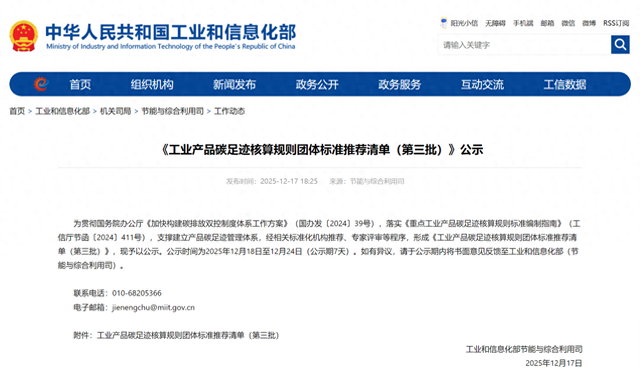
工信部:加强碳足迹核算标准供给 积极推进重点工业产品碳足迹核算规则标准制定
news flash· 2025-06-27 07:10
Core Viewpoint - The Ministry of Industry and Information Technology (MIIT) is enhancing the supply of carbon footprint accounting standards and actively promoting the formulation of carbon footprint accounting rules and standards for key industrial products [1] Group 1: Policy Implementation - The MIIT has issued an implementation plan to advance green and low-carbon standardization in the industrial and information sectors [1] - The focus will be on industrial products that have urgent market demand, significant emission reduction contributions, and notable supply chain driving effects [1] Group 2: Standard Development - The approach will follow the principle of trialing group standards first, which will gradually be transformed into industry or national standards [1] - There will be a steady and orderly expansion of the range of products covered, with the possibility of directly formulating national or industry standards when conditions are ripe [1] - Group standards with good implementation will be recognized as industry or national standards [1]