
科学文献综述

Search documents
助力降低AI引文幻觉提升准确率 新款开源语言模型与人类专家相仿
Zhong Guo Xin Wen Wang· 2026-02-05 07:28
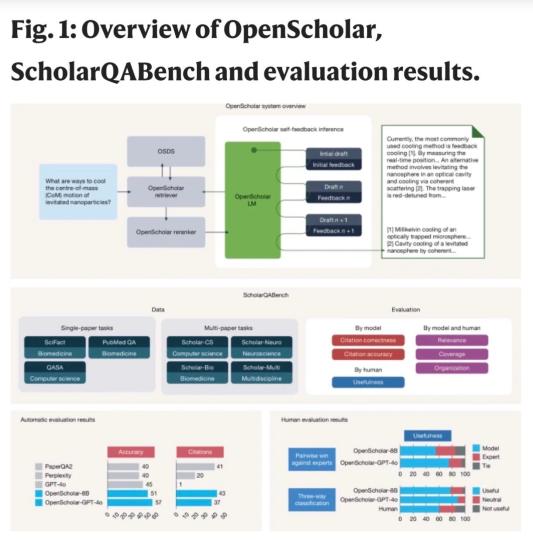
Core Insights - The article discusses the development of an open-source language model called OpenScholar, which surpasses commercial large language models (LLMs) in accuracy for literature reviews, achieving citation accuracy comparable to human experts [1][4]. Group 1: Model Performance - OpenScholar demonstrates a citation accuracy rate that is similar to human experts, while the commercial model GPT-4o exhibits citation hallucinations in 78%-90% of cases [1][4]. - The accuracy of OpenScholar is reported to be 6.1% higher than GPT-4o and 5.5% higher than another literature review tool, PaperQA2 [4]. Group 2: Research Context - The increasing volume of published scientific literature makes it challenging for researchers to keep up, highlighting the need for effective tools to assist in literature reviews [4]. - OpenScholar is designed specifically for research tasks and integrates a professional database containing 45 million open-access research papers along with a self-assessment mechanism to enhance its output [4]. Group 3: Future Implications - The results indicate a significant reduction in citation hallucinations, suggesting that OpenScholar has the potential to support and advance further research efforts [5]. - The authors emphasize that while OpenScholar shows promise, it still has limitations and cannot fully automate the literature review process [5].

引文幻觉大幅下降的AI模型诞生
Ke Ji Ri Bao· 2026-02-04 23:03
Core Insights - The article discusses the open-source language model "OpenScholar," which surpasses commercial large language models in accurately conducting literature reviews, with a citation accuracy rate comparable to human experts [1][2] - "OpenScholar" is designed to assist scientists in managing the increasing volume of scientific literature, addressing the limitations of existing commercial models that often produce errors such as citation hallucinations [1][2] Group 1: Model Performance - In experiments, "OpenScholar" demonstrated a 6.1% higher accuracy than GPT-4o and a 5.5% higher accuracy than PaperQA2, another literature review tool [2] - The answers generated by "OpenScholar" were found to be more useful than those from expert annotators in 50% to 70% of cases [2] Group 2: Importance of Literature Reviews - Scientific literature reviews are crucial for evidence-based decision-making, refining scientific processes, and guiding new discoveries, but the growing number of publications makes it challenging for researchers to keep up [1] - The introduction of "OpenScholar" aims to alleviate the burden on researchers by providing a reliable tool specifically designed for the scientific literature landscape [3] Group 3: Future Development - The research team has made both "ScholarQABench" and "OpenScholar" available to the academic community to encourage further research and optimization [2] - While "OpenScholar" shows promise, the team acknowledges that language model-based systems cannot fully automate the literature review process [2]