
ScholarQABench

Search documents
Nature:首个能写综述论文的开源AI模型来了,大幅减少科研“幻觉”,堪比人类专家
生物世界· 2026-02-06 04:26
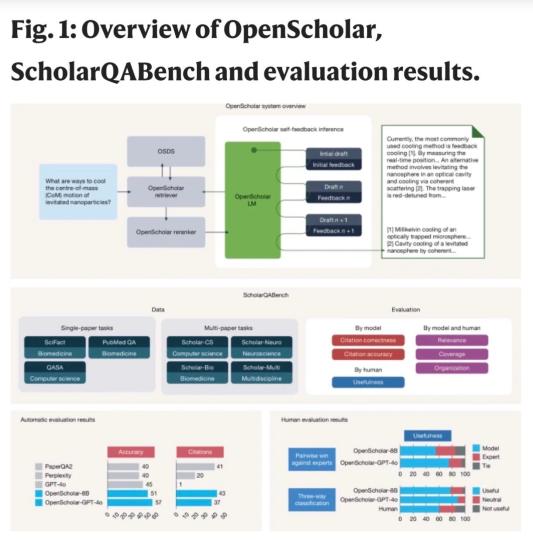
Core Viewpoint - The article discusses the development of OpenScholar, an AI assistant designed specifically for researchers to synthesize scientific literature accurately and efficiently, addressing the issue of "hallucination" in existing large language models [2][5][21]. Group 1: OpenScholar Overview - OpenScholar is a retrieval-augmented language model that can intelligently retrieve relevant paragraphs from 45 million open-access papers and generate comprehensive review papers with accurate citations [5][7]. - The model's citation accuracy is comparable to that of human experts and surpasses mainstream models like GPT-4o in multiple tests [5][11]. Group 2: Functionality and Workflow - OpenScholar operates through a three-step process: retrieval of relevant content, generation of answers with citations, and self-feedback for iterative improvement [7][9]. - The system is built on a dedicated data store (OpenScholar DataStore) that allows for transparent and reproducible research [7][21]. Group 3: Evaluation and Performance - The ScholarQABench benchmark was developed to assess AI systems' reliability in synthesizing scientific literature, featuring nearly 3,000 expert-written questions across various fields [12][13]. - OpenScholar demonstrated impressive results in the benchmark, outperforming GPT-4o in citation accuracy and overall usefulness, with human experts favoring OpenScholar's responses over those of GPT-4o [16][18][19]. Group 4: Implications for Research - The introduction of OpenScholar signifies a significant advancement in the application of AI in scientific research, potentially transforming literature reviews from a burdensome task into an efficient exploration process [21][23]. - Future developments may enhance OpenScholar's capabilities, making it a true collaborator for researchers, allowing them to focus more on innovation rather than information filtering [23].


助力降低AI引文幻觉提升准确率 新款开源语言模型与人类专家相仿
Zhong Guo Xin Wen Wang· 2026-02-05 07:28
Core Insights - The article discusses the development of an open-source language model called OpenScholar, which surpasses commercial large language models (LLMs) in accuracy for literature reviews, achieving citation accuracy comparable to human experts [1][4]. Group 1: Model Performance - OpenScholar demonstrates a citation accuracy rate that is similar to human experts, while the commercial model GPT-4o exhibits citation hallucinations in 78%-90% of cases [1][4]. - The accuracy of OpenScholar is reported to be 6.1% higher than GPT-4o and 5.5% higher than another literature review tool, PaperQA2 [4]. Group 2: Research Context - The increasing volume of published scientific literature makes it challenging for researchers to keep up, highlighting the need for effective tools to assist in literature reviews [4]. - OpenScholar is designed specifically for research tasks and integrates a professional database containing 45 million open-access research papers along with a self-assessment mechanism to enhance its output [4]. Group 3: Future Implications - The results indicate a significant reduction in citation hallucinations, suggesting that OpenScholar has the potential to support and advance further research efforts [5]. - The authors emphasize that while OpenScholar shows promise, it still has limitations and cannot fully automate the literature review process [5].
引文幻觉大幅下降的AI模型诞生
Ke Ji Ri Bao· 2026-02-04 23:03
Core Insights - The article discusses the open-source language model "OpenScholar," which surpasses commercial large language models in accurately conducting literature reviews, with a citation accuracy rate comparable to human experts [1][2] - "OpenScholar" is designed to assist scientists in managing the increasing volume of scientific literature, addressing the limitations of existing commercial models that often produce errors such as citation hallucinations [1][2] Group 1: Model Performance - In experiments, "OpenScholar" demonstrated a 6.1% higher accuracy than GPT-4o and a 5.5% higher accuracy than PaperQA2, another literature review tool [2] - The answers generated by "OpenScholar" were found to be more useful than those from expert annotators in 50% to 70% of cases [2] Group 2: Importance of Literature Reviews - Scientific literature reviews are crucial for evidence-based decision-making, refining scientific processes, and guiding new discoveries, but the growing number of publications makes it challenging for researchers to keep up [1] - The introduction of "OpenScholar" aims to alleviate the burden on researchers by providing a reliable tool specifically designed for the scientific literature landscape [3] Group 3: Future Development - The research team has made both "ScholarQABench" and "OpenScholar" available to the academic community to encourage further research and optimization [2] - While "OpenScholar" shows promise, the team acknowledges that language model-based systems cannot fully automate the literature review process [2]