科技出行产业技术趋势

Search documents
决胜2026:科技出行十大战略技术趋势
3 6 Ke· 2026-01-26 05:09
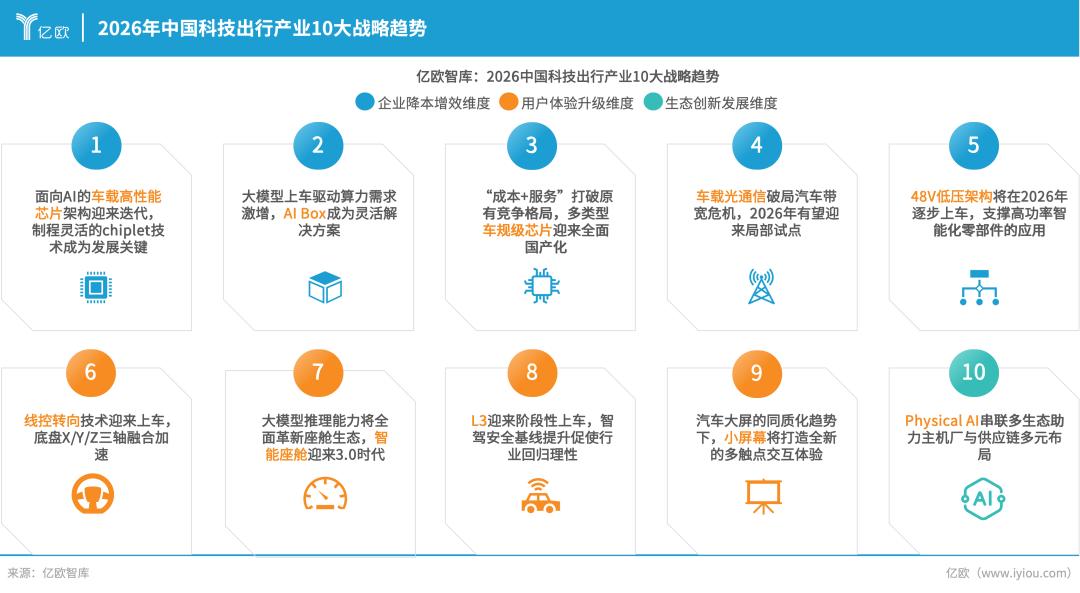
Core Insights - The report "2026 China Technology Mobility Industry 10 Strategic Technology Trends Outlook" aims to provide a key action guide for decision-makers in the industry chain, focusing on cost reduction, enhanced user experience, and ecological collaborative innovation [1][1] - The Chinese technology mobility industry is undergoing a profound systemic transformation driven by the accelerated integration of intelligence, electrification, and artificial intelligence technologies [1][1] - The industry is transitioning from a phase of incremental expansion to a high-quality development stage centered on efficiency, scale, and systemic capabilities amid intensified global automotive competition and evolving profit models [1][1] Trend Summaries - **Trend 1: Chiplet Restructuring Vehicle Chip Architecture** The traditional single-chip SoC is inadequate for L3+ autonomous driving and advanced cockpit requirements. Chiplet architecture is emerging as a mainstream solution for high-performance intelligent driving chips, enabling cost optimization and demand-driven scalability [4] - **Trend 2: AI Box Decoupling Computing Power Deployment** AI Box is becoming a key transitional solution for OEMs to achieve flexible computing power expansion, supporting local AI capabilities without major changes to vehicle electronic architectures [6] - **Trend 3: Accelerated Localization of Automotive Chips** Driven by supply chain security and cost optimization, communication chips and power semiconductors are leading the way in domestic chip localization, transitioning from technical feasibility to large-scale implementation [10] - **Trend 4: Optical Communication in Vehicles** Optical communication is moving from technology validation to mass production, addressing bandwidth limitations and electromagnetic interference in traditional vehicle networks, with significant advancements expected by 2026-2027 [13] - **Trend 5: 48V Low-Voltage Architecture** The 48V architecture is becoming essential for high-power intelligent components in electric vehicles, with initial applications in high-end models expected to scale by 2026 [15] - **Trend 6: Nearing the Inflection Point for Steer-by-Wire** With the maturation of technology and regulatory frameworks, steer-by-wire systems are transitioning from small-scale validation to mass production, becoming critical for advanced driving capabilities [19] - **Trend 7: Large Models Driving Intelligent Cockpits** The evolution of large models is transforming intelligent cockpits into system-level intelligent entities, enhancing user interaction and service optimization [22] - **Trend 8: Phased Implementation of L3 Autonomous Driving** L3 autonomous driving will be introduced gradually under regulatory constraints, focusing on safety and responsibility alignment, with commercial applications expected to begin in 2024-2025 [25] - **Trend 9: Redefining Interaction with Small Screens** The shift from centralized large screens to distributed small screens in vehicle interfaces aims to enhance user experience and reduce cognitive load during driving [28] - **Trend 10: Physical AI Driving Second Growth Curve** Physical AI capabilities are evolving into transferable competencies, enabling automotive technologies to extend across various intelligent terminals, fostering ecosystem collaboration [30] Overall Industry Outlook - The trends indicate a systemic restructuring in the Chinese technology mobility industry, focusing on integrated systems engineering and collaborative efficiency, with a shift from isolated performance to comprehensive system capabilities [32][34] - The next phase of competition will favor organizations that can build replicable, scalable, and evolvable system capabilities, marking 2026 as a pivotal year for technological scaling and global competitive landscape reshaping [34]