科技治水

Search documents
在绿水青山间追求共同现代化——中国推动共建清洁美丽世界的全球回响
Xin Hua She· 2025-10-18 15:53
Group 1 - The core viewpoint emphasizes China's commitment to ecological civilization and sustainable development, showcasing its efforts to harmonize economic growth with environmental protection [1][3][8] - During the 14th Five-Year Plan period, China's ecological environment quality has improved significantly, with PM2.5 concentration in cities decreasing by 16.3% compared to 2020, and the proportion of good water quality reaching 90.4% [3][6] - China has received numerous global honors in the field of ecological environment, reflecting international recognition of its green development philosophy and practices [3][4] Group 2 - The article highlights successful ecological projects in various regions, such as the green protective belt in the Taklamakan Desert and the transformation of energy sectors in Inner Mongolia [2][4] - China's ecological governance is characterized by practical actions rather than mere rhetoric, as evidenced by its collaborative efforts with developing countries to address environmental challenges [5][6] - The article discusses China's role in global ecological governance, emphasizing its commitment to multilateralism and cooperation in addressing climate change [6][7] Group 3 - By 2035, China aims to reduce greenhouse gas emissions by 7%-10% from peak levels and increase the share of non-fossil energy consumption to over 30% [6][7] - China has established the world's largest and fastest-growing renewable energy system, contributing significantly to global green development [7][8] - The article concludes with a call for international collaboration towards building a community of shared future for mankind, emphasizing the importance of sustainable development [8]
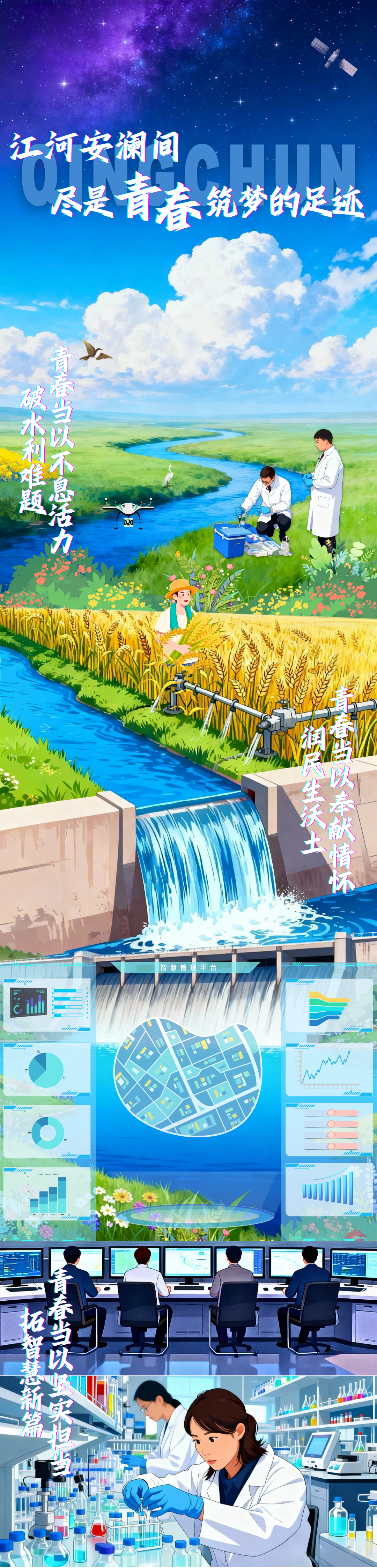
青春华章|漫评:江河安澜间,尽是青春筑梦的足迹
Huan Qiu Wang· 2025-10-14 05:35
Core Viewpoint - The article emphasizes the role of youth in addressing water resource challenges and contributing to the development of water management technologies in China, highlighting their dedication and innovative spirit in the field of water conservation and management [4][5]. Group 1: Youth Engagement in Water Management - Youth are actively involved in tackling issues such as water resource scarcity and ecological restoration, demonstrating their commitment through rigorous experimentation and technological advancements [4]. - Young researchers are optimizing water quality detection sensors and improving smart water management algorithms, showcasing their dedication to ensuring water safety for millions [4]. Group 2: Technological Innovation - The younger generation is taking on the responsibility of "technology-driven water management," injecting new vitality into traditional water management practices through digital empowerment [5]. - Their innovative efforts are crucial in overcoming technical challenges and enhancing the efficiency of water resource utilization [5]. Group 3: Community Contribution - Youth are engaging directly with communities, teaching farmers about water-saving irrigation techniques and addressing local water needs through tailored solutions [5]. - The hands-on approach of youth in rural areas, including assessing irrigation channels and designing small-scale water supply projects, reflects their commitment to improving the livelihoods of local populations [5].

从治水到智水
He Nan Ri Bao· 2025-07-06 23:23
Core Viewpoint - The article emphasizes the importance of technological advancements in water management and flood prevention along the Yellow River, highlighting a shift from traditional methods to intelligent and sustainable practices [3][10]. Group 1: Technological Innovations in Water Management - The use of the "Hua Shui No. 1" satellite for real-time monitoring of water bodies and sediment levels is a significant advancement in understanding and managing the Yellow River's complex hydrology [4][5]. - The development of a satellite remote sensing intelligent perception center allows for detailed analysis of water conditions and management strategies, enhancing flood response capabilities [5][6]. - The integration of a digital twin model of the Yellow River with physical models provides a comprehensive decision-making framework for flood prevention and water resource management [9]. Group 2: Flood Prevention Strategies - A flood simulation experiment conducted in June aimed to predict the behavior of the Yellow River under extreme weather conditions, providing critical data for flood management [7][8]. - The model of the Yellow River has been enhanced with AI and digital technologies, allowing for real-time data collection and analysis to improve flood response strategies [8][9]. - The collaboration of various models (prototype, model, and digital twin) creates a robust system for assessing flood risks and implementing preventive measures [9]. Group 3: Sustainable Resource Management - The article discusses the transition from passive to active management of sediment in the Yellow River, utilizing innovative biological engineering techniques to strengthen riverbanks and reduce erosion [11][12]. - Research into the resource potential of Yellow River sediment is ongoing, with efforts to convert sediment into valuable construction materials and improve soil quality [12][13]. - The development of technologies to activate and utilize sediment not only addresses environmental concerns but also reduces costs in construction and agricultural applications [13].
助力碧水东流!中建筑港长江安庆河段治理工程建设取得阶段突破
Zhong Guo Chan Ye Jing Ji Xin Xi Wang· 2025-05-07 08:25
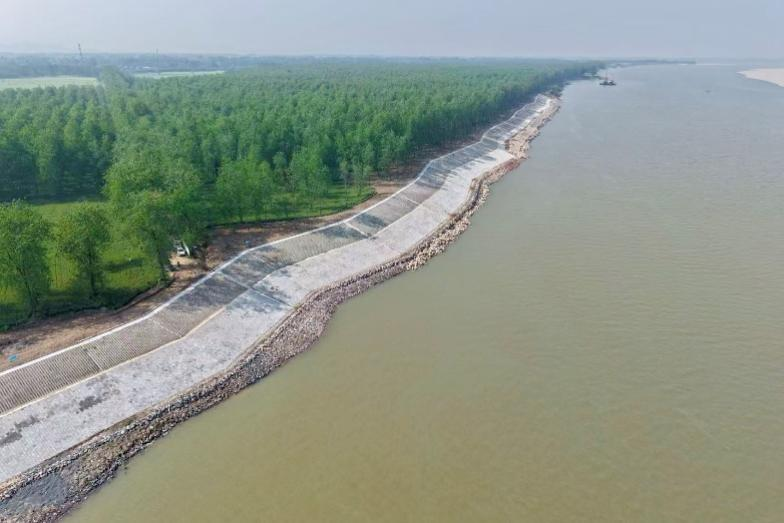
Core Insights - The Yangtze River Anqing River Section Governance Project I has achieved a significant milestone with the successful acceptance of its concealed works, laying a solid foundation for the restoration of navigation [1][3] Project Overview - The project is located in Anqing City, Anhui Province, and is one of the 150 major water conservancy projects prioritized in the national "14th Five-Year Plan" [3] - It involves the construction of 2.3 kilometers of new riverbank protection, including waterborne slopes and underwater footings, as well as the reinforcement of 1.1 kilometers of existing riverbank [3] - Upon completion, the project will facilitate the coordinated development of flood control and ecological protection, providing robust water conservancy support for the industrial transfer demonstration zone along the Wanjiang River and the integrated development of the Yangtze River Delta [3] Technical Innovations - The concealed works, primarily consisting of underwater footings, are critical for stabilizing the river's flow and ensuring flood safety [3] - The project team conducted research on key technologies for positioning stone throwing, successfully applying for a patent for a device that reduces stone drift distance, improving construction accuracy by over 30% [3] - To minimize ecological impact during construction, the team designed the slope protection using prefabricated ecological blocks, which include ecological holes and permeable concrete to support aquatic life [3] Future Developments - The project team will focus on advancing subsequent tasks related to landscape greening and ecological restoration, marking the beginning of a new chapter in ecological repair and functional enhancement [3][4]