税收优化

Search documents
AdvanSix(ASIX) - 2025 Q4 - Earnings Call Transcript
2026-02-20 15:32
Financial Data and Key Metrics Changes - The company reported Q4 2025 sales of $360 million, an increase of approximately 9% year-over-year, with sales volume up about 11% due to the prior year's extended planned turnaround [8][9] - Adjusted EBITDA for the quarter was $25 million, up $15 million from the previous year, resulting in an adjusted EBITDA margin of 6.9% [9][10] - Full-year adjusted EBITDA reached $157 million, with a margin expansion of 90 basis points to 10.3% [11][12] Business Line Data and Key Metrics Changes - In Nylon Solutions, volumes declined sequentially as production rates were moderated to manage inventory in a softer demand environment [10] - Plant nutrients showed strong performance with increased volumes and pricing, particularly in granular ammonium sulfate, supported by resilient sulfur nutrition demand [10][11] - Chemical intermediates pricing remained stable sequentially but was lower year-over-year, consistent with expectations as acetone pricing moderated from previous highs [11] Market Data and Key Metrics Changes - The agriculture and fertilizer market remains the largest end market for the company, with favorable ammonium sulfate supply-demand fundamentals and sulfur nutrition demand growing approximately 3%-4% [14] - Sulfur prices have increased significantly, settling at nearly $500 per long ton in Q1 2026, compared to $165 per ton in Q1 2025 [14][15] - The building construction market is expected to see a recovery in 2026, with third-party estimates indicating approximately 3% commercial construction growth [17] Company Strategy and Development Direction - The company is focused on bolstering sustainable cash flow generation through risk-based prioritization of capital investments, cost productivity, and operational execution [18][19] - A reduction in CapEx is expected for 2026, with planned spending in the range of $75 million-$95 million compared to $116 million in 2025 [20] - The company aims to optimize production output and sales volume mix while managing cash tax rates and maintaining a disciplined approach to capital investment [22] Management's Comments on Operating Environment and Future Outlook - The macro environment remains challenging, with anticipated headwinds from higher raw material input costs, particularly sulfur and natural gas prices [6][7] - The company expects to fully offset an estimated $8 million-$10 million unfavorable earnings impact in Q1 2026 as it progresses through the year [7] - Management remains optimistic about the potential for improved supply-demand conditions in the nylon chain due to recent industry announcements regarding capacity rationalization [6][29] Other Important Information - The company successfully executed planned turnarounds at the low end of its target spend range and delivered record annual production across key ammonia and sulfuric acid unit operations [5][13] - The company is actively managing its cash tax rate, anticipating it to be below 10% for the year [22] - The company has a healthy balance sheet with leverage exiting 2025 at approximately 1.2 times net debt to adjusted EBITDA [19] Q&A Session Summary Question: Nylon outlook and capacity closure announcements - Management noted that Europe remains structurally long in nylon production, with potential capacity closures from companies like Fibrant and DOMO, which could improve pricing dynamics [29][30] Question: Sulfur market dynamics and pricing drivers - Management indicated that both supply constraints and stronger demand in agriculture and mining are contributing to high sulfur prices, which are expected to moderate in 2026 [33][35] Question: Availability of sulfur supply - Management confirmed that they have contracts with multiple suppliers to ensure ample access to sulfur without concerns about availability [36] Question: Section 45Q carbon credits - Management expressed confidence in claiming Section 45Q credits worth $100 million-$120 million through 2029, with no expected impact from recent regulatory changes [39][40] Question: Record production rates and future capacity - Management highlighted that record production rates are a result of ongoing maintenance and optimization efforts, with potential for permanent increases in production capacity through debottlenecking [48][50] Question: Input cost pressures and pricing power - Management acknowledged significant increases in input costs for sulfur and natural gas, implementing price increases across the portfolio while managing margin compression [58][61] Question: Planned turnaround activities - Management clarified that they are focusing on key compliance and preventative maintenance activities while aligning turnaround schedules with necessary maintenance [64][66]

个人养老金:免税优惠虽好,需注意这3点再积极参与?
Sou Hu Cai Jing· 2025-08-05 09:53
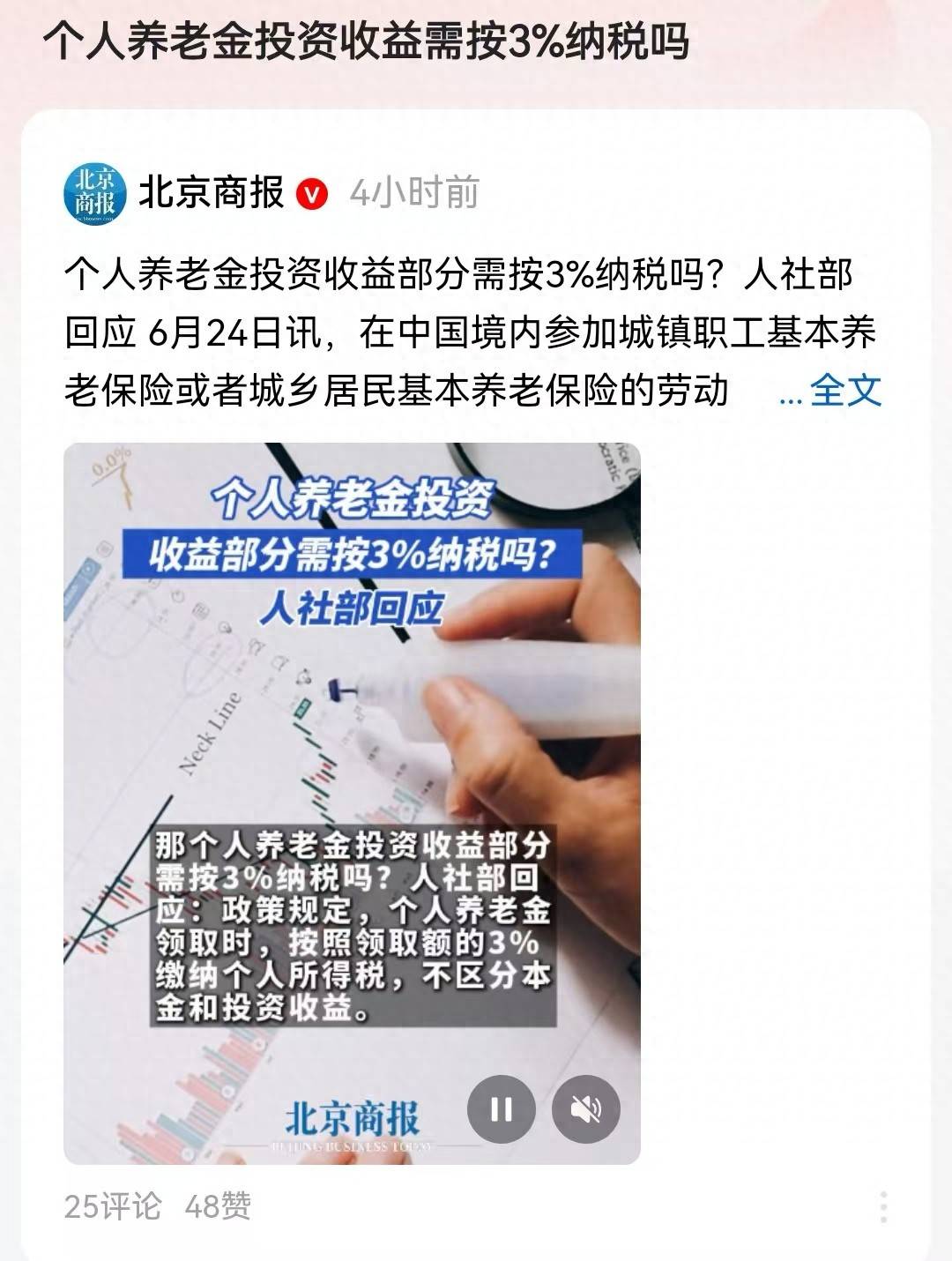
Core Viewpoint - The introduction of the personal pension plan is a strategic response to an aging society, allowing each worker to contribute up to 12,000 yuan annually into a dedicated personal pension account, with tax incentives to encourage participation [3][4]. Tax Benefits and Implications - The State Taxation Administration offers tax deductions for contributions, allowing workers to deduct the maximum 12,000 yuan from their taxable income, thus increasing their after-tax income [3][4]. - Withdrawals from the personal pension account incur a 3% personal income tax on both principal and earnings, contrary to common belief that only earnings are taxed [4][6]. Income Group Analysis - High-income individuals (annual income ≥ 300,000 yuan) benefit significantly, saving between 2,400 to 5,400 yuan in taxes annually while only paying 360 yuan upon withdrawal, resulting in substantial net gains [9]. - Middle-income individuals (annual income between 100,000 to 300,000 yuan) can save 1,200 to 2,400 yuan in taxes, but must balance short-term liquidity needs with long-term retirement planning [9]. - Low-income individuals (annual income < 100,000 yuan) may face a situation where they end up paying more tax upon withdrawal, making the pension plan less beneficial for them [6][9]. Investment Options - Funds in the personal pension can be allocated to four types of financial products: personal pension deposits, pension wealth management plans, pension fund products, and pension insurance products [11]. - Investment products like pension wealth management plans and pension funds are not guaranteed and may lead to capital loss, which could undermine the purpose of retirement funding [11]. - Insurance products, particularly annuity and increasing whole life insurance, are recommended for their stability and cash flow benefits, serving as a core component of retirement planning [11].

做美国本土电商为什么选择特拉华州作为公司所在地?
Sou Hu Cai Jing· 2025-05-22 13:08
Core Insights - Delaware is a highly favored state for company registration in the U.S., particularly for large enterprises and multinational corporations due to its legal environment, tax flexibility, and corporate governance advantages [2]. Legal Framework - Delaware General Corporation Law (DGCL) is the most mature and case-rich corporate law system in the U.S., providing clear legal provisions and efficient dispute resolution through specialized judges [2]. - The governance structure is flexible, allowing for single shareholders and directors, and decisions can be made through written consent without the need for in-person meetings [2]. Tax Advantages - No state sales tax for companies without a physical presence in Delaware, and no personal income tax for non-resident shareholders [2]. - Companies without business operations in the state only pay an annual franchise tax, starting at $175, depending on company type and capital [2]. - Many companies use Delaware as a "shell company" to allocate income to other states, thereby reducing overall tax burdens [2]. Privacy Protection - Delaware does not require the disclosure of shareholder or director information during registration, only necessitating the name and address of one executive in annual reports [2]. - This anonymity is beneficial for investors seeking to protect the privacy of actual controllers [2]. Capital Market Friendliness - Companies registered in Delaware are highly accepted by major exchanges like NYSE and NASDAQ due to lower legal risks and investor familiarity with the legal framework [2]. - Venture capital and private equity firms often prefer investments in Delaware-registered entities due to the flexibility in terms like preferred stock and equity structure [2]. Efficient Registration and Maintenance - The registration process is quick, typically completed within 1-2 business days, with expedited options available [5]. - The annual franchise tax is low, starting at $175, and there are many local registered agent services offering comprehensive support [5]. Suitable Business Types - Startups, particularly tech companies planning to raise funds or go public, shell companies for asset holding, and subsidiaries of multinational corporations entering the U.S. market are ideal candidates for Delaware registration [4]. International Recognition - Delaware serves as a U.S. alternative for offshore company registration, balancing compliance and tax optimization [5]. - The predictability of legal rulings in Delaware reduces commercial uncertainty, making it an attractive jurisdiction for businesses [5].