空间利用率

Search documents
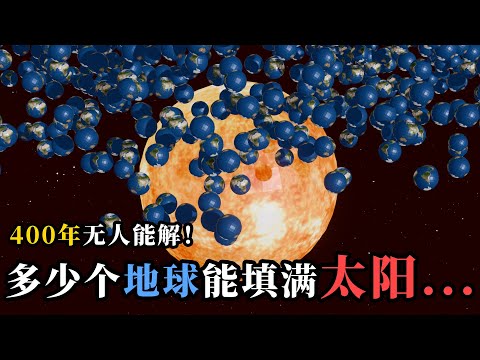
【4k 硬核科普】130万 vs 96万:多少个地球能填满太阳?引出一个人类400年的难题!
李永乐老师· 2025-11-17 09:30
Core Argument - The video explores how many Earths can fit inside the Sun, initially calculating based on volume ratio (approximately 1300000) and then adjusting for sphere packing efficiency (approximately 960000) [1] - It delves into the mathematical problem of sphere packing, specifically the Kepler Conjecture, and its relevance to the initial question [1][2][3] Mathematical Concepts - The volume of a sphere is proportional to the cube of its radius (V=4πr³/3), leading to the initial volume ratio calculation [1] - The densest packing of spheres in 3D space utilizes approximately 74% of the space, a concept related to the Kepler Conjecture [1][2] - The Kepler Conjecture, concerning the densest packing of spheres, was proven using computer-assisted methods after centuries of attempts [1][2][3] Sphere Packing - Two common densest packing arrangements are Hexagonal Close Packing (HCP) and Face-Centered Cubic (FCC), both achieving approximately 7405% space utilization [2] - The video explains how to calculate the packing density within a Face-Centered Cubic (FCC) crystal lattice, arriving at approximately 74048% [2] - Boundary effects become significant in small containers or when the sphere radius is large, invalidating the 74% packing efficiency assumption [2][3] Higher Dimensions - Sphere packing efficiency decreases drastically as the number of dimensions increases, a phenomenon known as the "curse of dimensionality" [3] - Understanding high-dimensional spaces involves techniques like projection and "slicing" to visualize and analyze sphere packing [3]