空间异质性下的环境治理理论

Search documents
上市公司企业环境监管距离测算数据2000-2024年
Sou Hu Cai Jing· 2025-09-18 00:15
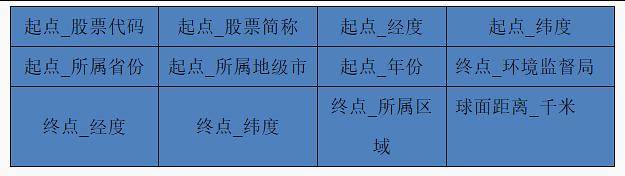
Core Insights - The article emphasizes the importance of environmental regulation as a means to promote green development and the role of spatial distance between companies and regulatory bodies in influencing regulatory efficiency [1][3]. Data Overview - The research utilizes the Gaode Map API to obtain the geographical coordinates of 31 provincial environmental protection departments and 365 municipal environmental bureaus across China, along with the office and registered addresses of listed companies from 2000 to 2024 [2][5]. - A total of over 25 million distance data points were generated by calculating the spherical distance between each listed company and environmental regulatory bodies using the Haversine formula [2]. Theoretical and Practical Significance - The study introduces a novel metric for quantifying regulatory pressure faced by companies, enriching the micro-foundation of environmental regulation theory and expanding the application of spatial economics in environmental governance [3]. - By analyzing the relationship between distance and corporate environmental behavior, the research aims to identify regulatory blind spots and inefficiencies, providing data support for environmental departments to optimize enforcement strategies and for companies to enhance their environmental risk management [3]. Future Research Directions - Future studies could explore the impact of distance on the probability and severity of environmental violations by listed companies, as well as the heterogeneous performance of firms based on ownership structure and industry type [4]. - Empirical tests could be conducted to examine how regulatory distance affects companies' environmental capital expenditures and R&D investments, revealing the role of geographical proximity in promoting proactive emission reductions [4]. - The research could also investigate the indirect effects of regulatory distance on stock returns and Tobin's Q value by influencing corporate environmental risks and social responsibility image [4].