
立春节气

Search documents
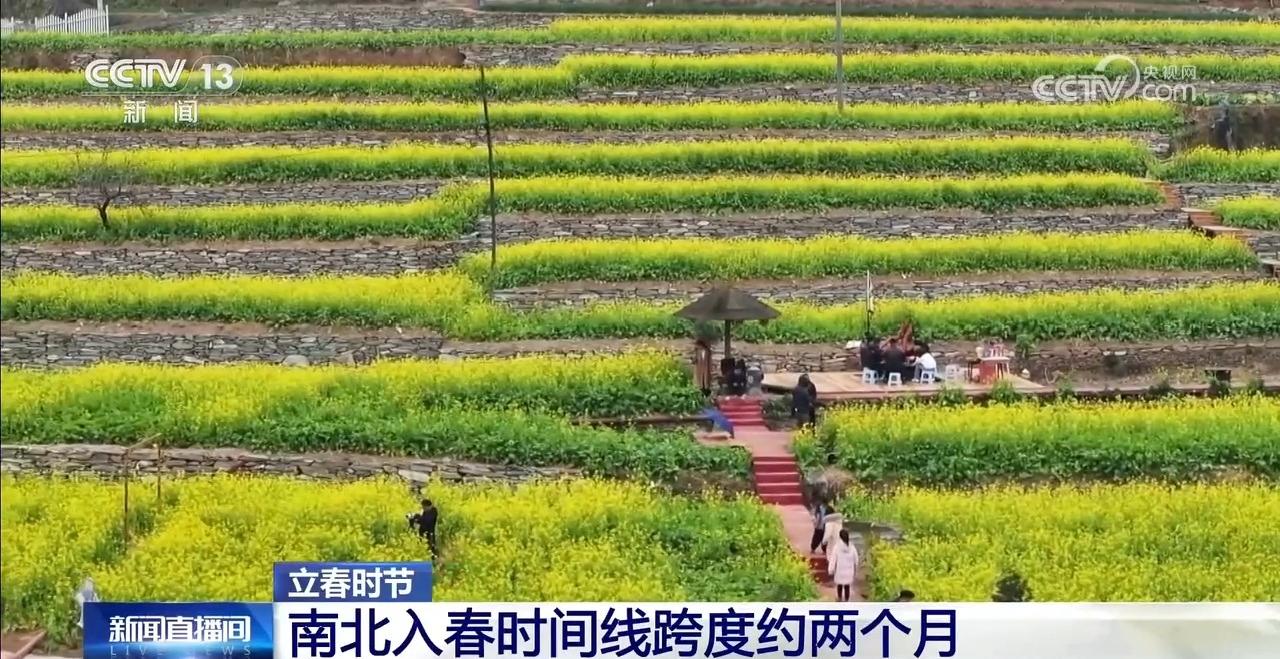
立春时节 气象数据显示我国南北季节差异依然显著
Yang Shi Wang· 2026-02-04 23:43
Core Viewpoint - The article highlights the significant seasonal differences across China, with the meteorological spring arriving at different times in various regions, despite the traditional start of spring being marked by the solar term "Lichun" [1][3]. Group 1: Meteorological Data - According to the China Meteorological Administration, the standard for meteorological spring is a stable average daily temperature exceeding 10°C for five consecutive days [1]. - The entry into spring varies across regions, with southern areas experiencing spring earlier than northern regions, creating a staggered timeline that spans two months [1][3]. Group 2: Regional Spring Timing - In the South, cities like Haikou, Fuzhou, Guangzhou, and Nanning have already entered meteorological spring, categorized as "no winter zones" [3]. - Cities such as Kunming, Chongqing, and Nanchang are expected to enter spring in February, while the Jiangnan region, including Hangzhou, Wuhan, and Changsha, will see spring in early March [3]. - Northern areas like Shijiazhuang, Tianjin, and Beijing will not experience spring until late March, and regions in the Northwest and Northeast, such as Lanzhou, Shenyang, and Harbin, will have to wait until mid to late April [3]. Group 3: Agricultural and Ecological Implications - The transition into spring is not only a seasonal change but also a crucial signal for agricultural production and ecological changes [3]. - As temperatures rise, soil in northern regions begins to thaw, and precipitation in southern areas is expected to increase, allowing for early planning of spring farming and outdoor activities [3].

春打六九头,气温大起伏
Xin Lang Cai Jing· 2026-02-03 23:53
Summary of Key Points Core Viewpoint - The weather in Jilin Province is experiencing significant temperature fluctuations, with a warming trend expected to be followed by a strong cold front, leading to a "rise, fall, and then rise again" temperature pattern [1]. Group 1: Temperature Trends - During the "Four Nine" period, the average temperature in Jilin Province was -20.8℃, which is 5.4℃ lower than the historical average for the same period [1]. - The "Five Nine" period saw an average temperature of -16.8℃, also 2.7℃ below the historical average, marking one of the coldest phases of the winter [1]. - The average temperature during the "Six Nine" period (February 4 to 12) is expected to be -12.5℃, which, while still slightly below the historical average, shows improvement compared to the previous cold periods [1]. Group 2: Precipitation and Weather Conditions - The expected precipitation during this period is projected to be in line with historical averages, at about 1.0 millimeter, with slightly more in the eastern regions [2]. - A significant snowfall event is anticipated from the night of February 4 to February 5, particularly affecting the central and eastern mountainous areas [2]. Group 3: Public Advisory - Despite the arrival of "Lichun" (the beginning of spring), Jilin Province remains in winter, and the meteorological spring is still some time away [2]. - Public advisories emphasize the need for appropriate clothing adjustments due to the large temperature fluctuations and the importance of safety during travel [2].
小观看天丨今天立春,盆地大部阴天间多云,早晚温差大(2026.2.4)
Xin Lang Cai Jing· 2026-02-03 22:56
Group 1 - The article discusses the weather forecast for February 4, indicating a transition to warmer temperatures with varying conditions across different regions of Sichuan Province [1] - The forecast predicts cloudy weather for most of the basin, with scattered light rain in the southwestern mountainous areas and possible light snow or rain in the northwestern and northern parts of Ganzi and Aba prefectures [1] - A new cold air mass is expected to bring a round of rain and snow to southern China starting from February 5, prompting the public to pay attention to weather updates and adjust clothing accordingly [1]