端到端+VLM

Search documents
L3自动驾驶量产元年,离L4的梦想又近了一步?
Xin Lang Cai Jing· 2025-12-17 06:30
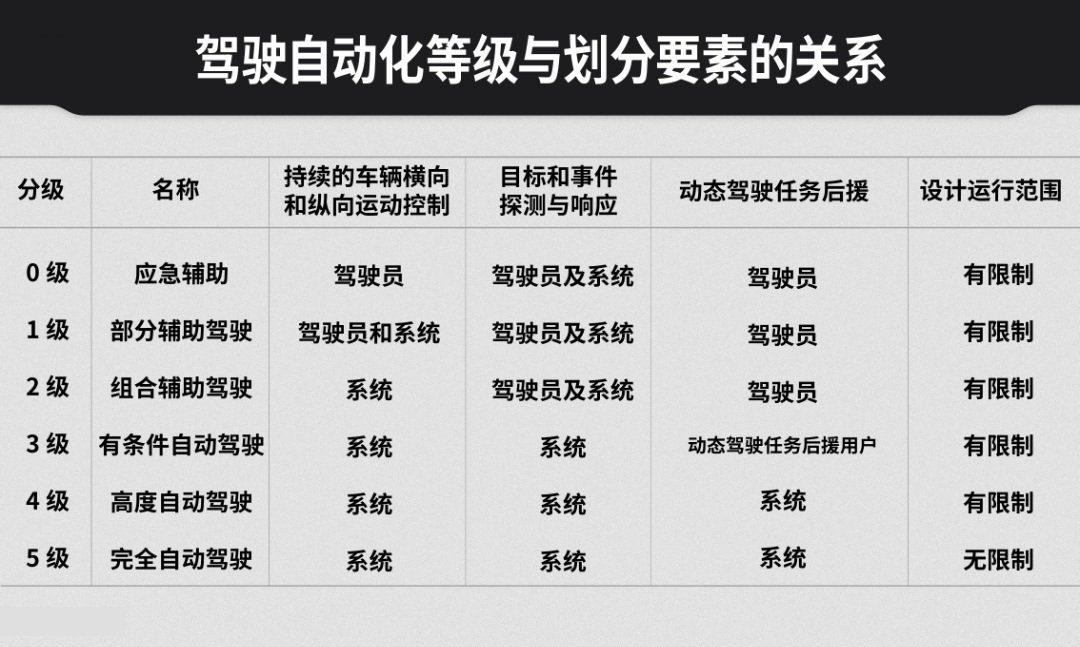
Group 1 - The Ministry of Industry and Information Technology has approved the commercial operation of L3 autonomous driving for the first time in China, allowing vehicles to operate under specific conditions with the system taking over driving tasks [1] - The two models approved for L3 autonomous driving are Changan Deep Blue SL03 and Arcfox Alpha S6, marking a significant step towards the commercialization of L3 technology [1] - The year 2026 is anticipated to be the "mass production year" for L3 autonomous driving, with several companies aiming to launch L3 vehicles by then [3][4] Group 2 - The approval clarifies the responsibility division for L3 autonomous driving, indicating that if an accident occurs while the system is activated, the car manufacturer may bear primary responsibility [1] - The L3 level is seen as a crucial transition from "assisted driving" to "fully autonomous driving," with L4 expected to achieve greater breakthroughs [1][4] - Major automotive companies, including XPeng, Chery, and GAC, have set timelines for the mass production of L3 vehicles, with GAC planning to launch its first L3 model in Q4 of this year [3][4] Group 3 - The automotive industry is experiencing intensified competition in intelligent driving technologies, with companies like BYD, Geely, and Chery developing their own autonomous driving systems [9] - The integration of AI and data-driven technologies is becoming essential for enhancing autonomous driving capabilities, moving beyond traditional rule-based systems [9][12] - The VLA model is emerging as a key technology in the transition from L2 to L4 autonomous driving, offering improved scene reasoning and generalization capabilities [9][14] Group 4 - The shift towards L3 autonomous driving represents a new beginning for human-machine coexistence, with ongoing exploration in technology iteration and regulatory improvement [17] - Companies are increasingly focusing on in-house development of core technologies, such as battery technology and autonomous driving algorithms, to enhance brand competitiveness [16] - The balance between self-research and collaboration is crucial for companies to maintain technological leadership while managing costs [16][17]