精准时效物流

Search documents
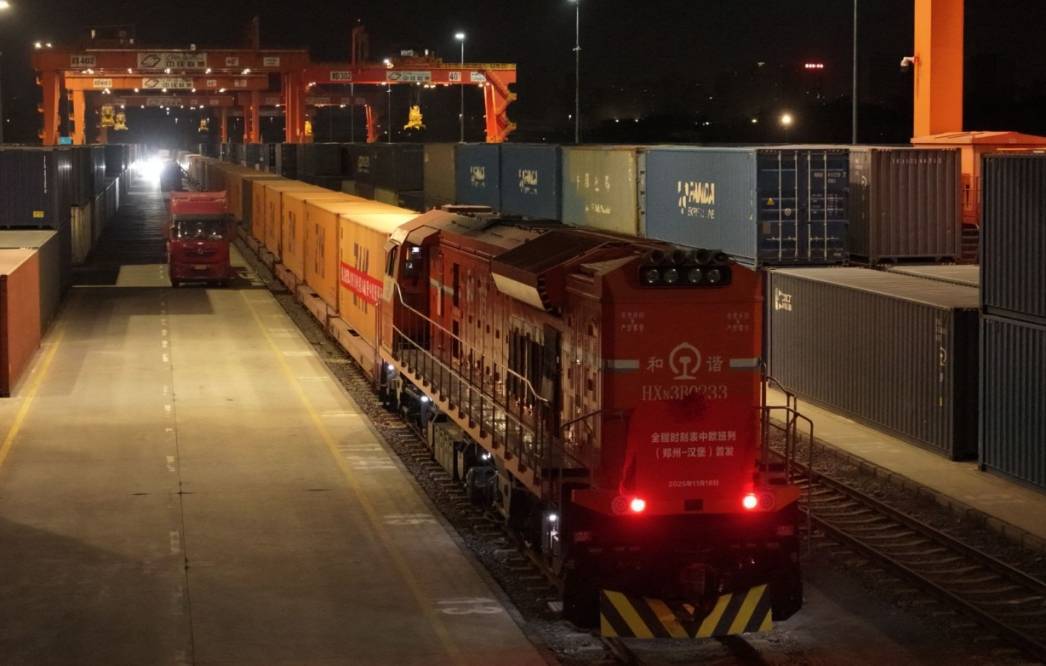
河南首列“高配版”中欧班列开行!直达德国汉堡用时缩减30%
Sou Hu Cai Jing· 2025-11-18 07:07
Core Viewpoint - The launch of the first "on-time high-spec" China-Europe freight train from Henan marks a significant advancement in logistics efficiency, reducing transit time by nearly 30% compared to regular services, and establishing a new standard for precise logistics in the region [1][3]. Group 1: Train Operation Details - The X8003 China-Europe freight train departed from Zhengzhou Putian Station on November 18, carrying various goods and is expected to arrive in Hamburg, Germany, on November 30 [1]. - This train is the first full-schedule China-Europe freight train from Henan and the first direct train to Hamburg, indicating a new phase of precise logistics for the region [3]. Group 2: Efficiency Improvements - The full-schedule train operates under a mechanism that ensures priority in assembly, loading, and departure, effectively transforming unpredictable shipping cycles into reliable services [3]. - The new service reduces overall transit time by over 100 hours, addressing previous issues of unpredictable delivery times caused by variable schedules and operational delays [3]. Group 3: Customs and Regulatory Support - Zhengzhou Customs has established a collaborative regulatory mechanism with customs along the route, implementing an "advance declaration" model to streamline customs procedures [3]. - The customs process has been optimized to prioritize inspections and releases for freight train goods, minimizing the time spent at domestic ports and creating a dedicated "fast track" for customs clearance [3]. Group 4: Growth Metrics - In the first ten months of the year, Zhengzhou Customs supervised 151,000 TEUs, a year-on-year increase of 12.5%, and managed 1.541 million tons of goods, up 9.2% [4]. - The number of China-Europe freight trains (Zhengzhou) has reached 2,616, representing a 49.4% increase year-on-year, positioning Zhengzhou among the top in the country for growth [4]. - Henan Province has surpassed a total of 16,000 freight train operations, maintaining its position as the leading region in central and eastern China and second nationally, facilitating a transformation from an "inland hinterland" to an "open highland" [4].