
综合环境生态

Search documents
未来产业潜力报告:北京上海双极引领,合肥加速崛起
Sou Hu Cai Jing· 2026-01-03 10:36
Core Insights - The report from Shanghai Zhongchuang Industrial Innovation Research Institute highlights that first-tier cities have fully activated future industries, with Beijing and Shanghai leading the potential index rankings for future industries [1] - The report evaluates the future industrial development potential of the top 30 cities in China based on five dimensions and 20 indicators, revealing a bipolar leadership and gradient distribution pattern [1] Innovation Source Capability - Beijing and Shanghai exhibit advantages in basic research, key disciplines, and R&D investment, showcasing their resource endowment in innovation source capability [3] - Provincial capital cities generally perform well in this dimension due to the concentration of provincial innovation resources [3] Industrial Hard Power Capability - In the assessment of industrial hard power, Beijing and Shanghai have advantages in the number of companies listed on the Sci-Tech Innovation Board and future industry projects [5] - Suzhou excels in the number of companies listed on the Sci-Tech Innovation Board and national enterprise technology centers, while Hefei is rapidly rising in emerging industries [5] Enterprise Growth Potential - Beijing and Shanghai host over 60% of the most investment-worthy startups in the country, indicating their strong attraction for top entrepreneurial projects [7] Incubation Acceleration Capability - Beijing, Shanghai, and Shenzhen lead in the number of national-level incubators, with notable performances from Hangzhou and Suzhou [9] - Shanghai, Shenzhen, and Beijing dominate in the number of companies receiving venture capital, while Xi'an shows high activity in future industry technology transactions [9] Comprehensive Environmental Ecology - Shanghai is at the forefront in terms of business environment and future industry layout, with a high-quality overall ecological environment [11] - Beijing and Shenzhen lead in artificial intelligence resource storage capabilities, while first-tier cities have activated all six major future industries [11] Recommendations for Future Industry Development - The report suggests that future industry development should be based on local resource endowments and encourage multi-path exploration to address technological uncertainties [13] - It emphasizes the need for patient capital to cope with long-term and high-risk nature, and to explore cross-border innovation paradigms suitable for the AI era [13]

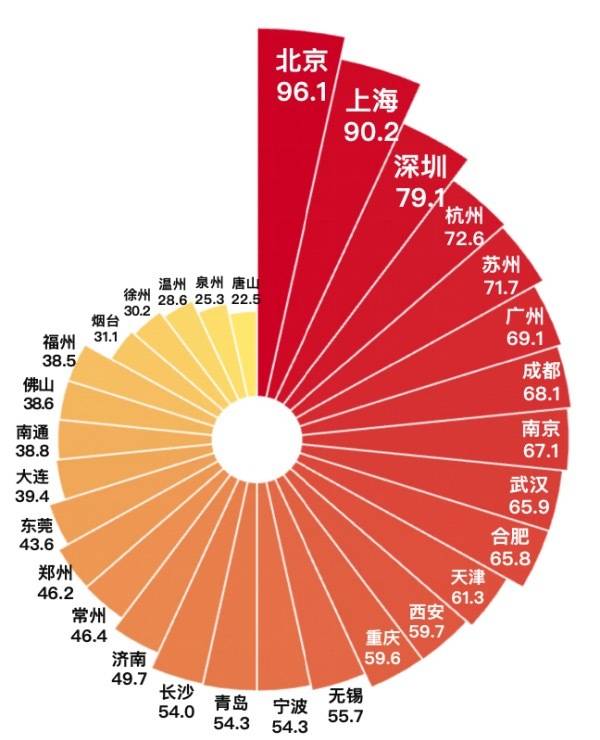
《TOP30:2025未来产业潜力指数报告》发布 北京、上海位列综合指数前两位
Zheng Quan Shi Bao Wang· 2025-12-30 04:17
Core Insights - The report titled "TOP30: 2025 Future Industry Potential Index Report" evaluates the future industry development potential of the top 30 cities in China based on GDP rankings, focusing on innovation capabilities and industrial strengths [1] Group 1: Comprehensive Index - The future industry potential of major cities in China shows a "dual-polar leadership and gradient distribution" pattern, with Beijing and Shanghai leading the comprehensive index [1] - Shenzhen, Hangzhou, Suzhou, and Guangzhou rank third to sixth, while Chengdu, Nanjing, and Wuhan are seventh to ninth, and Hefei ranks tenth [1] - There is a divergence between future industry potential indices and GDP rankings, with cities like Hangzhou and Hefei showing higher potential rankings compared to their GDP positions [1] Group 2: Innovation Source Index - Future industry potential largely depends on the innovation capabilities of cutting-edge technologies, with Beijing leading significantly, followed by Shanghai [2] - Provincial capital cities have advantages in innovation resources, including academic disciplines, talent, and R&D investment [2] Group 3: Industrial Hard Power Index - Beijing and Shanghai are closely matched in industrial hard power, with Beijing having a slight edge [2] - Shanghai leads in the number of companies listed on the Sci-Tech Innovation Board and national enterprise technology centers, while Beijing excels in the proportion of strategic emerging industry clusters [2] Group 4: Enterprise Growth Index - Beijing stands out in potential unicorns and highly investable startups, maintaining an absolute leading position [2] - Shanghai follows closely in competitiveness, with Suzhou and Shenzhen also performing well [2] Group 5: Incubation Acceleration Index - Beijing, Shanghai, and Shenzhen lead in incubation capabilities, with Hangzhou and Suzhou also showing strong performance [2] - The number of companies receiving venture capital is highest in these top-tier cities, while Xi'an shows high activity in future industry technology transactions [2] Group 6: Comprehensive Environmental Ecology Index - Shanghai leads in business environment and future industry layout, particularly in digital infrastructure and AI empowerment [3] - Hangzhou surpasses Shanghai and Beijing in digital infrastructure through a model that integrates computing power, data elements, and digital trade [3] - First-tier cities are advancing across six major future industries, while second and third-tier cities are focusing on niche areas based on comparative advantages [3]