创新策源能力

Search documents
未来产业潜力报告:北京上海双极引领,合肥加速崛起
Sou Hu Cai Jing· 2026-01-03 10:36
Core Insights - The report from Shanghai Zhongchuang Industrial Innovation Research Institute highlights that first-tier cities have fully activated future industries, with Beijing and Shanghai leading the potential index rankings for future industries [1] - The report evaluates the future industrial development potential of the top 30 cities in China based on five dimensions and 20 indicators, revealing a bipolar leadership and gradient distribution pattern [1] Innovation Source Capability - Beijing and Shanghai exhibit advantages in basic research, key disciplines, and R&D investment, showcasing their resource endowment in innovation source capability [3] - Provincial capital cities generally perform well in this dimension due to the concentration of provincial innovation resources [3] Industrial Hard Power Capability - In the assessment of industrial hard power, Beijing and Shanghai have advantages in the number of companies listed on the Sci-Tech Innovation Board and future industry projects [5] - Suzhou excels in the number of companies listed on the Sci-Tech Innovation Board and national enterprise technology centers, while Hefei is rapidly rising in emerging industries [5] Enterprise Growth Potential - Beijing and Shanghai host over 60% of the most investment-worthy startups in the country, indicating their strong attraction for top entrepreneurial projects [7] Incubation Acceleration Capability - Beijing, Shanghai, and Shenzhen lead in the number of national-level incubators, with notable performances from Hangzhou and Suzhou [9] - Shanghai, Shenzhen, and Beijing dominate in the number of companies receiving venture capital, while Xi'an shows high activity in future industry technology transactions [9] Comprehensive Environmental Ecology - Shanghai is at the forefront in terms of business environment and future industry layout, with a high-quality overall ecological environment [11] - Beijing and Shenzhen lead in artificial intelligence resource storage capabilities, while first-tier cities have activated all six major future industries [11] Recommendations for Future Industry Development - The report suggests that future industry development should be based on local resource endowments and encourage multi-path exploration to address technological uncertainties [13] - It emphasizes the need for patient capital to cope with long-term and high-risk nature, and to explore cross-border innovation paradigms suitable for the AI era [13]

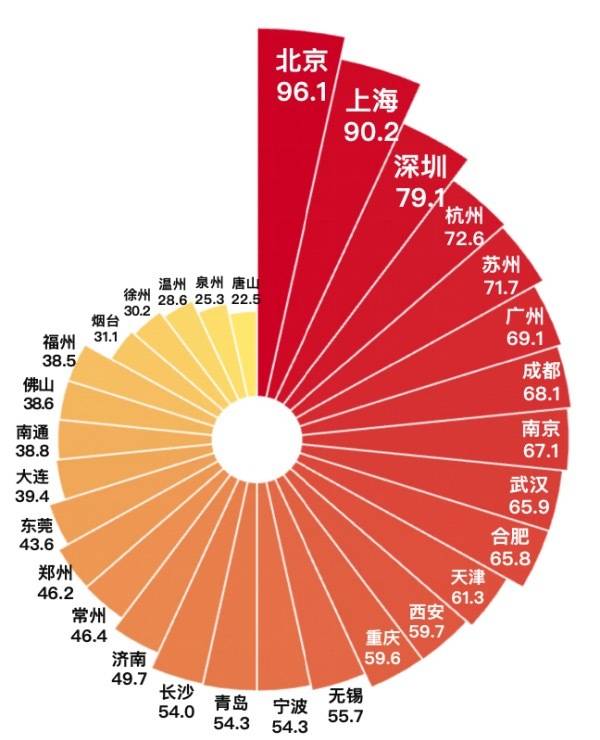
《TOP30:2025未来产业潜力指数报告》发布 北京、上海位列综合指数前两位
Zheng Quan Shi Bao Wang· 2025-12-30 04:17
Core Insights - The report titled "TOP30: 2025 Future Industry Potential Index Report" evaluates the future industry development potential of the top 30 cities in China based on GDP rankings, focusing on innovation capabilities and industrial strengths [1] Group 1: Comprehensive Index - The future industry potential of major cities in China shows a "dual-polar leadership and gradient distribution" pattern, with Beijing and Shanghai leading the comprehensive index [1] - Shenzhen, Hangzhou, Suzhou, and Guangzhou rank third to sixth, while Chengdu, Nanjing, and Wuhan are seventh to ninth, and Hefei ranks tenth [1] - There is a divergence between future industry potential indices and GDP rankings, with cities like Hangzhou and Hefei showing higher potential rankings compared to their GDP positions [1] Group 2: Innovation Source Index - Future industry potential largely depends on the innovation capabilities of cutting-edge technologies, with Beijing leading significantly, followed by Shanghai [2] - Provincial capital cities have advantages in innovation resources, including academic disciplines, talent, and R&D investment [2] Group 3: Industrial Hard Power Index - Beijing and Shanghai are closely matched in industrial hard power, with Beijing having a slight edge [2] - Shanghai leads in the number of companies listed on the Sci-Tech Innovation Board and national enterprise technology centers, while Beijing excels in the proportion of strategic emerging industry clusters [2] Group 4: Enterprise Growth Index - Beijing stands out in potential unicorns and highly investable startups, maintaining an absolute leading position [2] - Shanghai follows closely in competitiveness, with Suzhou and Shenzhen also performing well [2] Group 5: Incubation Acceleration Index - Beijing, Shanghai, and Shenzhen lead in incubation capabilities, with Hangzhou and Suzhou also showing strong performance [2] - The number of companies receiving venture capital is highest in these top-tier cities, while Xi'an shows high activity in future industry technology transactions [2] Group 6: Comprehensive Environmental Ecology Index - Shanghai leads in business environment and future industry layout, particularly in digital infrastructure and AI empowerment [3] - Hangzhou surpasses Shanghai and Beijing in digital infrastructure through a model that integrates computing power, data elements, and digital trade [3] - First-tier cities are advancing across six major future industries, while second and third-tier cities are focusing on niche areas based on comparative advantages [3]
var title1 = '2024年长三角区域发展指数稳步提升'; var title2 = '区域高质量发展行稳致远'; var title3 = '';
Guo Jia Tong Ji Ju· 2025-12-26 08:37
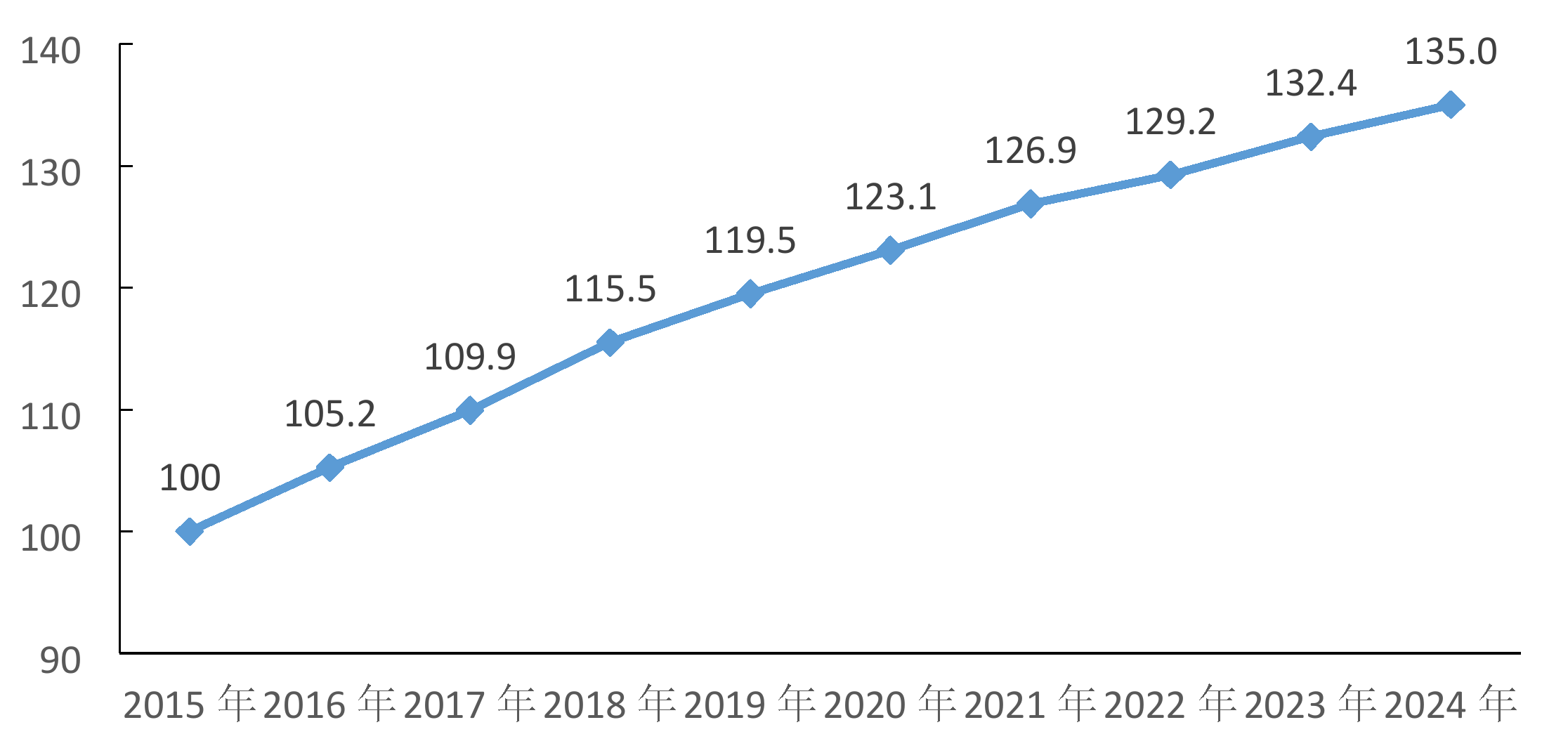
Core Insights - The Yangtze River Delta (YRD) region is solidifying its role as a strong growth engine and a model for high-quality development, with significant advancements in technological and industrial innovation, high-level openness, ecological protection, and improved public welfare in 2024 [1] Economic Development - The YRD's economic demonstration index increased to 129.8 in 2024, reflecting a 2.4 increase from 2023 and an average annual increase of 2.3 since 2018 [2] - The region's GDP reached 33.17 trillion yuan, 1.5 times that of 2018, accounting for 24.7% of the national total, a slight increase of 0.1 percentage points from 2023 [2] Innovation and R&D - The innovation co-construction index rose to 160.6 in 2024, an increase of 8.2 from 2023, with an average annual growth of 6.4 since 2018 [3] - R&D investment in the region reached 1.12 trillion yuan, a 10.5% increase from 2023, representing 30.9% of the national total [3] - The number of new invention patents reached nearly 300,000, with a per capita rate of over 12 patents, 1.6 times that of 2018 [3] Infrastructure and Coordination - The coordination index remained stable at 131.0 in 2024, with an average annual increase of 4.4 since 2018 [4] - The region's railway operating mileage exceeded 15,000 kilometers, a 43.6% increase since 2018, with high-speed rail accounting for over half of the total [4] Environmental Protection - The green co-protection index reached 163.8 in 2024, up 6.3 from 2023, with an average annual increase of 5.6 since 2018 [5] - The average proportion of good air quality days in 41 cities was 84.5%, a 0.8 percentage point increase from 2023 [5] Trade and Openness - The openness index was 106.6 in 2024, with the region's total import and export volume exceeding 16 trillion yuan, accounting for 36.5% of the national total [7] - The region's foreign direct investment share increased from 43.9% in 2023 to 46.3% in 2024, despite a 23.3% year-on-year decline in actual foreign investment [7] Public Welfare and Services - The public welfare index grew to 130.4 in 2024, a 0.9 increase from 2023, with an average annual increase of 3.1 since 2018 [8] - The average disposable income per capita reached 57,137 yuan, a nominal increase of 5.2% year-on-year [8]
最高支持3000万,一地出台仪器仪表产业发展专项政策
仪器信息网· 2025-08-16 04:05
Core Viewpoint - The article discusses the measures introduced by the Xuhui District Science and Technology Commission and the Xuhui District Market Supervision Administration to promote the development of the instrument and meter industry, focusing on enhancing innovation capabilities, accelerating industrial incubation, and promoting high-quality industrial development [2][3][7]. Group 1: Enhancing Innovation Capabilities - The measures aim to promote the establishment and development of major innovation carriers, projects, and platforms in the instrument and meter sector, providing support in terms of space, operations, and talent, with rewards for outstanding contributions [4][9]. - Support for the construction of common technology platforms, concept verification centers, and pilot test platforms, with a maximum funding of 30 million yuan for recognized projects [4][9]. - Strengthening the role of enterprises as innovation subjects by supporting the establishment or restructuring of national key laboratories and engineering research centers, with rewards of up to 2 million yuan and 1 million yuan respectively for national and municipal recognitions [4][9]. Group 2: Accelerating Industrial Incubation - Support for the construction of high-quality incubators for the instrument and meter industry, with funding generally not exceeding 30 million yuan [4][10]. - Encouragement for instrument and meter enterprises to lead the establishment of open innovation centers and innovation consortia, with phased support of up to 30 million yuan based on construction and operational effectiveness [4][10]. - Support for key technology breakthroughs in the instrument and meter field, with funding of up to 300,000 yuan for disruptive technology projects and up to 1 million yuan for the transformation of research results [4][10]. Group 3: Promoting High-Quality Industrial Development - Accelerating the gathering of high-quality enterprises in the instrument and meter sector, with one-time support of up to 10 million yuan for attracting domestic and foreign quality enterprises [5][11]. - Supporting the growth of instrument and meter enterprises to enhance their scale and influence, with rewards of up to 30 million yuan based on operational and growth capabilities [5][11]. - Encouraging the development of application scenarios in collaboration with AI and big data companies, with support of up to 500,000 yuan for projects demonstrating industry-leading effects [5][11][12].