
网络销售

Search documents
北疆小城,2万“娘子军”如何织就12亿大产业?
Zhong Guo Xin Wen Wang· 2026-02-08 01:58
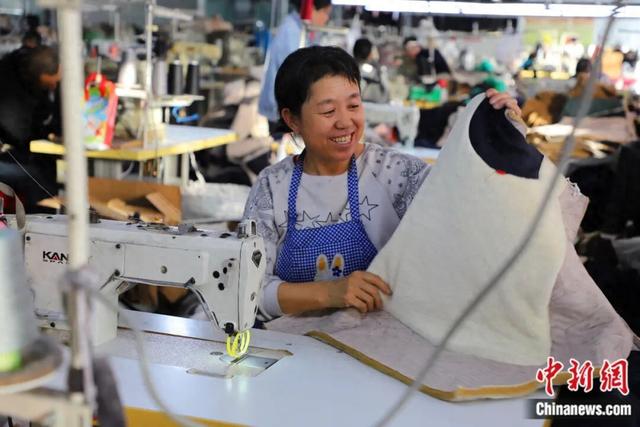
Core Viewpoint - The article highlights the development of the clothing industry in Huade County, Inner Mongolia, which has become a significant producer of winter clothing, particularly cotton-padded pants, contributing one-third of the northern cotton pants market in China. The local workforce, primarily women, has played a crucial role in this transformation, with many earning over 50,000 yuan annually [5][63]. Group 1: Industry Background - Huade County, known as the "Hometown of Cotton Pants," has a population of around 50,000, with one in every two to three eligible workers being an experienced female garment worker [5][12]. - The clothing industry in Huade began in the 1980s when a local accountant discovered a market demand for acrylic cotton pants, leading to the creation of the first wool-filled cotton pants in China [19][24]. Group 2: Resource and Production Advantages - The county's geographical environment, being semi-agricultural and semi-pastoral, provides natural advantages for the clothing industry, with abundant wool resources and proximity to quality alpaca wool sources [27][30]. - The local clothing industry has evolved from small workshops to large-scale enterprises, with over 95 clothing production companies and approximately 20,000 workers, producing 14 million garments annually with a total output value of 1.2 billion yuan [63][67]. Group 3: Technological and Product Innovations - The industry has seen significant technological advancements, including collaborations with research institutions to develop high-quality, anti-static, and non-pilling materials, filling gaps in the domestic market [53][56]. - The clothing produced in Huade is noted for its lightweight, washable, and warm characteristics, appealing to a wide range of consumers, including those in international markets such as Russia and Mongolia [63][67]. Group 4: Sales and Market Expansion - The sales model has shifted from traditional methods to modern e-commerce, allowing local businesses to reach national and international markets more effectively [61][63]. - The county has implemented supportive policies for clothing enterprises, including tax incentives and subsidies for job creation, fostering a conducive environment for industry growth [43][45]. Group 5: Future Development Plans - The local government plans to enhance brand creation, product quality, and consumer experience while encouraging innovation and exploring group development models to further elevate the clothing industry [70].

上半年山西76家重点零售企业销售额超422.89亿元
Zhong Guo Chan Ye Jing Ji Xin Xi Wang· 2025-08-13 00:36
Core Insights - The retail sector in Shanxi Province has shown significant sales performance in the first half of the year, with 76 key retail enterprises generating a total sales revenue of 42.289 billion yuan [1] - The top three performing segments are shopping centers, automotive, and supermarkets, collectively accounting for over 50% of total sales [1] Segment Analysis - The distribution of the 76 key retail enterprises spans 14 segments, with the automotive segment comprising 10 enterprises (over 10%), shopping centers and pharmacies each having 9 enterprises (over 10%), and supermarkets and mobile digital segments each having 8 enterprises (over 10%) [1] - In terms of sales revenue, shopping centers lead with over 10.259 billion yuan (over 20%), followed by the automotive segment with approximately 8.452 billion yuan (nearly 20%), and supermarkets with about 5.715 billion yuan (over 10%) [1] Growth Trends - Online sales exhibited the highest year-on-year growth, reaching over 4.583 billion yuan, a growth of over 70% [1] - The pedestrian street segment reported sales of approximately 968 million yuan, with a year-on-year increase of nearly 20% [1] - The home appliance segment achieved sales of about 1.309 billion yuan, reflecting a year-on-year growth of over 10% [1] - The mobile digital and automotive segments recorded sales of approximately 1.589 billion yuan and 8.452 million yuan, respectively, with year-on-year growth of over 10% and nearly 10% [1]