美国就业数据修正

Search documents
忘掉1月非农!年度就业或下修100万,美国就业正在被系统性高估
Hua Er Jie Jian Wen· 2026-02-02 08:40
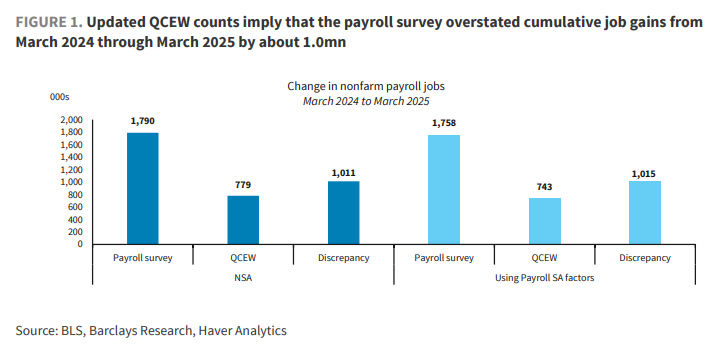
Core Viewpoint - There is a significant divergence in the January non-farm payroll (NFP) employment forecasts between Barclays and Citigroup, but both firms agree that the U.S. employment figures for 2025 are systematically overestimated, and the annual benchmark revision will reveal this discrepancy, indicating that the market is underpricing the risks of employment decline [1][5][20]. Group 1: Employment Predictions - Barclays predicts only 50,000 new jobs in January, with a similar increase in the private sector, while the unemployment rate is expected to slightly decrease to 4.3% [2]. - Citigroup, on the other hand, forecasts an increase of 135,000 jobs, with approximately 140,000 in the private sector, significantly above the market consensus of around 70,000, and maintains the unemployment rate at 4.4% [3]. Group 2: Data Quality Concerns - Both firms emphasize that the information content of the January employment data is low. Barclays notes that the employment data for Q4 2025 is significantly affected by government "delayed resignation plans," and short-term fluctuations do not represent trends [4]. - Citigroup points out that January is one of the most favorable months for seasonal adjustments, historically showing a pattern of "initial strength followed by a decline" [4]. Group 3: Systematic Overestimation of Employment - Despite differing views on January's data, both Barclays and Citigroup agree that the core issue lies in the overestimation of cumulative employment over the past year. Barclays cites QCEW data, indicating a discrepancy of nearly 1 million jobs between the non-farm survey and QCEW data from March 2024 to March 2025 [6][7]. - This suggests that the official non-farm payroll figures have systematically overestimated job growth by an average of 80,000 to 90,000 jobs per month [7]. Group 4: Market Mispricing of Employment Risks - The market is currently focused on whether the January NFP will "beat/miss" expectations and if the unemployment rate will hold at 4.5%, while neglecting critical signals indicating employment market pressures [12][13]. - Key indicators include a declining JOLTS hiring rate around 3.2%, worsening consumer sentiment regarding job availability, and significant distortions in employment data for the latter half of 2025 [17]. Group 5: Implications of Employment Revisions - A downward revision of employment figures by 700,000 to 1 million will alter the historical narrative, indicating that the past year's growth was not as robust as reported [18]. - This will necessitate a reevaluation of frameworks for wages, consumption, and GDP, and may challenge the perceived "employment safety net" by the Federal Reserve [18][19]. - The current labor demand intensity corresponding to the unemployment rate will be reassessed, suggesting that the employment market is closer to a "turning point" than the market anticipates [19].