考培分离

Search documents
应急管理部新规为1800万名特种作业人员减负增效
Xin Lang Cai Jing· 2026-01-29 19:50
Core Viewpoint - The Ministry of Emergency Management has revised the "Regulations on Safety Technical Training and Assessment Management for Special Operations Personnel," which will take effect on June 1, 2024, introducing several measures to facilitate convenience for businesses and workers [1][2]. Group 1: Key Changes in Regulations - The renewal requirement for special operation certificates has been optimized, changing from a three-year review to a six-year renewal, with no review required for certificates expiring after June 1, 2026 [1]. - The regulations eliminate the requirement for retraining for those who have completed training but failed the exam, allowing unlimited attempts for theoretical exams and increasing practical exam attempts from one to five [1][2]. - The regulations promote "cross-province handling," allowing applicants to apply for exams at any authorized assessment agency nationwide, removing the requirement for local residency [1]. Group 2: Educational and Certification Adjustments - The educational requirements for special operations personnel have been adjusted, no longer requiring a minimum of junior high school education for roles such as electrical work and welding [2]. - The regulations state that individuals holding valid vocational skill certificates can directly take the special operation certificate exam without undergoing safety technical training [2]. Group 3: Safety and Compliance Measures - In 2024, the Ministry of Emergency Management will collaborate with other governmental bodies to conduct special governance in the special operations sector, addressing issues such as the use of fake certificates, with 19,000 fake certificates identified and criminally prosecuted [2]. - In 2025, efforts will be made to consolidate governance results, with nearly 6,000 cases of unlicensed or fake certificate operations being investigated, aiming to curb the prevalence of such issues [2]. - Future plans include stricter assessment and training management, implementation of AI evaluation systems for practical exams, development of big data analysis models for exam anomalies, and enhanced supervision to address serious issues in training and examination processes [2].
培训机构能操纵考试?调查滑雪教练考证市场
Zhong Guo Xin Wen Wang· 2026-01-23 06:30
Core Viewpoint - The increasing interest in skiing and the demand for ski instructor certifications are leading to a surge in training programs, but there are concerns about the legitimacy and quality of these programs [1][4][12]. Group 1: Training Programs and Certification - Many training institutions are promoting ski instructor certifications, claiming that individuals can earn significant income as ski instructors [1][4]. - The "National Vocational Qualification Level 5" for ski instructors is often misrepresented as a comprehensive qualification, while it is actually an entry-level certification [4][13]. - Training programs are marketed with promises of easy certification, but the actual process requires passing theoretical and practical exams, which are managed separately from training [12][16]. Group 2: Market Dynamics and Demand - The ski instructor market is experiencing a significant demand, with projections indicating a shortfall of 10,000 to 20,000 instructors by 2026 due to the growing popularity of skiing [18]. - The number of candidates for ski instructor certifications is expected to rise sharply, from over 7,000 in 2024 to 17,000 in 2025 for snowboard instructors [18]. - The ski industry is evolving, with new assessment criteria being introduced to ensure safety and skill proficiency among candidates [17][18]. Group 3: Training Quality and Regulation - The National Sports Administration emphasizes a separation between training and examination to maintain the integrity of the certification process [12][16]. - Concerns have been raised about some training programs that guarantee certification for a fee, which contradicts the established examination protocols [12][16]. - The upcoming revisions to the certification guidelines will include new safety assessments to ensure candidates meet basic skiing proficiency before taking exams [17][18].

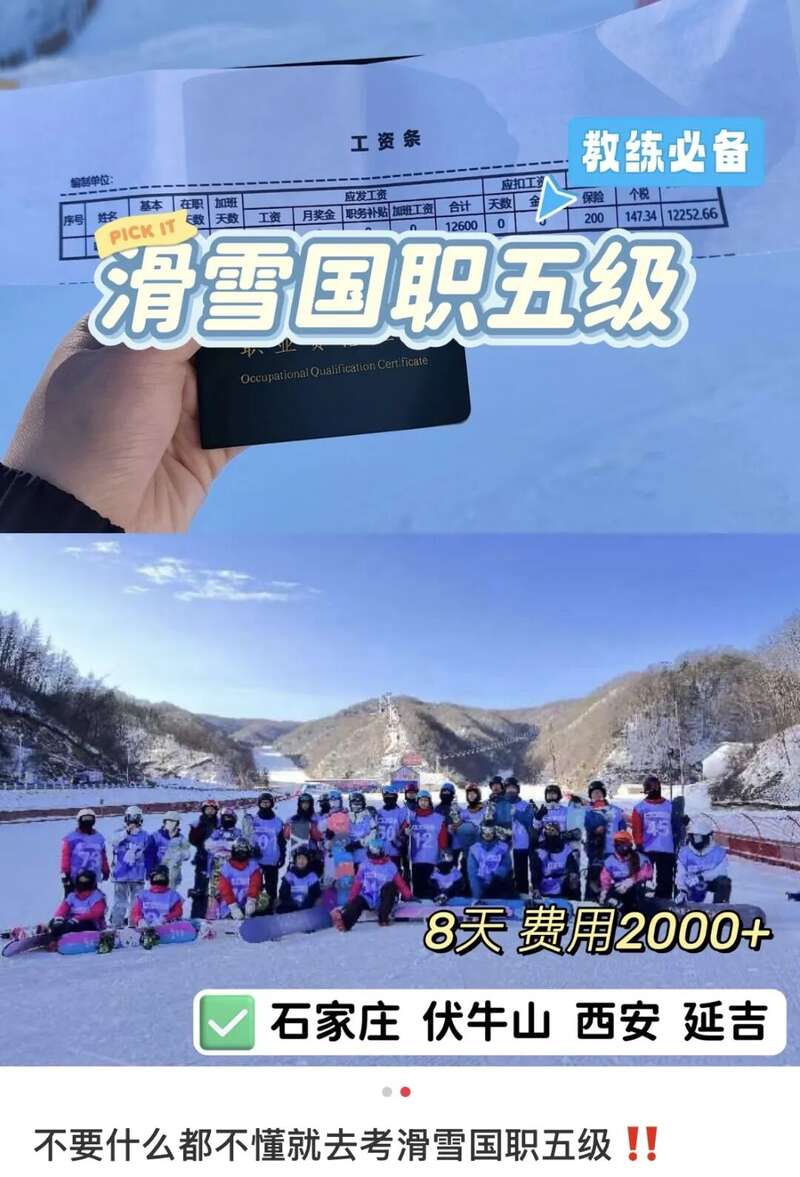
民生调查局|培训机构能操纵考试?调查滑雪教练考证市场
Zhong Guo Xin Wen Wang· 2026-01-22 07:23
Core Insights - The increasing interest in becoming ski instructors in China is evident, with many aspiring instructors seeking certification as a side job, particularly as the 2026 snow season approaches [1][7] - The "National Ski Instructor Level 5" certification is often misunderstood, as it is merely an entry-level qualification that requires formal training and passing an examination [4][13] Group 1: Certification and Training - The "National Ski Instructor Level 5" certification is a basic qualification that requires candidates to complete a specified number of training hours and obtain a completion certificate [4] - The training and examination process is managed by the National Sports Administration, which emphasizes a separation between training and assessment [4][15] - Many training institutions are misleading potential candidates by suggesting that payment guarantees certification, which contradicts the established examination protocols [12][15] Group 2: Training Programs and Costs - Various training programs are available, including basic and zero-based classes, with costs ranging from 2,980 to 6,810 yuan depending on the location and duration of the course [5][6] - Training sessions typically last between 3 to 7 days, with daily training hours averaging 6 to 7 hours [8][12] - Some institutions offer "guaranteed pass" claims, which are not supported by the National Sports Administration, as passing requires successful completion of both theoretical and practical assessments [12][15] Group 3: Employment and Market Demand - Obtaining the certification does not automatically qualify individuals for employment as ski instructors, as practical skills and additional training are often required by employers [13] - The demand for ski instructors is expected to grow, with projections indicating a shortfall of 10,000 to 20,000 instructors in the ice and snow industry by 2026 [17] - The number of candidates for ski instructor examinations is increasing significantly, with projections showing a rise from over 7,000 in 2024 to 17,000 in 2025 for snowboard instructors alone [17]
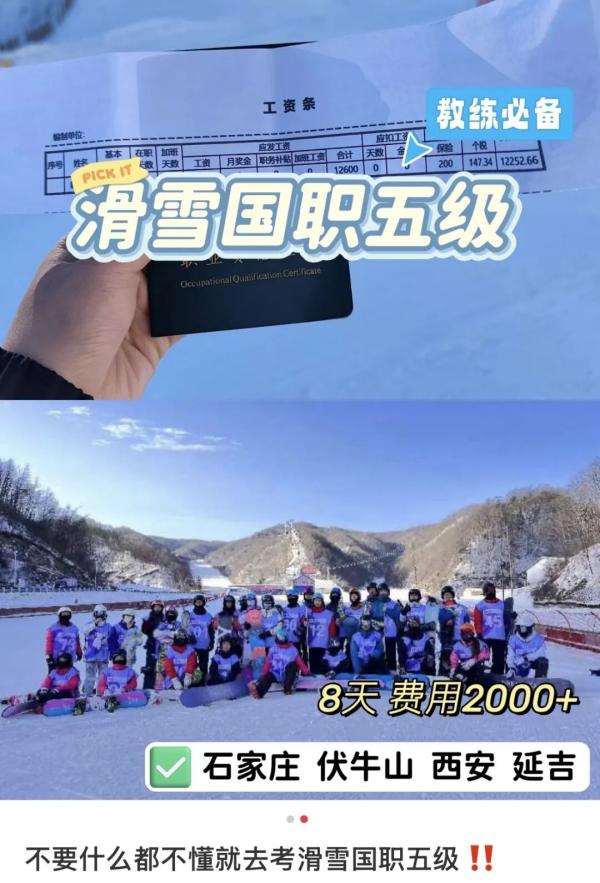
5天拿证的滑雪“速成教练”能执教吗?记者调查→
Xin Lang Cai Jing· 2026-01-16 17:04
Core Viewpoint - The rising popularity of snow sports and consumption during the winter season has led to an increase in training programs for "ski instructor national vocational certificates," with claims of rapid certification within five days, raising questions about the qualifications of these "fast-track instructors" [1][6]. Group 1: Training and Certification Process - The "Ski Social Sports Instructor National Vocational Qualification Certificate" requires specific training and examination as outlined in the National Occupational Qualification Directory (2021) [3]. - The training for ski instructors is categorized into five skill levels, with the fifth level being the entry-level, which includes functions such as promotion, technical guidance, and safety protection [4]. - Training programs typically last between 5 to 7 days, with costs ranging from 3,000 to 7,000 yuan, and are designed for both beginners and those with prior experience [6][8]. Group 2: Examination and Qualification Standards - The actual pass rate for the examination is reported to be around 80%, with assessments including both theoretical and practical components [9]. - The separation of training and examination is emphasized as a means to ensure the credibility of the certification, with the training focusing on reinforcing the skills outlined in the assessment guidelines [10]. - The industry recognizes that obtaining a certificate is merely the minimum requirement to enter the profession, and further qualifications and experience are necessary to become a professional instructor [10]. Group 3: Market Demand and Industry Trends - The growing interest in snow sports has led to a demand for instructors who not only teach skills but also provide a deeper understanding of snow culture [12]. - The market is seeing two main types of candidates: those seeking certification to validate their skills and younger individuals aiming to pursue teaching careers [12].