职普分流

Search documents
这十年,高考什么变了
经济观察报· 2025-06-06 13:48
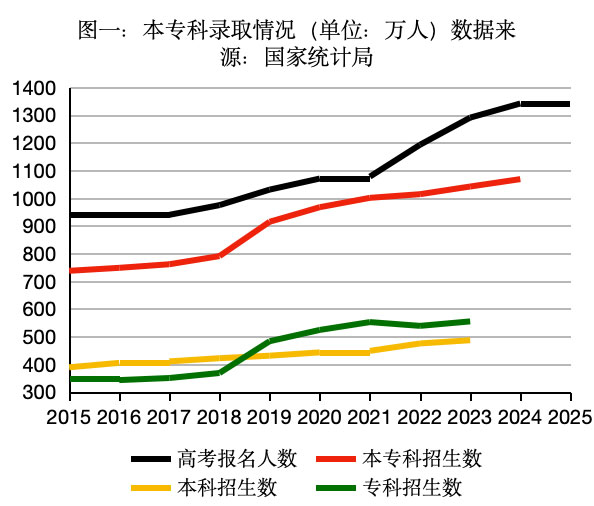
Core Insights - The number of high school graduates in China is projected to decline, leading to a widening gap between college admissions and high school enrollment, with the "scissor difference" increasing from 767,000 in 2021 to 2,731,000 in 2024 [1][3][8] - The decrease in high school enrollment is primarily attributed to a reduction in repeat students and those with vocational school diplomas seeking university admission [4][6] - The expansion of vocational colleges has slowed down, stabilizing at around 5.5 million enrollments since 2022, while the number of high school graduates continues to rise significantly [9][21] Enrollment Trends - In 2023, the total number of high school graduates was 12.91 million, with 4.871 million admitted to undergraduate programs and 5.551 million to vocational colleges [2][3] - The gap between high school graduates and college admissions has been increasing, indicating a mismatch between the number of students and available spots in higher education [6][8] - The enrollment ratio of vocational schools has decreased significantly, with a notable decline in the number of vocational school admissions since 2022 [21][23] Regional Analysis - In provinces like Henan and Guangdong, the number of high school students remains high, but Henan has a larger average class size compared to Guangdong [12][13] - Henan has the highest number of higher education institutions in China, but a significant portion of these are vocational colleges, indicating a reliance on vocational education [14][15] - The enrollment trends in different provinces show that while most regions follow the national trend, Guizhou has seen a significant increase in vocational school admissions, contrasting with the national decline in vocational enrollments [25][26] Policy Implications - The "vocational and academic separation" policy remains crucial in China's education system, with ongoing discussions about optimizing this policy to better align vocational education with labor market needs [20][18] - The need for skilled labor in specific sectors emphasizes the importance of vocational education, which is currently undervalued in the broader educational framework [18][19]


这十年,高考什么变了
Jing Ji Guan Cha Wang· 2025-06-06 13:24
Group 1 - The core viewpoint of the articles highlights a decline in the number of high school entrance exam (Gaokao) candidates in 2023, marking the first drop since 2017, with a total of 13.35 million candidates, down by 70,000 from the previous year [1] - The number of candidates for the 2023 Gaokao is 12.91 million, with 4.871 million admitted to undergraduate institutions and 5.551 million to vocational colleges [1] - The gap between the number of Gaokao candidates and the enrollment numbers for undergraduate and vocational colleges has widened significantly from 767,000 in 2021 to 2.731 million in 2024, indicating a growing disparity in educational opportunities [4][6] Group 2 - The expansion of vocational college enrollment has slowed down after a significant increase from 2019 to 2021, where the number of vocational college admissions surged from approximately 3.6 million to 5.526 million [5][6] - The government initiated a large-scale expansion of vocational colleges in 2019, which was a strategic decision to address structural unemployment and support economic transformation [5] - The ratio of students to teachers in vocational colleges has increased from 22.8 in 2018 to over 26 in 2023, indicating a growing emphasis on vocational education [5] Group 3 - In 2023, Henan province has the highest number of vocational school students at 1.12 million, while its regular high school enrollment is 2.623 million, reflecting a strong emphasis on vocational education [8] - The number of regular high schools in Henan is 174, the highest in the country, but only 34.5% of these are undergraduate institutions [7] - The enrollment ratio of regular high schools to vocational schools has increased from 57.6% in 2020 to 64.3% in 2024, indicating a trend towards more students entering regular high schools [13] Group 4 - The disparity in the development of regular high schools and vocational schools is evident, with the number of vocational schools decreasing significantly from over 14,000 in 2009 to 7,085 in 2023 [13] - The investment in vocational education varies significantly across provinces, with some regions like Beijing having a much lower student-to-teacher ratio compared to others like Hainan and Guizhou [14] - The educational focus in eastern regions tends to prioritize regular high school education, while in central and western regions, there is a more balanced approach towards vocational education [14]