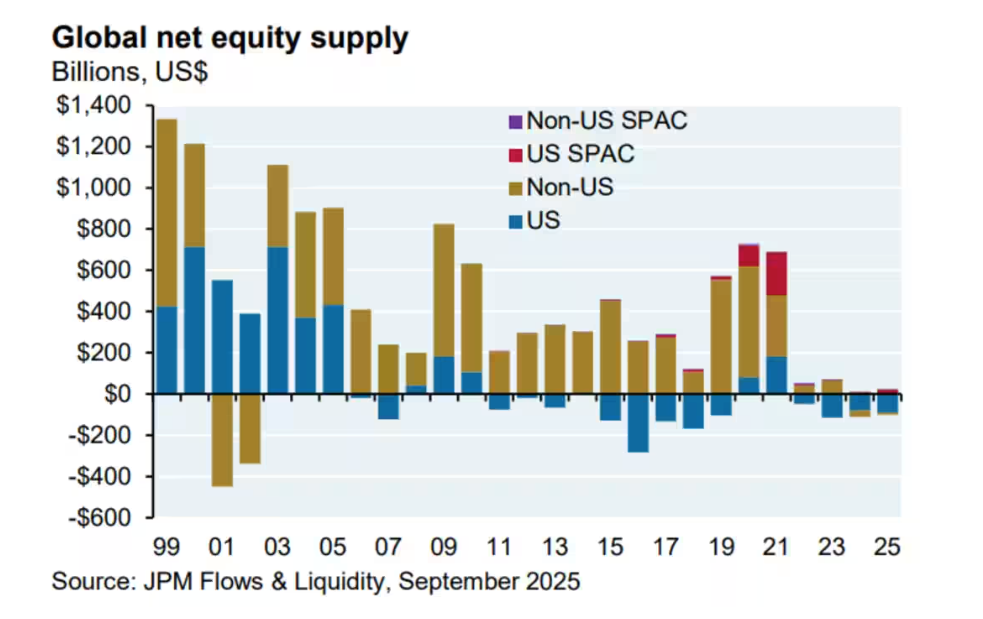
股市供需失衡

Search documents
美股15年长牛的背后,有一个关键推手经常被忽视!
Jin Shi Shu Ju· 2025-09-26 09:47
Core Insights - The article discusses the steady rise of the U.S. stock market post-financial crisis, attributing it to various factors including expanding profit margins of large corporations and the significant impact of tech giants like Microsoft and Apple on the global economy [1][3] - A critical point raised is the supply-demand imbalance in the stock market, which is considered a key factor in maintaining market resilience against volatility [1][3] Group 1: Market Dynamics - The supply of U.S. stocks has been on a declining trend since 2011, with a notable exception during the COVID-19 pandemic when IPO activity surged [3] - Corporate stock buybacks have been identified as a significant driver of this declining supply trend [3] - Despite a decrease in the proportion of fixed income pension plan inflows relative to the total market capitalization of the S&P 500, an annual influx of $1.5 trillion still needs to find investment opportunities [3] Group 2: Market Performance - Since 2011, investors have faced multiple stock market sell-offs, but only two have evolved into bear markets: the bear market in 2022, which resulted in the worst annual performance for the S&P 500 since 2008, and the brief sell-off in March 2020 due to the pandemic [3] - The article notes that the U.S. stock market indices, including the S&P 500, Dow Jones, and Nasdaq, experienced a decline, marking the first simultaneous three-day drop since March [3]